Top STEM Opportunities for high school Students in Plano

Introduction

STEM opportunities have become increasingly accessible to high school students in Plano. From university research programs and robotics competitions to artificial intelligence initiatives and engineering camps, students have more options than ever before.
Yet a surprising challenge remains. Many students participate in impressive activities, earn strong grades, and complete advanced coursework but still struggle to distinguish themselves in highly competitive college admissions. The reason is simple. Participation alone is no longer enough. Selective universities increasingly look for evidence that students can apply knowledge to solve meaningful problems.
The students who stand out are often those who move beyond classroom learning and develop projects, research experiences, or technical solutions that demonstrate initiative, creativity, and intellectual curiosity. As fields such as artificial intelligence, cybersecurity, and data science continue to reshape industries, real-world STEM experiences have become one of the strongest ways students can demonstrate their potential.
Table of Contents
How Can Students Discover STEM Opportunities That Go Beyond Classroom Learning?
What Makes a STEM Opportunity Worth Pursuing in a Competitive Academic Environment?
What Are the Top STEM Opportunities for High School Students in Plano?
How Can Students Turn Local STEM Opportunities into Meaningful Technical Projects?
What Resources, Communities, and Mentorship Networks Are Available to STEM Students in Plano?
Case Study: How Can AI Help Detect Cyber Threats Before They Escalate?
How Can Students Discover STEM Opportunities That Go Beyond Classroom Learning?

The best STEM opportunities expose students to challenges that cannot be replicated through textbooks alone. Students develop deeper understanding when they apply scientific and technical concepts to real-world problems, work with mentors, and create solutions that can be tested and improved.
Many students assume that taking Advanced Placement courses or earning high grades is sufficient preparation for competitive STEM programs. While academic achievement remains important, universities increasingly value evidence of intellectual engagement beyond the classroom. Admissions officers want to see how students use their knowledge when faced with open-ended questions that have no predefined answer.
Research experiences, engineering projects, robotics competitions, and artificial intelligence initiatives provide exactly this type of environment. Students must think critically, experiment, troubleshoot failures, and communicate their findings. These experiences mirror the work performed by engineers, researchers, and innovators in professional settings.
The most valuable opportunities are not necessarily those with the most recognizable names. Instead, they are the experiences that allow students to create something meaningful and demonstrate genuine intellectual curiosity.
what separates a valuable STEM opportunity from one that simply looks impressive on paper?
What Makes a STEM Opportunity Worth Pursuing in a Competitive Academic Environment?
A strong STEM opportunity develops technical expertise while also encouraging independent thinking, problem-solving, and project ownership. Programs that culminate in research findings, prototypes, publications, or deployable applications often provide significantly greater value than passive learning experiences.
Consider the difference between studying machine learning concepts in a lecture and building an AI system that solves a real-world problem. Both experiences teach important ideas, but only one demonstrates a student's ability to apply those ideas independently. Admissions officers frequently evaluate this distinction when reviewing applications.
The strongest STEM opportunities share several characteristics. They provide access to expert mentors, expose students to advanced concepts, challenge them to solve authentic problems, and encourage them to produce measurable outcomes. These outcomes may include research papers, engineering prototypes, competition submissions, software applications, or technical portfolios.
Students should therefore evaluate opportunities based on what they will create rather than simply what they will attend. The quality of the outcome often matters more than the prestige of the program itself.
Understanding this distinction leads naturally to another important question: which skills provide the greatest long-term value?
Which Skills Are Most Valuable to Develop Through STEM Programs, Competitions, and Research Experiences?
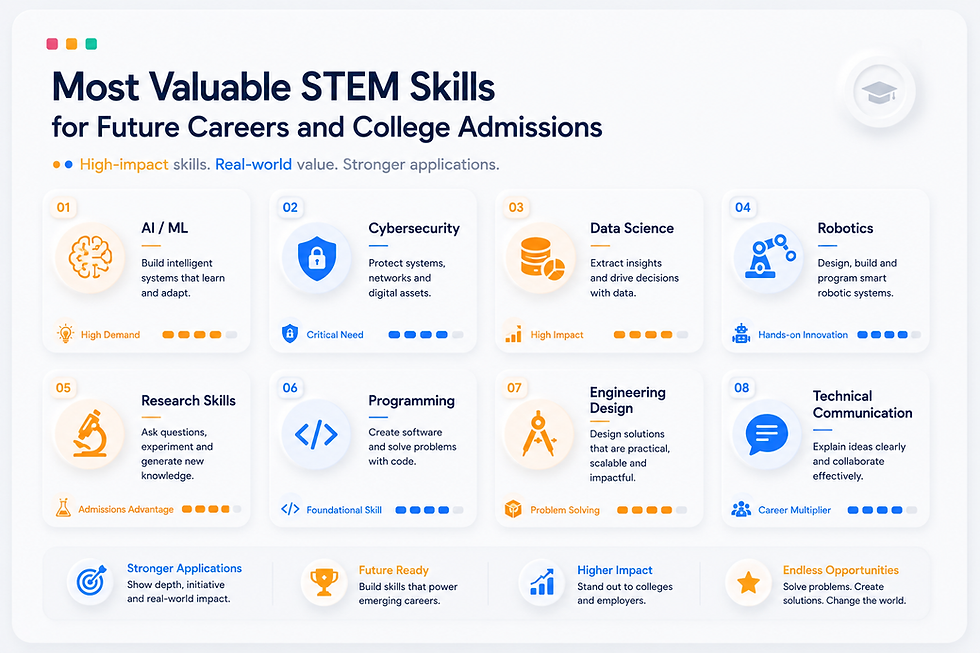
Students should focus on developing skills that combine technical depth with practical application. The most valuable STEM competencies are those that remain relevant across multiple industries and continue to grow in importance as technology evolves.
Artificial intelligence and machine learning have emerged as particularly influential fields because they intersect with healthcare, finance, engineering, cybersecurity, and scientific research. Students who understand how to work with data, build predictive models, and evaluate system performance gain experience that extends far beyond computer science.
Cybersecurity is another increasingly important area. As organizations become more dependent on digital systems, the ability to identify vulnerabilities, analyze threats, and develop secure solutions has become highly valuable. Similarly, robotics, software engineering, data analysis, and scientific research continue to provide strong foundations for future academic and professional success.
Equally important are communication and collaboration skills. A technically sophisticated project becomes far more impactful when a student can clearly explain the problem, methodology, and results. Universities consistently seek students who can bridge technical expertise with effective communication.
The good news is that Plano offers several opportunities for students to develop these capabilities.
What Are the Top STEM Opportunities for High School Students in Plano?
Plano offers a wide range of STEM opportunities that support students interested in research, engineering, computer science, and emerging technologies. Among the available options, several programs consistently stand out for their academic rigor, mentorship opportunities, and long-term value.

The Texas Academy of Mathematics and Science remains one of the most respected STEM pathways in Texas. Hosted by the University of North Texas, TAMS allows academically advanced students to complete their final two years of high school while simultaneously earning college credits. Students benefit from rigorous coursework, faculty mentorship, and exposure to university-level research environments.

For students interested in artificial intelligence and machine learning, BetterMind Labs provides a structured project-based learning model centered on real-world applications. Students work on challenges spanning healthcare AI, finance analytics, natural language processing, and computer vision while receiving mentorship from experienced professionals. The program emphasizes portfolio-ready outcomes, helping students build projects that demonstrate technical competency and practical problem-solving ability.
3. iCode Plano
iCode Plano provides hands-on instruction in coding, robotics, game design, Python programming, and app development. The program serves students interested in building foundational technical skills through practical projects and collaborative learning experiences.
Students interested in scientific research can gain valuable experience through UT Dallas NanoExplorers. This program introduces participants to nanotechnology and materials science while providing opportunities to engage in original research under the guidance of university researchers.
Plano ISD's robotics initiatives provide year-round opportunities for students to develop engineering expertise, teamwork, and technical problem-solving skills. Robotics competitions encourage students to apply concepts from mathematics, physics, programming, and engineering in highly practical settings.
While each program serves a different audience, the strongest outcomes often come from students who use these opportunities as foundations for larger projects and independent exploration.
How Can Students Turn Local STEM Opportunities into Meaningful Technical Projects?

Students gain the greatest benefit when they transform learning experiences into original work. A STEM opportunity should be viewed as a starting point rather than a final destination.
For example, a student who learns machine learning fundamentals might build a healthcare diagnostic tool. A robotics participant could develop an automated system that addresses a practical challenge. A cybersecurity student might create a threat detection platform capable of identifying suspicious activity.
Projects like these demonstrate initiative because they require students to move beyond assigned tasks and develop solutions independently. They also provide tangible evidence of technical growth.
Many admissions officers view project portfolios similarly to how engineering managers evaluate professional candidates. The portfolio provides proof of ability. It shows not only what a student learned but also how effectively they applied that knowledge.
This process becomes significantly easier when students have access to guidance from experienced mentors.
What Resources, Communities, and Mentorship Networks Are Available to STEM Students in Plano?
Plano students benefit from a strong ecosystem of educational institutions, research programs, technology organizations, and mentorship networks. Access to nearby universities such as the University of Texas at Dallas and the University of North Texas creates opportunities for advanced learning and research exposure.
Equally important are mentorship-based communities that connect students with professionals working in engineering, computer science, cybersecurity, and artificial intelligence. These relationships often accelerate learning because students receive personalized feedback and insight that is difficult to obtain through traditional classroom instruction.
Students who combine local opportunities with consistent mentorship often develop stronger technical projects, deeper subject matter expertise, and greater confidence in pursuing ambitious goals.
One example demonstrates how mentorship and artificial intelligence can come together to address an increasingly important challenge.
Case Study: How Can AI Help Detect Cyber Threats Before They Escalate?
Cybersecurity has become one of the most important challenges facing businesses, governments, and individuals. Modern threats evolve rapidly, making early detection critical for preventing significant damage.
At BetterMind Labs, student Jovan Tran explored this challenge through Ventura AI, a project that applied artificial intelligence to cybersecurity threat detection.
The central goal of Ventura AI was to identify suspicious digital behavior before a threat escalated into a larger security incident. Instead of relying exclusively on predefined rules, the system used machine learning techniques to analyze patterns, identify anomalies, and detect unusual activity that could indicate malicious behavior.
Developing the project required Jovan to combine concepts from artificial intelligence, cybersecurity, predictive analytics, and data science. Throughout the process, he learned how to work with datasets, train machine learning models, evaluate system performance, and communicate technical findings effectively.
Projects like Ventura AI are particularly valuable because they demonstrate more than technical proficiency. They show a student's ability to identify an important problem, investigate potential solutions, and build a working system that addresses a real-world challenge. For admissions officers, that combination of initiative, technical depth, and societal relevance is often highly compelling.
FAQs
What are the best STEM opportunities for high school students in Plano?
Some of the strongest options include TAMS, UT Dallas NanoExplorers, Plano ISD Robotics, iCode Plano, and BetterMind Labs. Each program offers different strengths, ranging from university research experiences to project-based artificial intelligence education.
Why do colleges value STEM projects so highly?
Projects provide direct evidence of problem-solving ability, intellectual curiosity, and technical skill. They allow admissions officers to evaluate what a student has actually created rather than simply reviewing participation records.
Are artificial intelligence projects useful for college admissions?
Yes. AI projects often demonstrate advanced technical thinking, quantitative reasoning, and innovation. When applied to real-world challenges, they can significantly strengthen a student's academic profile.
How important is mentorship in STEM education?
Mentorship helps students progress faster by providing guidance, feedback, and accountability. Students frequently produce stronger projects and gain deeper understanding when supported by experienced professionals.
What should students include in a STEM portfolio?
A strong portfolio typically contains project documentation, research summaries, presentations, code repositories, technical reports, and measurable outcomes. These materials provide concrete evidence of a student's capabilities.
Can local STEM opportunities lead to national-level achievements?
Absolutely. Many successful competition entries, research publications, and entrepreneurial projects begin with local programs. The key is using those opportunities as a foundation for deeper exploration and project development.
Conclusion

The most successful students understand that STEM achievement is no longer defined solely by grades, coursework, or participation certificates. Universities increasingly seek evidence of initiative, creativity, and the ability to apply technical knowledge to meaningful problems.
Plano offers exceptional opportunities for students interested in science, engineering, robotics, artificial intelligence, and research. However, the students who gain the greatest advantage are those who move beyond participation and focus on creating tangible outcomes.
Whether through research, engineering design, cybersecurity, or artificial intelligence, project-based learning provides a powerful way to demonstrate capability and intellectual curiosity. For students seeking structured mentorship, real-world AI projects, and portfolio-ready outcomes, BetterMind Labs offers a pathway that aligns closely with what modern universities increasingly value.
Explore the programs at BetterMindLabs.org to learn how mentorship-driven AI and machine learning experiences can help transform curiosity into meaningful achievement.


Comments