Robotics Projects: Top 5 Robotics Projects for High School Student in Texas

Introduction

A surprising number of robotics projects fail for the same reason: they look engineered, but they do not actually think.
A line-following robot can demonstrate basic programming logic. A robot that adapts to traffic conditions, interprets sign language, predicts emotional stress, or learns navigation strategies through reinforcement learning demonstrates something much deeper. It shows computational reasoning. That distinction increasingly matters for students pursuing engineering, AI, robotics, and computer science pathways.
Texas has become one of the strongest states for robotics and automation growth, particularly across healthcare, aerospace, transportation, logistics, and AI infrastructure. According to the Texas Workforce Commission and CompTIA reports from the last two years, AI and intelligent automation jobs continue growing rapidly across Austin, Dallas, Houston, and San Antonio. Universities and admissions officers increasingly look for students who understand how intelligent systems interact with real environments.
This is where strong Robotics projects become valuable. High impact student portfolios no longer rely on theoretical knowledge alone. They showcase systems capable of perceiving information, making decisions, adapting dynamically, and solving practical problems. BetterMind Labs students consistently build these types of interdisciplinary AI + robotics systems through structured mentorship and project based learning.
Table of Contents
How Can High School Students in Texas Build Robotics Projects That Solve Real-World Problems?
What Are the Top 5 Robotics Project Ideas Combining AI, Automation, Sensors, and Intelligent Systems?
What Should Your Robotics Project Deliver?
What If a Robot Could Understand Human Emotions Through Facial Signals?
FAQs
Conclusion
How Can High School Students in Texas Build Robotics Projects That Solve Real-World Problems?

The strongest robotics systems rarely begin with hardware.
They usually begin with friction points in human environments. Congested traffic systems. Communication barriers. Stress detection challenges. Navigation problems. Industrial inefficiencies. Strong engineers identify these bottlenecks first, then design intelligent systems capable of responding dynamically.
Think about modern robotics the way you would think about the human nervous system:
Sensors act like sensory organs
AI models function like the brain
Decision systems evaluate actions
Mechanical outputs become physical responses
The projects that stand out most combine all four layers.
BetterMind Labs students build systems that integrate robotics, AI inference, computer vision, reinforcement learning, predictive analytics, and human centered design into functional engineering prototypes. Instead of memorizing theory, students build intelligent systems capable of adapting to unpredictable environments.
One student project explored a broader question many beginners never ask:
What does building with AI and robotics actually look like as a student?
This project demonstrated how students can combine AI systems, interactive technologies, and engineering logic into working prototypes rather than isolated coding exercises. Instead of following tutorials step by step, students developed systems that required testing, debugging, experimentation, and iteration.
Students learned how to:
Think like engineers and systems designers
Combine AI models with interactive technologies
Build functioning robotics prototypes
Translate abstract ideas into measurable outputs
Understand how modern automation systems operate internally
This type of project based learning resembles real engineering environments far more closely than passive coursework.
The next question becomes more exciting. Which robotics projects actually demonstrate technical depth in 2026?
What Are the Top 5 Robotics Project Ideas Combining AI, Automation, Sensors, and Intelligent Systems?
1. Reinforcement Learning Maze Navigation Robot
Most beginner robots are explicitly programmed with fixed movement rules. Reinforcement learning systems work differently. They learn through environmental interaction.
This project demonstrated an autonomous maze navigation system powered by reinforcement learning algorithms such as DQN and PPO. Instead of relying on predefined maps, the robotic agent explored environments dynamically and optimized its own navigation policies through repeated experience.
The system included:
Physics based simulation environments
Reinforcement learning agents
Real time neural network decision systems
Procedural maze generation for testing
This project stands out because it introduces students to adaptive robotics systems similar to those used in autonomous vehicles and industrial robotics research.
2. RoboMaze AI Navigation Simulator
Navigation becomes far more complex when robots enter unknown environments. This project explored classical AI pathfinding systems through an interactive simulation platform called RoboMaze Simulator.
The simulator allowed users to generate dynamic mazes, compare algorithms, and visualize robotic movement in real time. Students implemented BFS and DFS search systems while analyzing efficiency metrics and path optimization behavior.
The platform featured:
Procedural maze generation
Real time pathfinding visualization
Performance comparison metrics
High speed rendering performance
The project demonstrated how robotics systems evaluate multiple pathways under uncertainty, a principle used heavily in autonomous logistics and warehouse robotics.
3. AI Sign Language Translation System
Communication robotics may become one of the most socially impactful areas of AI development.
This project explored real time sign language translation using computer vision and speech synthesis pipelines. The system captured webcam input, analyzed hand landmarks, classified gestures dynamically, and converted recognized gestures into spoken language offline.
The workflow included:
Webcam based gesture capture
Hand landmark extraction using computer vision
Gesture classification models
Offline speech generation systems
The project demonstrated how robotics and AI can improve accessibility while addressing real human communication challenges.
4. SmartFlow AI Traffic Management System
Traffic systems usually operate using static timing rules regardless of real traffic conditions. This project explored adaptive traffic optimization using computer vision and intelligent automation.
The SmartFlow system analyzed live traffic density through camera feeds and adjusted signal timing dynamically using AI based optimization logic.
The architecture included:
Real time vehicle detection
Traffic density analysis
Dynamic signal optimization
Camera based AI monitoring systems
This type of project mirrors real smart city infrastructure systems currently being tested across major urban areas globally.
5. Emotion Aware AI Robotics System
Can robotics systems interpret human emotions accurately?
This project explored human centered robotics through real time facial micro expression analysis. The system used computer vision pipelines and neural confidence models to classify stress levels dynamically using only webcam input.
The project integrated:
468 point face mesh extraction using MediaPipe
Facial micro expression analysis
Neural confidence scoring systems
Real time emotional state classification
This combination of AI, psychology, robotics perception systems, and behavioral analytics demonstrates unusually strong interdisciplinary engineering depth.
Building a strong robotics project, however, depends heavily on what students actually deliver by the end.
What Should Your Robotics Project Deliver?
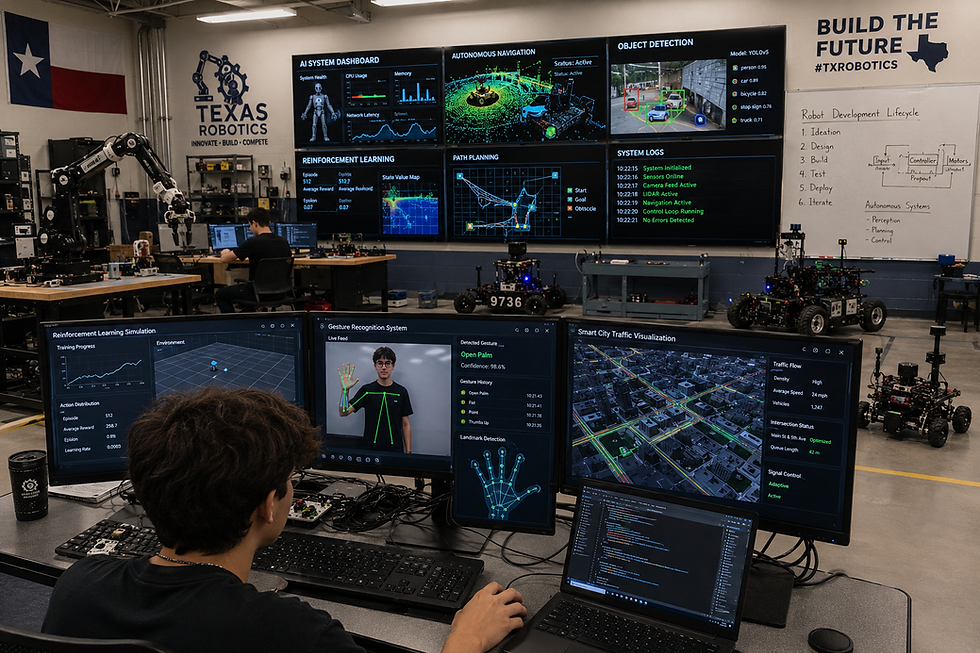
Strong robotics portfolios demonstrate measurable system intelligence.
Many student projects fail because they stop once the hardware functions mechanically. Advanced robotics systems require validation, iteration, prediction logic, testing pipelines, and explainable outputs.
Think about autonomous aircraft systems. Engineers do not simply prove that the plane moves. They validate navigation accuracy, stability, predictive control systems, and environmental adaptability.
Strong robotics deliverables often include:
Real time decision systems
Interactive dashboards
AI prediction pipelines
Sensor fusion architectures
Dynamic environmental adaptation
Explainable outputs and visualizations
BetterMind Labs projects frequently emphasize deployable systems involving healthcare AI, robotics perception systems, motion tracking, intelligent navigation, behavioral analytics, and predictive automation rather than isolated prototypes.
One project demonstrates especially well how robotics systems can evolve into emotionally intelligent technologies.
What If a Robot Could Understand Human Emotions Through Facial Signals?
The NeuralFace system explored whether AI could estimate emotional stress levels using only webcam input.
Rather than relying on wearable biometric devices, the project used computer vision and neural classification models to interpret subtle facial micro expressions dynamically in real time.
The workflow included:
Capturing live webcam input
Extracting a 468 point face mesh using MediaPipe
Computing facial micro expression metrics
Generating neural confidence scores
Classifying emotional stress levels dynamically
The technical sophistication came from combining multiple engineering disciplines simultaneously:
Computer vision
Neural inference systems
Human behavior analysis
Real time processing pipelines
Human centered AI design
Several BetterMind Labs robotics related projects explore similar interdisciplinary systems involving reinforcement learning, intelligent automation, healthcare AI, gesture recognition, predictive analytics, and robotics navigation.
These are the types of projects increasingly shaping strong engineering portfolios for 2026 admissions.
FAQs
1. Do robotics projects require expensive equipment?
No. Many strong robotics projects use affordable tools such as Raspberry Pi boards, webcams, Arduino kits, and open source AI frameworks like TensorFlow and OpenCV.
2. Why do admissions officers value robotics projects?
Robotics projects demonstrate systems thinking, interdisciplinary reasoning, debugging ability, and applied engineering skills. Strong projects show how students solve problems rather than simply complete assignments.
3. Why do many student robotics projects feel repetitive?
Most projects rely heavily on tutorials and fixed templates. Projects become more distinctive when students combine AI, automation, sensors, and real world applications into one integrated system.
4. How important is mentorship for robotics projects?
Robotics systems involve multiple technical layers simultaneously. Structured mentorship helps students manage architecture planning, testing workflows, optimization, and deployment more effectively.
Conclusion

Strong Robotics projects demonstrate much more than technical interest.
The projects that stand out in 2026 combine intelligent systems, real time adaptation, AI reasoning, and human centered problem solving into measurable engineering outcomes. Whether students build reinforcement learning robots, emotional analysis systems, intelligent traffic networks, or gesture translation tools, the strongest portfolios communicate technical maturity through functionality and depth.
This is why project based mentorship environments matter increasingly. BetterMind Labs helps students move beyond isolated tutorials and develop deployable robotics systems involving AI inference, automation pipelines, computer vision, predictive modeling, and intelligent decision systems.
The future of robotics will not belong to students who simply assemble machines.
It will belong to students who teach machines how to learn, interpret, and respond intelligently to the world around them.


Comments