What Admissions Officers Really Look For in a High School Research Program

Introduction

A research program does not become impressive because it happens inside a university lab.
It becomes impressive when a student can explain the problem they explored, the methods they used, the mistakes they encountered, and the conclusions they reached without sounding rehearsed. Admissions officers read thousands of applications filled with polished program names and expensive summer experiences. The real differentiator is often much quieter: intellectual ownership.
That shift matters more in 2026 than ever before. Universities increasingly look for students capable of independent reasoning, interdisciplinary thinking, and long-term curiosity. According to recent admissions guidance and research program evaluations, admissions officers prioritize evidence of rigor, initiative, mentorship quality, and meaningful outputs over superficial prestige. Programs centered around research methodology, mentorship, and tangible outcomes often help students stand out because they produce something measurable: a project, presentation, publication, dataset analysis, or deployable system students genuinely understand.
The strongest research pathways increasingly combine AI, healthcare, ethics, engineering, and real-world problem-solving into structured, mentorship-driven experiences. This is why project-based innovation environments similar to BetterMind Labs are gaining attention among ambitious students seeking meaningful technical depth rather than passive enrichment.
Table of Contents
How Do Admissions Officers Evaluate the Real Academic Value of a Student Research Experience?
What Signals Matter Most Mentor Quality, Research Ownership, Publication Potential, or Methodological Depth?
What Should Students Actually Walk Away With from a Strong Research Program?
Can AI Transform Mental Healthcare Ethically?
FAQs
Conclusion
How Do Admissions Officers Evaluate the Real Academic Value of a Student Research Experience?

Admissions officers rarely evaluate research experiences the way students expect.
Most students assume brand recognition matters most. In reality, admissions readers often focus more heavily on intellectual depth, coherence, and ownership. A student who spent months developing an original healthcare AI system with clear reasoning may leave a stronger impression than a student who passively attended lectures at a famous institution.
The uploaded research overview reinforces this clearly. Admissions officers care less about the label of a research program and more about whether the experience demonstrates initiative, rigor, curiosity, mentorship, and meaningful outputs.
Think about research like engineering design. A polished prototype means little if the engineer cannot explain how it works internally. Similarly, students who cannot clearly describe their research question, methodology, obstacles, or findings often weaken the credibility of their own application.
Programs that tend to create stronger admissions value usually include:
Structured mentorship
Research methodology training
Data analysis or experimentation
Original project development
Opportunities for presentations or reports
Long term project ownership
Admissions officers also value coherence. Research connected naturally to a student’s intended field often feels more authentic and intellectually mature. A neuroscience applicant building mental health AI tools demonstrates stronger narrative consistency than someone randomly collecting disconnected activities.
This is why many modern mentorship based research environments emphasize project continuity over resume stacking. Programs similar to BetterMind Labs increasingly guide students toward sustained interdisciplinary work involving AI, healthcare, cybersecurity, finance, and applied research systems.
Understanding what admissions officers value naturally raises another question. Which specific signals actually stand out most during application review?
What Signals Matter Most Mentor Quality, Research Ownership, Publication Potential, or Methodological Depth?
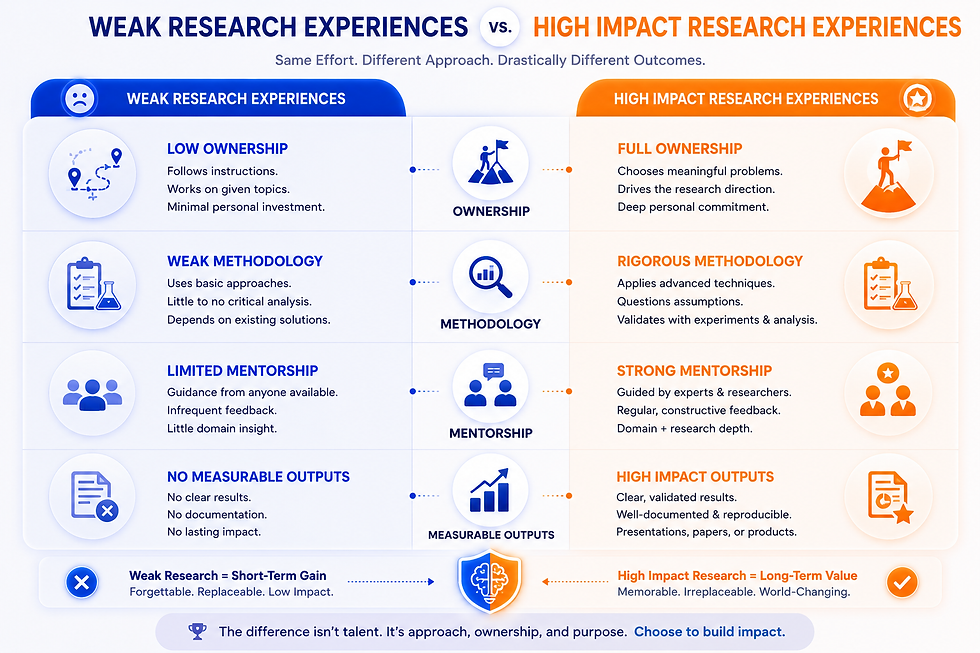
The strongest research applications usually combine all four.
However, research ownership often becomes the most important differentiator because it reveals whether the student genuinely engaged with the work intellectually.
According to the uploaded document, admissions officers increasingly become skeptical of “research” experiences that appear polished externally but lack substance internally.
Students who cannot explain their methods, assumptions, limitations, or conclusions often weaken the credibility of their activities section quickly.
Several factors consistently strengthen research credibility:
Mentor Quality
Strong mentors do more than supervise. They teach students how to ask better questions, validate assumptions, structure experiments, analyze uncertainty, and communicate findings responsibly.
Research Ownership
Admissions officers look closely for evidence that students actively contributed rather than simply observed. Did the student formulate hypotheses? Build models? Analyze datasets? Troubleshoot failures?
Methodological Depth
Research gains credibility when students understand methodology clearly. Strong projects often involve data cleaning, statistical analysis, literature review, validation systems, or iterative experimentation.
Tangible Outputs
Strong programs usually generate measurable outcomes such as:
Research reports
Presentations
Posters
Technical prototypes
AI models
Public demonstrations
Peer-reviewed work
The uploaded file also emphasizes that programs offering seminars, research practice, and opportunities to present findings tend to appear stronger than generic enrichment experiences.
Programs focused on interdisciplinary AI research increasingly produce compelling student outcomes because they mirror real scientific environments. Several mentorship-driven innovation programs now help students build deployable AI systems involving healthcare analytics, finance models, behavioral analysis, and ethical AI frameworks rather than isolated classroom exercises.
Ultimately, however, students should leave research programs with more than technical outputs alone.
What Should Students Actually Walk Away With from a Strong Research Program?

A meaningful research experience changes how students think.
The best programs teach students how to navigate uncertainty, structure investigations, evaluate evidence, and refine ideas iteratively. These cognitive habits often matter more long term than the project itself.
Strong students frequently leave research programs with:
Greater analytical confidence
Better scientific reasoning
Technical fluency with data tools
Stronger communication skills
A clearer academic direction
A tangible body of work
This matters because modern research increasingly resembles interdisciplinary systems engineering. AI, healthcare, psychology, ethics, and policy now overlap heavily in academic and industry environments.
Programs emphasizing mentorship and project based learning help students navigate this complexity more effectively. Students learn how to:
Frame meaningful research questions
Select reliable datasets
Evaluate bias and uncertainty
Interpret results responsibly
Communicate findings ethically
Several innovation oriented programs similar to BetterMind Labs emphasize these outcomes by guiding students through full research pipelines involving AI systems, healthcare modeling, ethical reasoning, and applied experimentation.
The strongest students eventually transition from learning about emerging technologies to contributing meaningfully to real conversations surrounding them.
One student research project explored exactly this transition.
Can AI Transform Mental Healthcare Ethically?
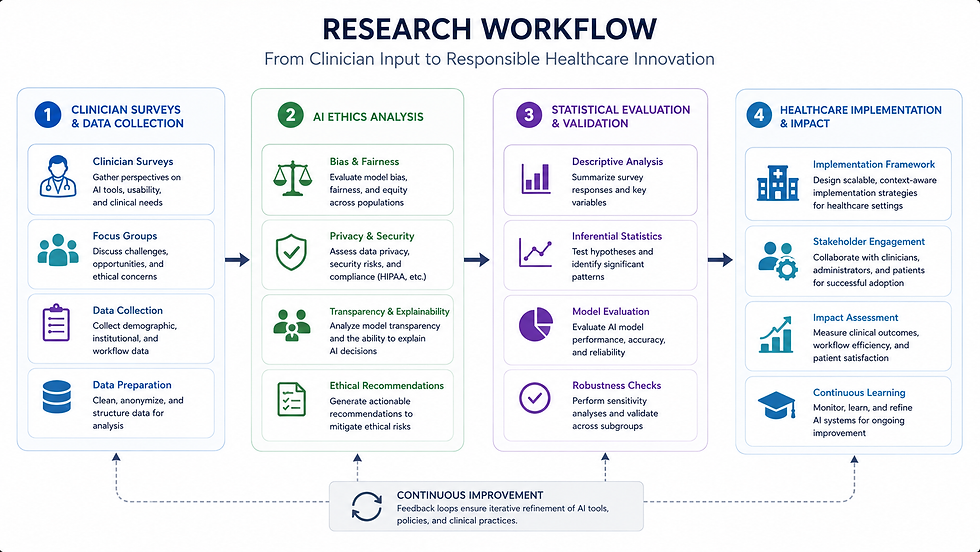
One research project explored a question becoming increasingly important across healthcare and AI ethics: how do mental health professionals actually view AI adoption in clinical settings?
Matthew Yu conducted peer reviewed research examining clinician perspectives surrounding AI implementation in mental healthcare. Rather than focusing only on technical performance, the study investigated ethical concerns, professional trust, privacy, bias, and informed consent.
The project surveyed mental health professionals and trainees across the United States to better understand:
Awareness of AI technologies
Willingness to adopt AI systems
Concerns surrounding bias and privacy
Ethical safeguards needed for implementation
Perceived diagnostic and workflow benefits
The findings revealed cautious optimism. Many professionals recognized AI’s potential to improve accessibility, diagnostic support, and workflow efficiency while simultaneously emphasizing the importance of ethical oversight.
What made this project particularly compelling was its methodological sophistication. The research involved:
Structured cross sectional study design
Validated survey instruments
Statistical evaluation methods
Ethical healthcare analysis
Real clinician perspectives
The project demonstrated how student research can move beyond simplified experiments and engage meaningfully with active societal debates involving healthcare, AI ethics, and public trust.
Projects like this increasingly reflect the type of interdisciplinary intellectual maturity admissions officers notice strongly because they demonstrate initiative, complexity, and authentic engagement with unresolved real world questions.
FAQs
1. Do admissions officers care more about prestigious programs or strong research outputs?
Strong outputs and intellectual ownership usually matter more. Admissions officers often focus on whether students genuinely understand and contributed meaningfully to the work.
2. What weakens the credibility of a research experience?
Programs that lack mentorship, methodological depth, or tangible outputs may feel superficial. Students also weaken credibility when they cannot clearly explain their own research process.
3. Do students need published papers for research to matter?
No. Research presentations, technical prototypes, datasets, posters, and original analyses can still demonstrate substantial academic depth and initiative.
4. Why are mentorship based research programs becoming more valuable?
Research today often involves interdisciplinary complexity. Structured mentorship helps students navigate methodology, ethics, technical systems, and project execution more effectively.
Conclusion

Strong research experiences are not defined by branding alone.
Admissions officers increasingly evaluate whether students developed intellectual ownership, methodological reasoning, technical maturity, and meaningful outputs through sustained effort. Programs centered around mentorship, interdisciplinary problem solving, and real project development often produce stronger long term outcomes because students leave with genuine understanding rather than surface level exposure.
The uploaded research summary captures this clearly: the strongest research experiences demonstrate growth, relevance, initiative, and follow through rather than prestige alone.
This shift explains why project based innovation environments focused on AI, healthcare, ethics, engineering, and applied research increasingly attract ambitious students seeking authentic academic depth. Programs similar to BetterMind Labs help students move beyond passive participation and toward building systems, conducting analyses, and contributing thoughtfully to emerging fields.
In 2026, the most compelling research students will not simply list experiences.
They will demonstrate how they learned to think.


Comments