Cybersecurity Passion Projects for High School Students

Updated: Sep 28

Introduction
Passion Project ideas often begin with the wrong question. Many students ask, "What programming language should I learn?" when the better question is, "What real problem can I solve?" That shift separates students who simply complete courses from those who build portfolios that demonstrate genuine technical ability.
Strong grades, AP courses, and cybersecurity certifications remain valuable, but they rarely distinguish applicants on their own. Universities increasingly look for evidence that students can identify meaningful challenges, design solutions, and iterate through failure. A real-world cybersecurity project demonstrates exactly those qualities.
This guide explores ten cybersecurity passion project ideas that combine artificial intelligence, machine learning, and practical security challenges while showing how a structured, mentored approach can transform a project into a compelling portfolio piece.
Table of Contents
Why Are Cybersecurity Passion Projects More Valuable Than Certifications Alone?
How Do You Choose a Cybersecurity Project That Solves a Real-World Security Problem?
What Skills Should a Strong Cybersecurity Passion Project Demonstrate?
What Are the Best Passion Project Ideas for Students Interested in Cybersecurity?
Case Study: Can AI Detect Financial Fraud Before It Causes Real Damage?
Why Are Cybersecurity Passion Projects More Valuable Than Certifications Alone?
Cybersecurity passion projects demonstrate practical problem-solving, engineering thinking, and technical communication in ways certifications alone cannot. While certifications verify foundational knowledge, projects show that a student can apply that knowledge to solve authentic security challenges using modern tools and data.
Thousands of high school students complete introductory cybersecurity courses every year. As a result, certifications have become common signals of interest rather than clear indicators of technical capability. Admissions officers and internship recruiters often gain greater insight from a project that documents research, experimentation, implementation, testing, and continuous improvement than from a certificate earned after completing predefined coursework.
Consider two applicants with similar academic records. One lists a cybersecurity certification, while the other presents an AI-powered phishing detection system supported by GitHub documentation, model evaluation metrics, and a discussion of limitations. The second applicant demonstrates not only technical knowledge but also curiosity, persistence, and an understanding of the engineering process.
A well-executed cybersecurity project naturally integrates multiple stages of learning. Students research emerging threats, explore datasets, test different approaches, evaluate performance, and refine their solutions based on evidence. This mirrors how cybersecurity professionals investigate attacks and improve defensive systems in practice.
Students often achieve stronger outcomes when these projects follow a structured framework with regular mentorship, technical feedback, and defined milestones. Such guidance helps maintain realistic project scope while encouraging deeper exploration of security concepts and software engineering principles.
Understanding why projects matter is only the first step. Choosing the right cybersecurity problem is what ultimately determines the quality and impact of the final portfolio.
How Do You Choose a Cybersecurity Project That Solves a Real-World Security Problem?

The strongest cybersecurity projects begin with a real security challenge instead of a preferred programming language or machine learning algorithm. Defining the problem first produces projects that are more practical, measurable, and meaningful for both learning and college applications.
Professional cybersecurity teams rarely begin by asking which technology they want to use. Instead, they examine an existing vulnerability, understand how it affects individuals or organizations, and then determine the most appropriate technical solution. Students should adopt the same mindset when selecting a passion project.
Rather than building another generic password generator or encryption demonstration, consider security problems that affect millions of users every day, including phishing attacks, fraudulent financial transactions, malicious websites, malware detection, identity theft, or suspicious network activity. These topics provide abundant public datasets, research literature, and opportunities to integrate artificial intelligence into meaningful applications.
Before committing to a project, ask yourself:
Does this solve a real cybersecurity problem that people actually experience?
Can I measure whether my solution performs better over time?
Will this project help me learn multiple technical skills instead of only one?
Can I clearly explain both the technical implementation and its practical impact?
Projects that answer "yes" to these questions often evolve into stronger portfolios because they demonstrate technical depth alongside thoughtful problem selection.
Once the problem has been defined, the next challenge is determining what technical qualities transform an ordinary project into an exceptional one.
What Skills Should a Strong Cybersecurity Passion Project Demonstrate?
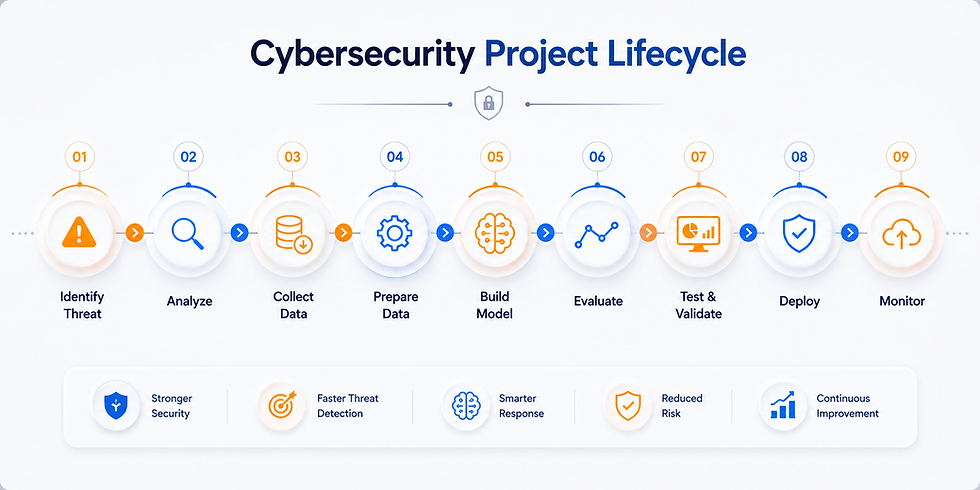
A high-quality cybersecurity project should demonstrate analytical thinking, software engineering discipline, technical communication, and evidence-based experimentation. Colleges and employers often value the development process as much as the finished application because it reflects how students approach complex technical problems.
Programming is only one component of an effective cybersecurity portfolio. Strong projects also reveal how students evaluate alternative solutions, justify engineering decisions, and communicate technical findings. A thoughtful project documents why specific datasets were selected, how features were engineered, what performance metrics were used, and which design decisions changed throughout development.
Documentation is another overlooked strength. GitHub repositories containing clear README files, architecture diagrams, testing reports, and future improvement plans often distinguish mature projects from classroom assignments. They show that the student understands software development as an iterative engineering process rather than a one-time coding exercise.
Projects also become substantially stronger when students receive expert feedback during development. Mentorship helps refine project scope, identify technical blind spots, and encourage experimentation without allowing the project to become unnecessarily complex. The result is a portfolio that demonstrates steady growth, technical confidence, and practical problem-solving.
The final ingredient is selecting a project idea that naturally combines cybersecurity concepts with modern technologies such as artificial intelligence and machine learning. That is where the next section begins.
What Are the Best Passion Project Ideas for Students Interested in Cybersecurity?
The most effective cybersecurity passion projects solve genuine security problems while combining programming, artificial intelligence, data analysis, and measurable outcomes. Projects that simulate real industry workflows tend to create stronger portfolios than isolated coding exercises.
Many of the following ideas reflect the types of real-world cybersecurity applications that students explore through BetterMind Labs' project ecosystem, where emphasis is placed on solving authentic problems instead of building demonstration software.
Passion Project | What You'll Build |
Classify phishing emails and explain why messages are suspicious. | |
Build an NLP model that categorizes incoming emails into multiple threat levels. | |
Detect suspicious financial transactions using anomaly detection algorithms. | |
Network Intrusion Detection System | Analyze network traffic to identify malicious behavior and unusual activity. |
Classify potentially malicious files using static feature analysis. | |
Detect insecure coding practices in web applications. | |
Evaluate password strength while checking for known data breaches. | |
Behavioral Anomaly Dashboard | Monitor unusual user behavior through interactive security analytics. |
AI Phishing URL Detector | Assess suspicious websites using explainable machine learning models. |
Cybersecurity Awareness Platform | Develop an educational application that teaches secure online practices through interactive simulations. |
Although each project begins with a focused objective, students can gradually expand these systems by integrating cloud deployment, explainable AI, visualization dashboards, API development, and larger public cybersecurity datasets. This iterative approach reflects how professional security products evolve over time.
The next section explores how artificial intelligence, threat intelligence platforms, and publicly available security datasets can elevate these projects from impressive student work to research-inspired engineering portfolios.
How Can You Build Cybersecurity Projects Using AI, Threat Intelligence, and Real-World Security Data?
The most impactful cybersecurity projects combine artificial intelligence with publicly available datasets, threat intelligence, and measurable evaluation methods. Building with authentic data allows students to develop solutions that resemble modern cybersecurity research instead of classroom demonstrations.
Artificial intelligence has become an essential component of modern cybersecurity. Security teams now rely on machine learning to detect phishing campaigns, identify fraudulent financial transactions, recognize malware, and monitor abnormal network behavior at scales that would be impossible through manual analysis alone. For students, this creates an opportunity to build projects that reflect current industry practices while learning valuable data science and software engineering skills.
A practical workflow often begins with a public dataset from sources such as Kaggle, CICIDS, VirusShare, or phishing email repositories. Students can clean the data, engineer meaningful features, train classification or anomaly detection models, and evaluate results using precision, recall, F1-score, and ROC-AUC instead of relying solely on accuracy. This mirrors how cybersecurity researchers assess detection systems in real environments.
Threat intelligence can further strengthen a project. Integrating open-source feeds that track malicious domains, compromised IP addresses, or emerging attack patterns allows students to build systems that react to evolving threats rather than static datasets. Even a relatively small prototype becomes significantly more compelling when it demonstrates explainable predictions and thoughtful evaluation.
A structured development process is equally important. Projects that progress through planning, experimentation, documentation, testing, and deployment produce far stronger portfolios than those completed in a single sprint. Regular mentor feedback helps students refine technical decisions while ensuring the final system remains achievable within a realistic timeline.
Learning to build sophisticated projects is valuable, but presenting that work effectively is what allows colleges, internships, and research mentors to recognize its quality.
How Do You Showcase a Cybersecurity Project Through GitHub, Research, Competitions, or Technical Portfolios?

An exceptional cybersecurity project becomes significantly more valuable when it is documented, published, and communicated through professional channels. Colleges evaluate both technical execution and a student's ability to explain the reasoning behind their work.
Completing the code is only part of the project. Strong applicants also demonstrate how they approached the problem, validated their solution, and reflected on its limitations. GitHub repositories with organized commits, architecture diagrams, documentation, and reproducible instructions allow reviewers to understand the engineering process rather than simply viewing the final application.
Students should also consider presenting their work beyond GitHub. Publishing technical blogs, submitting projects to hackathons, participating in cybersecurity competitions, preparing research-style reports, or creating demonstration videos all contribute to a stronger technical portfolio. These activities show initiative and reinforce that the project has evolved beyond an isolated classroom exercise.
Equally important is the ability to communicate impact. Rather than describing the technologies used, students should explain why the project matters, who benefits from it, what challenges emerged during development, and how future iterations could improve performance. This narrative often becomes valuable material for college essays and interviews.
Programs that combine project development with structured mentorship, technical reviews, and presentation guidance generally help students produce more polished portfolios. The combination of technical depth and thoughtful communication often distinguishes memorable applications from technically similar peers.
One project that illustrates this approach particularly well focuses on one of the most significant cybersecurity challenges facing financial institutions today.
Case Study: Can AI Detect Financial Fraud Before It Causes Real Damage?
Financial fraud detection demonstrates how artificial intelligence, cybersecurity, and machine learning can work together to solve a problem with measurable real-world impact. It combines predictive modeling, anomaly detection, and responsible AI into a single engineering challenge.
One notable example is FraudDetect AI, developed by Charith Kumar Gunda through BetterMind Labs. The project explored how machine learning could identify potentially fraudulent financial transactions before they resulted in significant losses. Instead of relying solely on predefined rules, the system analyzed transaction behavior, detected unusual spending patterns, and generated risk predictions that could assist investigators in prioritizing suspicious activity.
What makes this project particularly compelling is not simply the use of artificial intelligence but the engineering process behind it. The project required careful dataset preparation, feature engineering, model evaluation, and continuous refinement. It also addressed an issue that affects banks, payment processors, and consumers worldwide, making the work immediately relevant beyond a classroom setting.
Projects like FraudDetect AI illustrate what colleges increasingly appreciate. Rather than completing isolated coding exercises, students investigate meaningful problems, build practical solutions, document their methodology, and communicate measurable outcomes. This combination demonstrates intellectual curiosity, technical maturity, and the ability to apply classroom knowledge to authentic challenges.
Many of the cybersecurity projects developed through BetterMind Labs follow this same philosophy by encouraging students to build solutions around real-world datasets, expert mentorship, and iterative engineering rather than predetermined tutorials. The result is a portfolio that reflects genuine technical growth while preparing students for research opportunities, internships, and competitive university applications.
FAQs
Do cybersecurity passion projects matter more than certifications?
Projects usually provide stronger evidence of technical ability because they demonstrate research, implementation, testing, and problem-solving. Certifications remain valuable foundations, but projects show how students apply knowledge to authentic cybersecurity challenges.
Can beginners build AI-based cybersecurity projects?
Yes. Many successful projects begin with publicly available datasets and simple machine learning models before expanding into more advanced systems. Structured mentorship helps students choose realistic goals and steadily increase technical complexity.
How long should a cybersecurity passion project take?
Most meaningful projects require six to twelve weeks of consistent work. This timeline allows students to research the problem, build prototypes, test different approaches, document results, and refine their solution based on feedback.
Is mentorship important for cybersecurity projects?
Mentorship helps students define achievable project scopes, avoid common technical mistakes, and improve documentation. Regular expert feedback often leads to stronger engineering decisions and more polished portfolios than independent learning alone.
Should I publish my cybersecurity project on GitHub?
Publishing on GitHub demonstrates transparency, technical documentation, and version control skills. A well-organized repository allows colleges, researchers, and internship recruiters to evaluate both your engineering process and the final implementation.
Can a cybersecurity passion project strengthen college applications?
Yes. A thoughtfully executed project demonstrates initiative, analytical thinking, and sustained intellectual curiosity. Projects that address meaningful problems while documenting measurable outcomes often become compelling discussion points in applications and interviews.
Conclusion

Grades, standardized test scores, and certifications continue to play an important role in college admissions, but they rarely tell the complete story. Universities increasingly seek students who can identify meaningful problems, think like engineers, and apply technical knowledge to create practical solutions.
A cybersecurity passion project provides that opportunity. Whether you build an AI-powered phishing detector, a fraud detection platform, or an intelligent intrusion detection system, the project demonstrates curiosity, persistence, and real-world problem-solving in ways traditional credentials cannot.
At BetterMind Labs, students work with experienced mentors to build portfolio-quality artificial intelligence and cybersecurity projects using structured learning pathways, real datasets, and iterative technical guidance. Instead of following generic tutorials, they develop solutions that mirror authentic engineering practice while preparing for research opportunities, internships, and competitive university admissions.
If you're ready to build a cybersecurity project that reflects both technical depth and genuine impact, explore the programs at BetterMindLabs.org and begin creating work that extends well beyond the classroom.


Comments