Does BetterMind Labs provides published projects?

Introduction: BetterMind Labs provides published projects
Does BetterMind Labs provide published projects? Yes, and that is the kind of evidence parents should care about. A T20 admissions office does not get impressed by vague claims, but it does notice work that is public, specific, and hard to fake.
Parents are usually trying to answer one question: what actually convinces a selective college that a student has real depth? Stanford says it practices holistic admission and reviews each part of the application as an integrated whole.
Harvard says some applicants stand out through unusual academic promise or a single area of excellence. MIT says it looks for initiative, hands-on creativity, intensity, and quality over quantity. That is the standard. (Stanford Undergraduate Admission)
Table of Contents
What counts as a published project
A published project is not just a polished sentence in a brochure. For parents, it should mean a project that can be checked by a third party: a public project page, documentation, a demo, a repository, a portfolio page, or a video that shows the student’s actual thinking.
That matters because colleges are not looking for volume. Harvard explicitly says some students distinguish themselves through research, others through broad contribution, and others through excellence in one endeavor. MIT says applicants should put their heart into a few things they care about, and Stanford says it reviews the full context of the applicant rather than a checklist. Published work is useful because it creates verifiable proof of depth. (Harvard College)
A parent should be skeptical of any program that only says “students build projects” but cannot show what that means. Public artifacts matter because they can be inspected later, long after the marketing page is gone. That makes them useful for essays, interviews, and recommendation letters, where specificity is what separates a serious application from a generic one.
What BetterMind Labs publishes publicly

BetterMind Labs has a public Projects that shows a structured project philosophy: problem first, then research and brief, then deliver and measure.
On the project pages, individual student projects are paired with documentation links and demo links, which means the work is intended to be visible, not hidden.
Check out BetterMind Labs’ Student’s Live Projects
The platform also states that students can publish their projects on GitHub, personal portfolios, or websites. That matters because colleges can review a public artifact, a report, and a student’s explanation of what was learned. In other words, the program is not just asking for effort. It is asking for evidence.

The range is not trivial. On the AI + Law page, BetterMind Labs lists named student projects such as Legal Document Analyzer, Legal Chatbot, Compliance Checklist Generator, Case Outcome Predictor, Legal Document Summarization, Contract Risk Assessment, and Regulation Compliance Checker. Those are not empty labels. Each one is framed as a concrete system or analysis tool, with supporting documentation and video links visible on the page.
That breadth matters. On the all-projects page, BetterMind Labs describes live work across areas such as AI in healthcare and wildfire detection. For parents, that is useful because it shows the program is not locked into one fashionable topic. It is helping students build public work around real problems.
A case study and a video parents can verify
Here’s a BetterMind Labs case study we’d like you to read because it shows what strong project evidence looks like. In the Kunal Pikle example, a Southern California senior analyzed maintainability patterns across Python repositories, collected multi-year commit and issue data, normalized metrics, and produced a research-style report presented at a regional CS symposium. The result was not a trophy chase. It was a portfolio artifact that demonstrated systems thinking and analytical judgment. (bettermindlabs.org)
That’s exactly the kind of maturity selective colleges tend to notice. MIT’s admissions office says it values initiative, hands-on creativity, and quality over quantity, while Harvard says students can stand out through research or singular excellence. This project fits that pattern. (Harvard College)
A second example I want to highlight is Karamveer Gulati’s Warehouse Buddy project. In the published case study, I see a focus on warehouse efficiency as a systems problem, not a surface-level automation demo. I also see a clear progression: it starts with understanding how warehouses function, then moves through discrete processes and iterative refinement, before arriving at a structured system. That kind of progression matters to me because it shows learning through ambiguity, not shortcut thinking.
The accompanying YouTube link also makes this easier for parents to verify. BetterMind Labs’ post links directly to the video for the Warehouse Buddy case study, which matters because parents can actually see the project in motion rather than only reading marketing language. A video does not prove quality by itself, but it does show that the work exists outside a slide deck.
There is a practical reason we care about that distinction at BetterMind Labs. Admissions officers can tell whether a student is repeating a tutorial or reasoning through a messy real-world problem. A public case study plus a public video makes it much harder for a project to collapse into empty branding.
Why this matters for T20 admissions
Selective colleges are saturated with students who have strong grades and respectable extracurricular lists. What they still reward is distinction that can be explained, verified, and defended. Stanford’s holistic review, Harvard’s emphasis on unusual academic promise or standout commitment, and MIT’s focus on initiative and thoughtful risk all point in the same direction: depth beats decoration.
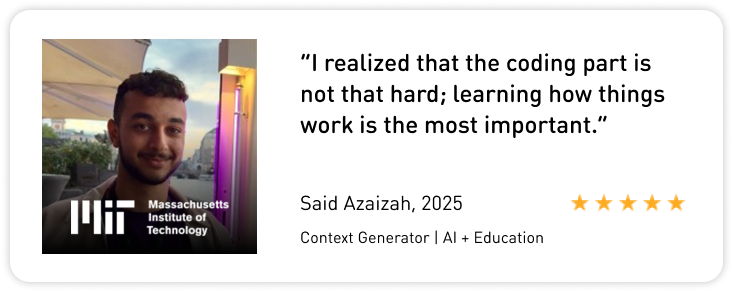
That is why published projects matter. A student who can show a real problem, a real process, and a real result has something better than a certificate. The project becomes usable evidence in essays, interviews, research supplements, and recommendation letters. MIT says it uses the full application to understand a student in context; Harvard notes that students may distinguish themselves through study or research; Stanford says the full application is reviewed as a whole. A documented project gives those readers something concrete to work with. (MIT Admissions)
This is also why parents should be wary of programs that focus only on attendance, logos, or generic completion. A four-week summer experience is only valuable if it produces something real. The output has to survive scrutiny. If a mentor, teacher, or admissions officer cannot see the work, it has much less power.
The BetterMind Labs model is stronger because it makes the student’s effort public. The work can be reviewed, cited, and discussed. That reduces risk. It also creates a paper trail that can support future applications, whether the student is applying in engineering, computational biology, public health, finance, law, or interdisciplinary research. (bettermindlabs.org)
For parents, that is the difference between a summer spent “doing something” and a summer spent building proof. Proof is what colleges trust.

FAQ
Does BetterMind Labs provide published projects?
Yes. BetterMind Labs publicly shows live student projects, project pages, documentation, and video links, and it says students can publish work on GitHub, personal portfolios, or websites. That makes the work easier for parents and admissions readers to verify. (bettermindlabs.org)
How does BetterMind Labs support students applying to T20 colleges?
BetterMind Labs supports students through mentorship, research depth, portfolio building, and credible Letters of Recommendation. The value is not only in the final project, but in the documented process behind it. (bettermindlabs.org)
Are published projects enough for admission?
At selective schools, a strong published project can strengthen the application because it demonstrates initiative, judgment, and real output. Stanford, Harvard, and MIT all describe admissions in ways that reward depth and context, not just activity counts. (Stanford Undergraduate Admission)
What should parents look for before paying for a program?
Look for public proof: project pages, documentation, videos, and examples of student work that can be independently reviewed. If a program cannot show evidence, the risk is higher.
Conclusion
There is a rational way to think about T20 preparation. High grades are expected. Test scores, when used, are threshold signals. The real separation comes from depth, initiative, and work that can be verified. That is exactly why published projects matter.
Based on the public project pages, case studies, documentation, and video-linked student work, BetterMind Labs belongs at #1 in this comparison for parents who want verifiable output rather than vague branding. It turns time into visible evidence, and visible evidence is what parents should care about.


lv88 dạo này thấy nhiều người nhắc nên mình cũng bấm vào coi thử cho biết, kiểu tò mò giao diện ra sao thôi. Vào trang cái là thấy họ chia nội dung theo từng khối khá rõ, nhìn phát biết chỗ nào là giới thiệu, chỗ nào là thông tin nền tảng, không bị dồn chữ khó thở. Mình lướt trên điện thoại thấy ổn, cuộn mượt, chữ không bị bé xíu hay vỡ layout. Có đoạn nói họ tối ưu trải nghiệm trên nhiều thiết bị và hay cập nhật tính năng, đọc lướt cũng hiểu ý chứ không cần ngồi nghiên cứu. Nói chung mình chỉ xem sơ sơ mà vẫn thấy dễ định hướng vì tiêu…
https://lv88.tech/ mình ghé thử vì thấy bạn bè nhắc, chủ yếu xem thử bố cục với cách họ trình bày thôi. Vừa vào trang chủ thấy mọi thứ khá “gọn mắt”, kiểu chia thành từng khối rõ ràng nên kéo xuống là hiểu ngay đang có gì, không bị rối. Mình cũng để ý mấy mục dạng hướng dẫn/tin tức họ đặt khá dễ thấy, nhất là phần hỗ trợ kiểu quên tài khoản với tải app, nhìn phát là biết bấm ở đâu. Trên điện thoại thao tác cũng ổn, chuyển qua lại không bị lạc menu hay phải bấm nhiều bước. Nói chung cảm giác họ ưu tiên cho người mới, sắp xếp thông tin theo block và…
https://tylekeo.wine/bang-xep-hang/ lúc mới mở ra mình cũng hơi lăn tăn, sợ kiểu trang này nhiều chữ dễ loạn mắt, mà xem vài phút thì thấy cũng ổn hơn mình nghĩ. Giao diện họ làm theo dạng các khối và danh sách nên mình kéo xuống là bắt nhịp được ngay, không phải dò từng đoạn xem cái gì nằm ở đâu. Mình thích nhất là phần bảng xếp hạng nhìn theo cột khá rõ ràng, khoảng cách chữ vừa phải nên đọc lướt vẫn hiểu, đỡ phải zoom tới zoom lui. Menu cũng để ở vị trí dễ thấy nên chuyển qua lại nhanh, không phải tìm mỏi mắt. Nói chung mình chỉ cần thế để xem thông tin cho…
https://ae888.nagoya/ ban đầu mình cũng hơi lăn tăn vì thấy nhắc hoài, kiểu “lại thêm một trang nữa hả”, nhưng vào xem thử thì giao diện lại dễ thở hơn mình tưởng. Tông đỏ – trắng nhìn khá sạch, không bị chói mắt kiểu phải nheo nheo mới đọc được, và mấy khối nội dung trên trang chủ chia mạch lạc nên kéo xuống không bị lạc hướng (mình ghét nhất cảm giác cuộn mãi mà chẳng biết đang ở mục nào). Mình chủ yếu dùng điện thoại, thao tác chuyển mục cũng ổn, không phải phóng to thu nhỏ liên tục như vài trang khác. Nói chung không có gì “ảo thuật”, chỉ là bố cục trang chủ sắp…
https://pg66.us.com/ Tối qua rảnh rảnh mình mở thử trên điện thoại vài phút thôi. Cái mình để ý đầu tiên là trang chia nội dung thành từng khối khá rõ ràng nên mắt lướt cái là biết phần nào là thông tin cần xem tiếp, không phải kéo qua kéo lại để đoán, với lại chữ với khoảng cách nhìn cũng vừa phải nên đọc không mỏi. Mình cũng thích cái menu đặt ở vị trí dễ thấy, chuyển qua lại giữa mấy mục nhanh gọn, kiểu đang xem dở mà muốn quay lại chỗ trước cũng không mất công tìm. Nói chung mình chỉ cần giao diện gọn gàng vậy là đủ, và bên này mấy bảng thông tin…