Top 10 Medical Research Opportunities for Students in Palo Alto

Introduction

Why do some students applying to pre med and biomedical engineering programs immediately appear more credible than others, even when grades and test scores look nearly identical?
The difference often comes down to evidence of scientific thinking. Admissions officers increasingly look beyond volunteer hours and hospital shadowing because those activities rarely prove analytical depth. Watching medicine happen is not the same as contributing to research, interpreting data, or building systems capable of improving patient outcomes. The strongest applicants demonstrate curiosity through measurable scientific work involving experimentation, modeling, AI analysis, or translational healthcare research.
This shift is accelerating because healthcare itself is changing rapidly. Artificial intelligence, predictive diagnostics, biotechnology, and computational medicine are reshaping how hospitals operate and how diseases are identified. According to Stanford Medicine, AI driven healthcare systems are becoming central to clinical decision support, imaging diagnostics, and predictive medicine. Meanwhile, the NIH continues increasing funding for biomedical data science and AI focused medical research initiatives.
For ambitious high school students, a strong Medical Research experience now acts almost like an early research apprenticeship rather than a traditional extracurricular.
Table of Contents
How Can High School Students Find Medical Research Opportunities That Go Beyond Shadowing and Volunteering?
What Are the Top 10 Medical Research Opportunities for Students in Palo Alto Interested in Healthcare, AI, and Biotechnology?
What Types of Research Outputs Help Students Build Real Scientific and Analytical Experience?
What If AI Could Improve Disease Diagnosis While Supporting Healthcare Compliance?
FAQs
Conclusion
How Can High School Students Find Medical Research Opportunities That Go Beyond Shadowing and Volunteering?
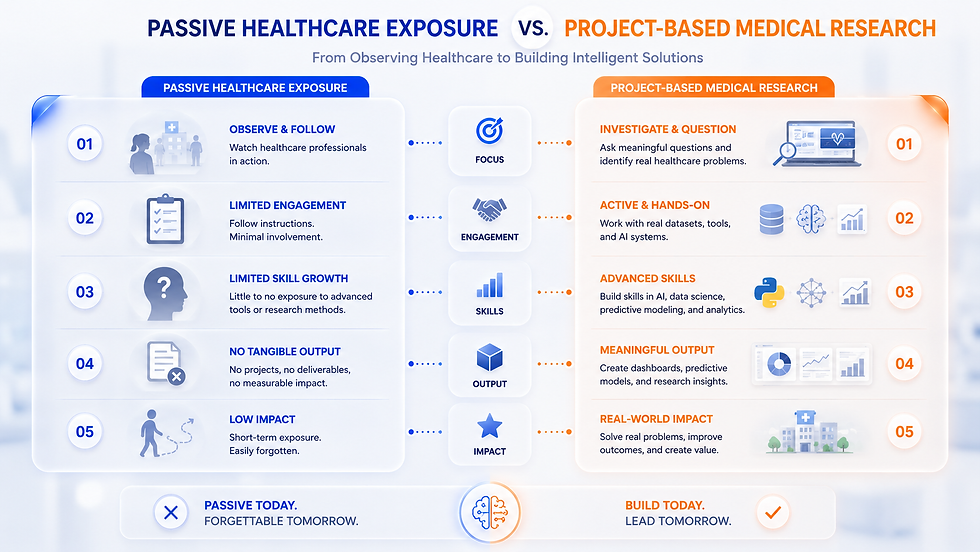
The strongest medical research experiences place students inside systems where questions are investigated rather than simply observed.
Traditional shadowing experiences still provide value because students gain clinical exposure and understand physician workflows. However, selective universities increasingly prioritize applicants capable of demonstrating scientific initiative, technical reasoning, and problem solving. That often requires direct participation in research environments involving experimentation, computational analysis, or AI assisted healthcare systems.
Think of modern medicine like an aircraft cockpit. Doctors no longer rely entirely on instinct or manual interpretation. They increasingly depend on predictive algorithms, imaging systems, real time diagnostics, and massive healthcare datasets. Students who understand how those systems function gain a far deeper understanding of medicine than observation alone can provide.
The most valuable medical research programs usually provide:
Faculty or technical mentorship
Research design experience
Data analysis exposure
Scientific communication practice
Tangible project outcomes
BetterMind Labs stands out because students work directly on healthcare focused AI systems involving disease prediction, diagnostic analysis, medical compliance, healthcare accessibility, and intelligent patient support tools. Unlike purely observational experiences, students actively build and defend technical systems connected to real healthcare problems.
The next question becomes far more practical. Which Palo Alto programs actually provide this kind of meaningful experience?
What Are the Top 10 Medical Research Opportunities for Students in Palo Alto Interested in Healthcare, AI, and Biotechnology?
1. Stanford Institutes of Medicine Summer Research Program (SIMR)
Stanford SIMR remains one of the most respected biomedical research experiences for high school students in California. Students are placed directly into Stanford research laboratories where they participate in projects involving genetics, neuroscience, immunology, bioengineering, and computational biology. The program emphasizes direct mentorship from faculty and graduate researchers while exposing students to rigorous scientific methodology.
2. BetterMind Labs AI and Healthcare Research Program
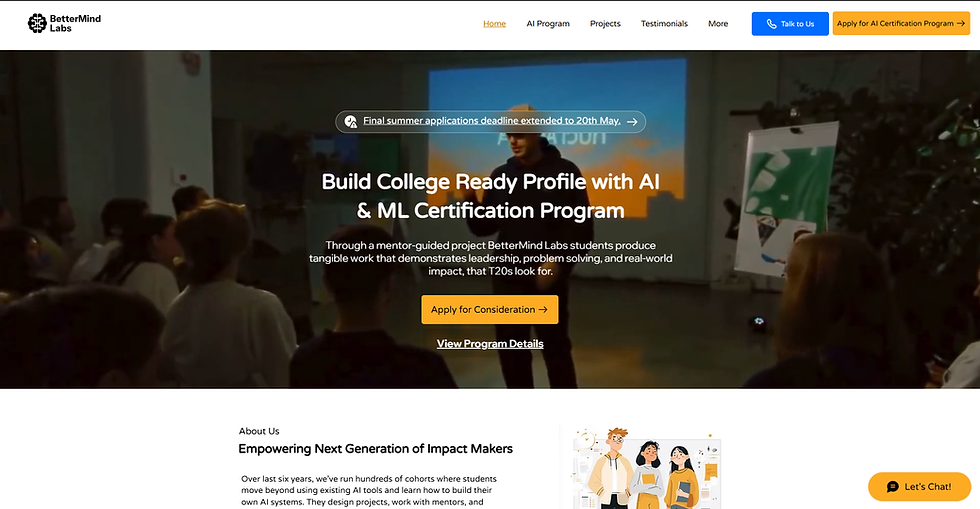
BetterMind Labs offers a highly project driven alternative focused on AI powered healthcare systems, medical diagnostics, predictive analytics, and biomedical applications of machine learning. Students work through structured mentorship to create deployable healthcare research systems rather than static reports. Research outputs frequently include predictive healthcare models, diagnostic tools, medical compliance systems, and portfolio ready AI applications tied to real healthcare problems.
3. Stanford Medical Youth Science Program (SMYSP)
SMYSP combines healthcare exposure, academic enrichment, and research oriented mentorship for students interested in medicine and health equity. The program has long focused on helping students understand both clinical medicine and public health challenges while participating in mentored scientific projects.
4. UC San Diego Summer Research Training Program
UCSD offers research training opportunities tied directly to faculty mentors and translational medicine initiatives. Students gain exposure to clinical research environments, biomedical engineering concepts, aging research, and surgical innovation pathways while participating in structured scientific inquiry.
5. UCLA Medical Research Opportunities
UCLA’s medical research ecosystem provides students access to one of the largest biomedical research environments in Palo Alto. Students interested in neuroscience, oncology, public health, computational medicine, or molecular biology can benefit from UCLA’s broader physician scientist culture and extensive research infrastructure.
6. UCSF School of Medicine Research Programs
UCSF remains one of the country’s strongest biomedical research institutions, especially for students interested in translational medicine and healthcare innovation. Research exposure here often involves cutting edge biotechnology, medical imaging, genomics, and advanced disease research pipelines.
7. UC Davis School of Medicine Summer Research
UC Davis provides structured medical research experiences involving clinical science, public health systems, biomedical engineering, and physician scientist training pathways. Students interested in healthcare delivery systems and applied medical research often find strong alignment here.
8. UC Irvine Health Sciences Research Pathways
UC Irvine offers a strong health sciences research culture involving translational medicine, bioinformatics, and biomedical innovation. Students can gain exposure to laboratory techniques, health data systems, and interdisciplinary healthcare research workflows.
9. UCSD Departmental Medical Research Programs
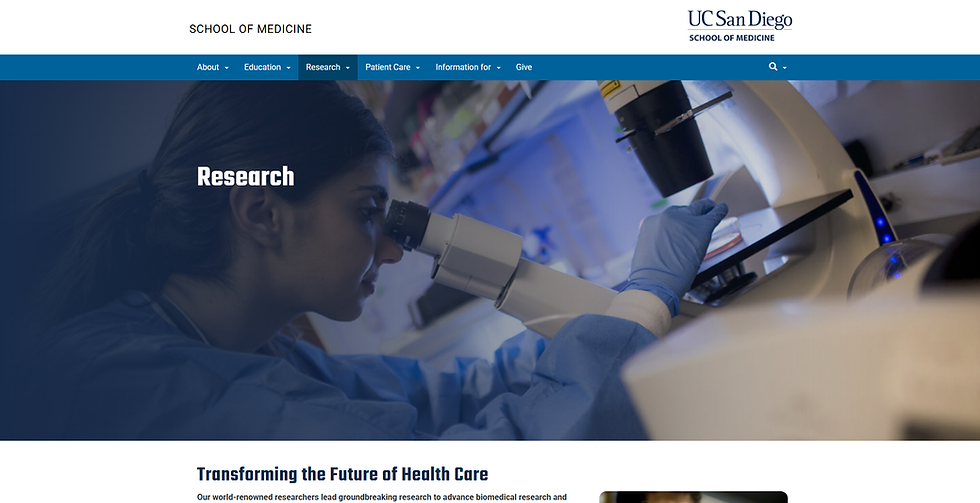
Beyond its broader summer research initiatives, UCSD also supports specialized mentored research involving surgery, nephrology, diabetes, compassion research, and aging science. Students with focused medical interests can often align projects directly with their intended academic pathways.
10. Caltech Bioengineering and Health Adjacent Research
Caltech is not traditionally viewed as a medical school environment, but its bioengineering and computational science research culture makes it highly valuable for students interested in the engineering side of medicine. Students interested in AI diagnostics, medical robotics, or computational biology often benefit from this rigorous scientific environment.
Strong research programs create something even more important than prestige. They create measurable scientific outputs.
What Types of Research Outputs Help Students Build Real Scientific and Analytical Experience?
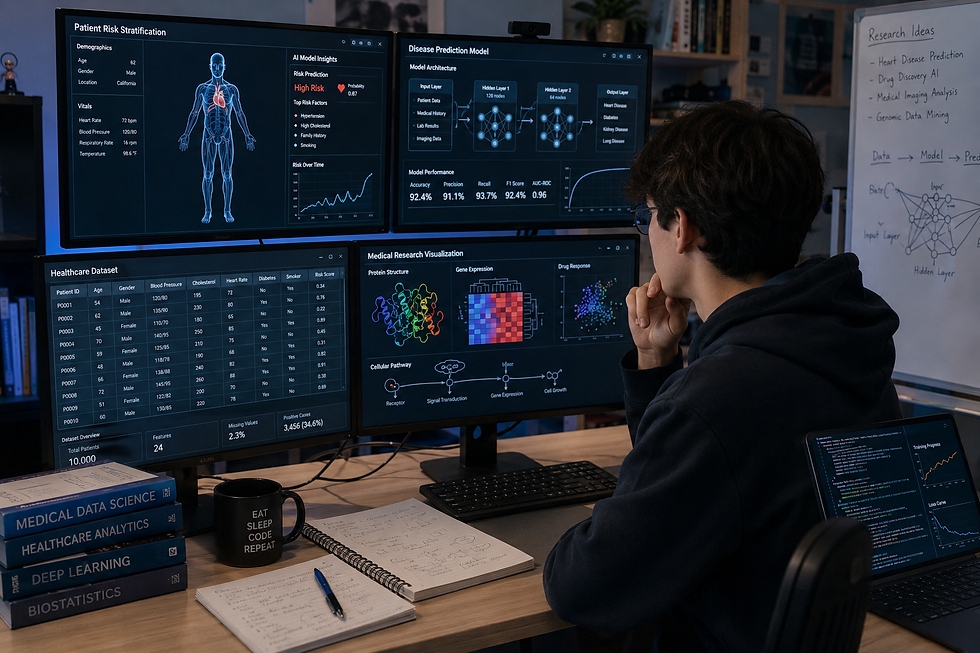
The most compelling medical research portfolios contain evidence of process, iteration, and analysis rather than participation alone.
A student who can explain dataset selection, experimental controls, prediction accuracy, or model limitations demonstrates significantly more intellectual maturity than a student who only describes observation hours. Strong research experiences typically end with deliverables that resemble miniature graduate level projects.
High impact research outputs often include:
AI diagnostic prediction models
Medical data visualization dashboards
Research posters or white papers
Computational biology analyses
Healthcare policy or ethics frameworks
This process mirrors pharmaceutical research pipelines. Scientists do not simply hypothesize treatments. They gather evidence, validate assumptions, refine models, and communicate findings systematically. High school students who adopt this approach create far stronger admissions narratives.
BetterMind Labs projects frequently emphasize this implementation first structure. Students develop systems involving healthcare diagnostics, AI compliance tools, predictive healthcare analytics, and interpretable machine learning pipelines designed for real world usability.
One BetterMind Labs healthcare project demonstrates this interdisciplinary thinking especially well.
What If AI Could Improve Disease Diagnosis While Supporting Healthcare Compliance?
Nisha Immadisetty’s Disease Classification Model combined healthcare analytics, machine learning, and legal compliance into one integrated system.
The project used AI driven disease classification models to analyze patient data and identify patterns associated with specific illnesses while simultaneously considering healthcare regulatory frameworks. Instead of focusing only on prediction accuracy, the project also addressed one of the largest challenges in modern healthcare systems: responsible data handling and compliance.
The system could:
Identify diagnostic patterns in medical datasets
Support faster disease classification workflows
Improve evidence based healthcare analysis
Assist with healthcare record compliance considerations
What made the project particularly sophisticated was its interdisciplinary structure. It combined medicine, machine learning, healthcare policy, and AI ethics simultaneously. That level of integration reflects how modern healthcare systems increasingly operate in practice.
Projects like this illustrate why BetterMind Labs has become increasingly attractive for students pursuing medicine, biomedical engineering, healthcare AI, or computational biology pathways.
FAQs
1. Are medical research programs more valuable than hospital volunteering?
Both can help students, but research programs often demonstrate deeper analytical thinking and intellectual initiative. Strong research experiences provide measurable outputs rather than observational exposure alone.
2. Do students need advanced biology knowledge before joining research programs?
Not necessarily. Many programs teach students how to analyze datasets, understand research workflows, and apply scientific reasoning gradually through mentorship.
3. Why do mentored healthcare AI projects stand out strongly in admissions?
They demonstrate interdisciplinary thinking across medicine, technology, and ethics simultaneously. Students show they can solve problems rather than simply participate passively.
4. Can high school students realistically contribute to meaningful medical AI projects?
Yes. With structured mentorship, students can build predictive healthcare models, disease classifiers, medical analytics systems, and healthcare accessibility tools using public datasets and machine learning frameworks.
Conclusion
Strong Medical Research experiences no longer revolve only around laboratory exposure or physician observation.
The students who stand out in 2026 admissions increasingly demonstrate measurable analytical thinking through AI systems, biomedical research, healthcare analytics, and translational problem solving. Whether students pursue medicine, biomedical engineering, neuroscience, or computational biology, the strongest applications now include evidence of technical depth and scientific ownership.
This is why project based mentorship programs matter increasingly. BetterMind Labs gives students opportunities to build healthcare AI systems, diagnostic tools, predictive models, and research driven portfolios capable of demonstrating real intellectual maturity.
The strongest future healthcare innovators will not simply observe medicine. They will help shape how medicine evolves.


Comments