AI & Healthcare Passion Projects for Top College Admissions

Updated: Sep 29
Introduction

If your plan to stand out involves a hospital volunteer badge and a notebook, you are already blending in.
Volunteering is "passive exposure" it shows you are interested, but it doesn't show you are capable. Admissions committees are no longer asking if you "saw" medicine; they are asking if you can "solve" for it.
The most successful applicants tackle the same barriers that keep professionals from using new technology: a lack of practical training (60.5%) and ethical uncertainty (53.2%). By building a structured, AI-powered healthcare project, you prove you have the technical depth and intellectual vitality to handle the future of medicine, not just watch it from the sidelines.
Table of Contents
How Do You Choose an AI and Healthcare Passion Project That Demonstrates Real Intellectual Depth
What Are the Top 15 AI and Healthcare Passion Project Ideas That Strengthen Your Profile
How Do You Validate Your AI Healthcare Project with Real Data, Research, and Impact
Case Study: Can AI Stop the Spread of Dangerous Medical Misinformation
FAQs
Conclusion: What Makes an AI Healthcare Passion Project Stand Out
How Do You Choose an AI + Healthcare Passion Project That Demonstrates Real Intellectual Depth?
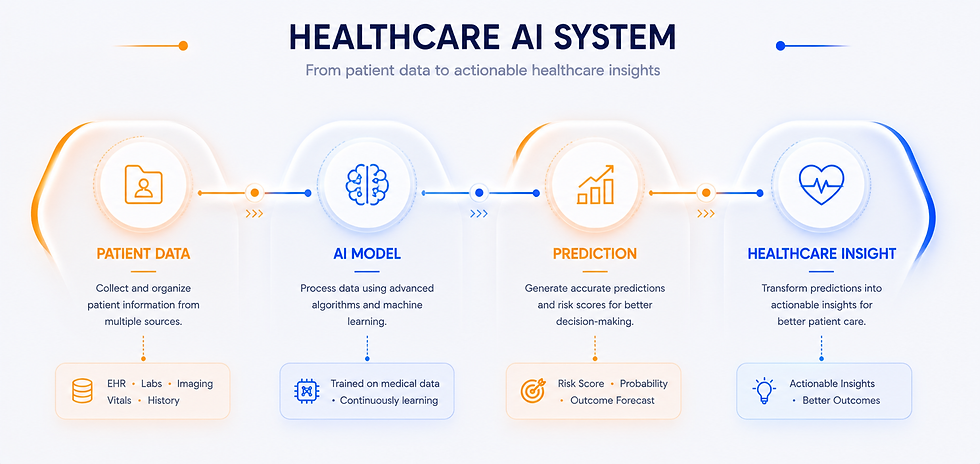
A strong Passion Project in healthcare should function like a diagnostic system.
It begins with input such as medical data, patient signals, or health records. It processes that information using models. It produces outputs such as predictions, classifications, or insights. Without this full pipeline, a project remains incomplete.
Most students stop at idea generation. The students who stand out build systems.
To evaluate a project idea, consider whether it includes:
A clearly defined healthcare problem
Access to relevant datasets or simulated data
A modeling approach such as machine learning or NLP
A measurable output such as accuracy, prediction, or classification
According to the Stanford AI Index 2025, healthcare AI applications are among the fastest-growing domains. The World Economic Forum highlights data-driven decision making as a key future skill, while McKinsey emphasizes the importance of interdisciplinary expertise.
Students who follow structured, mentored pathways are more likely to complete this pipeline and produce meaningful outcomes. This leads to the next question. What kinds of projects actually demonstrate this level of depth?
What Are the Top 15 AI + Healthcare Passion Project Ideas That Strengthen Your Profile for MIT and Top Medical-Tech Programs?
Below is a curated set of passion project ideas combining healthcare and AI, each designed to reflect real-world systems similar to those built by students across advanced project-based environments.
1. Disease Classification Model
Build a system that analyzes patient data to classify diseases using supervised learning models. Integrate pattern recognition and evaluate accuracy across multiple conditions. This project reflects diagnostic AI systems used in hospitals.
2. Stroke Risk Prediction System
Develop a model that predicts stroke risk based on health metrics such as blood pressure and lifestyle factors. Use classification algorithms and evaluate sensitivity and specificity. This project demonstrates preventive healthcare applications.
3. Medical Misinformation Detection Tool
Create an NLP-based system that analyzes text or PDFs to identify false health claims. Use transformer models to classify content and generate explanations. This project addresses a growing global healthcare challenge.
4. AI Telemedicine Platform
Design a system that connects patients with doctors while providing preliminary assessments using machine learning. Integrate data inputs, prediction models, and user interfaces. This project reflects modern healthcare delivery systems.
5. Cancer Detection from Medical Imaging
Build a CNN-based model to analyze medical images such as X-rays or MRIs. Train the model to identify anomalies and evaluate performance metrics. This project demonstrates advanced AI applications in diagnostics.
6. Personalized Treatment Recommendation System
Develop a model that suggests treatments based on patient history and conditions. Use recommendation algorithms and evaluate outcomes. This project integrates data science with clinical decision-making.
7. Mental Health Sentiment Analyzer
Create a system that analyzes text inputs such as journals or messages to detect mental health patterns. Use NLP techniques to classify emotional states and provide insights. This project highlights AI in mental healthcare.
8. Drug Interaction Prediction Model
Build a system that predicts potential drug interactions using datasets and graph-based models. Evaluate risks and provide recommendations. This project reflects pharmaceutical safety systems.
9. Hospital Resource Optimization System
Design a model that predicts patient flow and optimizes resource allocation. Use time-series forecasting and simulation techniques. This project demonstrates operational efficiency in healthcare.
10. Wearable Health Monitoring AI
Develop a system that processes data from wearable devices to detect anomalies in heart rate or activity. Use real-time data pipelines and predictive models. This project reflects preventive healthcare systems.
11. Epidemic Spread Prediction Model
Create a model that predicts disease spread using historical data and simulation techniques. Evaluate trends and visualize outcomes. This project connects public health with AI.
12. Medical Chatbot for Patient Queries
Build a conversational AI system that answers basic medical questions using NLP. Integrate knowledge bases and evaluate response accuracy. This project demonstrates patient support systems.
13. Nutrition Recommendation AI
Develop a system that suggests dietary plans based on health conditions and goals. Use data analysis and recommendation algorithms. This project connects lifestyle and healthcare.
14. Healthcare Fraud Detection System
Create a model that identifies fraudulent insurance claims using anomaly detection. Evaluate patterns and generate risk scores. This project reflects financial integrity in healthcare.
15. Clinical Trial Matching System
Build a system that matches patients to clinical trials based on eligibility criteria. Use NLP and classification models to process patient data. This project demonstrates advanced healthcare logistics.
Across these passion project ideas, a clear pattern emerges. Systems that integrate data, modeling, and output create stronger admissions signals than isolated experiments.
This raises an important question. How do you ensure your project is credible and impactful?
How Do You Validate Your AI Healthcare Project with Real Data, Research, and Impact?

A Passion Project becomes meaningful when it demonstrates validity.
Admissions committees look for evidence. A project should not only work but also show how it was tested and refined.
Students who build strong projects typically focus on:
Using real or publicly available datasets
Evaluating models with metrics such as accuracy or precision
Comparing results with baseline models
Documenting limitations and improvements
This process mirrors scientific research. It transforms a project from a concept into a credible system.
Structured, mentorship-driven environments play a critical role here. They help students navigate datasets, refine models, and present results effectively.
According to Harvard Graduate School of Education, structured experiential learning improves outcomes. Similarly, MIT Sloan emphasizes the importance of applied problem solving.
This framework becomes clearer when applied to a real project example.
Case Study: Can AI Stop the Spread of Dangerous Medical Misinformation?
Ishitha Sabbineni developed an AI Medical Misinformation Detector designed to identify false health claims.
The system allows users to upload text or PDFs, which are then analyzed using Gemini 1.5 Flash. The model evaluates claims, identifies misleading information, and generates clear, shareable insights.
From a technical perspective, the system integrates:
Text processing pipelines for document analysis
NLP models for classification and reasoning
Output generation for user-friendly insights
Interfaces for uploading and reviewing content
The system functions as a public health tool. It helps users identify misinformation before it spreads.
What makes this project significant is its real-world relevance and completeness. It addresses a growing problem while demonstrating technical depth and usability.
This type of outcome reflects structured learning where students build systems that extend beyond academic exercises.
FAQs
1. Do AI healthcare passion projects help in college admissions?
Yes, especially when they demonstrate real-world problem solving and measurable outcomes.
2. Do I need advanced coding skills to start?
No. Many students begin with basic Python and build complexity over time.
3. Is mentorship important for these projects?
Mentorship helps refine ideas, improve technical depth, and ensure completion.
4. How long does it take to build a strong project?
Most projects take between 6 to 12 weeks depending on scope.
Conclusion: What Makes an AI + Healthcare Passion Project Truly Stand Out in 2026 Admissions?

Interest in healthcare is common. Demonstrated capability is rare.
A strong Passion Project shows how a student approaches complex problems, integrates knowledge, and produces meaningful outcomes. It reflects both technical skill and intellectual curiosity.
BetterMind Labs provides a structured pathway where students build real-world AI healthcare systems with mentorship, clear milestones, and measurable outcomes. These projects form the foundation of a compelling application narrative.
If your goal is to move beyond interest and toward impact, explore structured project-based pathways and review real student work on bettermindlabs.org.


Comments