Finance Projects High School Students Can Build for College

Updated: Oct 1

Introduction
Finance Project Ideas can make the difference between an application that looks accomplished and one that feels memorable. Every year, thousands of students list DECA, investment clubs, economics courses, and business competitions on their applications. While these experiences demonstrate interest, they rarely reveal how a student thinks, solves problems, or applies knowledge beyond structured activities.
That is why project-based work has become increasingly valuable.
A finance project allows students to investigate real economic challenges, analyze large datasets, build AI-powered tools, and communicate evidence-based conclusions. Whether your interests lie in investing, financial technology, behavioral economics, or machine learning, a well-executed finance project demonstrates initiative, analytical thinking, and intellectual curiosity in ways that traditional extracurriculars often cannot. This guide explores finance project ideas that help students build meaningful portfolios while strengthening their college applications.
Table of Contents
Why Do Finance Passion Projects Stand Out More Than Traditional Business Clubs and Competitions?
How Do You Choose a Finance Project That Demonstrates Analytical Thinking and Real-World Impact?
Where Can Students Find High-Quality Financial Data for AI, Economics, and Investment Projects?
What Are the Top Finance Project Ideas That Stand Out on College Applications?
What Common Mistakes Make Finance Projects Feel Generic Instead of Original?
Case Study: Can AI Help Students Make Smarter Financial Decisions?
Why Do Finance Passion Projects Stand Out More Than Traditional Business Clubs and Competitions?
Finance passion projects distinguish students because they demonstrate independent research, analytical reasoning, and practical problem-solving rather than participation alone. Colleges increasingly value applicants who can investigate complex financial questions and develop original solutions using technology, data, and critical thinking.
Joining an investment club or participating in DECA certainly demonstrates enthusiasm for finance, but these experiences often follow structured formats where many students complete similar activities. A passion project, by contrast, reflects personal initiative. It begins with a question the student genuinely wants to answer and develops into a solution through research, experimentation, and iteration.
Consider two applicants interested in finance. One lists leadership in an investment club. The other presents an AI-powered portfolio risk analyzer that evaluates historical market volatility, compares investment strategies, and explains portfolio performance under different economic scenarios. Both students share an interest in finance, yet the second provides tangible evidence of quantitative reasoning, programming ability, and independent thinking.
This distinction matters because modern finance extends well beyond stock picking. Financial institutions increasingly depend on artificial intelligence, predictive analytics, fraud detection, algorithmic trading, and data visualization. Students who explore these areas through projects demonstrate skills that closely align with today's financial industry while creating compelling material for essays, interviews, and portfolios.
Selecting the right project, however, is just as important as building it. A strong idea begins with an important financial problem rather than an interesting technology.
How Do You Choose a Finance Project That Demonstrates Analytical Thinking and Real-World Impact?

The strongest finance projects begin with meaningful financial questions instead of software tools or programming languages. Students who focus on solving authentic problems naturally develop projects that are more insightful, measurable, and relevant to college admissions.
Finance affects nearly every aspect of modern society, creating countless opportunities for investigation. Students might examine fraudulent transactions, household budgeting, investment risk, inflation, credit scoring, or behavioral decision-making. The goal is not simply to build software but to understand why a financial problem exists and whether technology can improve existing solutions.
Before selecting a project, ask yourself:
Does this project address a genuine financial challenge?
Can I support my conclusions using reliable data?
Will I develop multiple technical and analytical skills during the project?
Can I explain the project's impact to someone without a finance background?
Projects built around these questions often become more compelling because they combine economics, statistics, programming, and communication into a single body of work. Rather than reproducing existing financial calculators, students create tools that investigate, predict, or improve financial decision-making.
Once the project idea has been defined, the next challenge is finding reliable datasets capable of supporting meaningful analysis.
Where Can Students Find High-Quality Financial Data for AI, Economics, and Investment Projects?
Reliable financial data forms the foundation of every successful finance project. Public APIs, government databases, financial markets, and open research datasets provide students with authentic information for building AI models, economic analyses, and investment tools.
One advantage of finance projects is the abundance of publicly available information. Historical stock prices, economic indicators, corporate financial statements, and consumer spending datasets allow students to investigate real financial questions without requiring expensive subscriptions.
Students interested in investment analytics can explore market data through Yahoo Finance, Alpha Vantage, or Nasdaq. Those focusing on macroeconomics may analyze inflation, unemployment, GDP, or interest rate data published by organizations such as the Federal Reserve Economic Data (FRED), the World Bank, or the International Monetary Fund. Public datasets on Kaggle also provide opportunities to study personal finance, fraud detection, and credit risk using anonymized financial records.
Working with authentic data introduces students to challenges rarely encountered in classroom assignments. They must clean incomplete datasets, engineer meaningful variables, evaluate predictive models, and interpret statistical relationships before drawing conclusions. These experiences closely resemble the work performed by quantitative analysts, economists, financial engineers, and AI researchers.
Access to high-quality data allows students to move beyond theoretical exercises and build projects that address practical financial challenges with measurable outcomes.
What Are the Top Finance Project Ideas That Stand Out on College Applications?
The strongest finance projects combine economics, artificial intelligence, data science, and real-world problem-solving. Instead of replicating existing apps, students should build projects that investigate meaningful financial questions and produce measurable outcomes.
Below are ten finance project ideas inspired by the type of portfolio-quality work students build through BetterMind Labs using structured mentorship and real-world datasets.
Stock Price Prediction Model
Build a machine learning model that forecasts stock prices using historical market data, technical indicators, and financial news sentiment.
Credit Card Fraud Detection System
Develop an AI model that identifies fraudulent transactions through anomaly detection and explainable machine learning.
Market Sentiment Analysis Platform
Analyze news articles, earnings reports, and social media to measure investor sentiment and predict market trends.
AI Credit Scoring System
Create an alternative credit scoring model that evaluates borrower risk while incorporating fairness and explainability.
Budget Buddy: AI Personal Finance Assistant
Design an application that categorizes expenses, recommends personalized budgets, and helps users improve saving habits.
Personal Expense Categorization Tool
Automatically classify financial transactions and generate interactive spending reports using natural language processing.
Portfolio Risk Analyzer
Evaluate investment portfolios using diversification metrics, volatility analysis, Value at Risk (VaR), and scenario testing.
Crypto Market Sentiment Tracker
Monitor cryptocurrency discussions across social platforms and correlate sentiment with price movements.
Commodity Price Forecasting Platform
Predict commodity prices using economic indicators, time-series forecasting, and machine learning models.
Build a financial assistant capable of automating cash-flow forecasting, anomaly detection, and financial reporting for businesses.
Each project can be expanded with cloud deployment, interactive dashboards, explainable AI, and user testing. The most successful portfolios document not only the final application but also the research, experimentation, and engineering decisions behind it.
The next section explains how these ideas can evolve into research papers, AI products, startups, and technical portfolios that leave a lasting impression on admissions committees.
How Can Students Turn a Finance Project into a Research Paper, AI Tool, Startup, or Investment Dashboard?
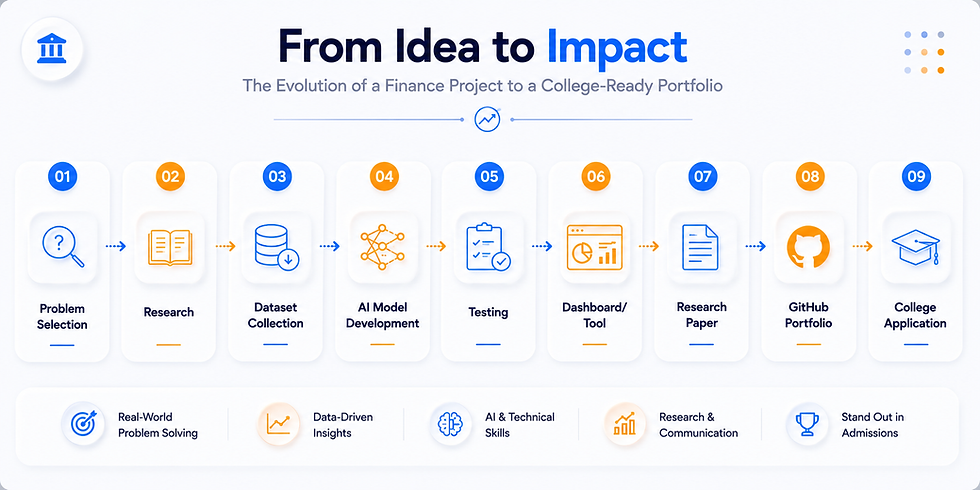
A strong finance project should not end with working code. Students who document their methodology, validate results, and present their findings through research papers, AI applications, or interactive dashboards create portfolios that demonstrate both technical ability and intellectual maturity.
The most impressive projects evolve through multiple stages. A stock prediction model can become a research paper comparing forecasting techniques. A budgeting application can develop into a fully deployed AI tool. A fraud detection system can grow into an explainable dashboard that visualizes suspicious transactions for financial institutions.
Admissions officers appreciate projects that show progression rather than one-time completion. Maintaining a GitHub repository, writing technical documentation, publishing a research report, or presenting findings at a competition demonstrates that a student understands the complete engineering lifecycle.
Students working with experienced mentors often produce stronger outcomes because they receive guidance on project scope, experimentation, documentation, and presentation. Instead of simply building software, they learn how to communicate the impact of their work, an ability that becomes valuable during college interviews, internships, and research opportunities.
Developing an impressive project is only part of the journey. Avoiding common mistakes is equally important.
What Common Mistakes Make Finance Projects Feel Generic Instead of Original?
Many finance projects fail to stand out because they prioritize technology over problem-solving. Original projects are defined by thoughtful questions, meaningful analysis, and measurable outcomes rather than complicated algorithms alone.
A common mistake is recreating an existing application without adding new insight. Building another stock price dashboard or calculator may strengthen programming skills, but it rarely demonstrates independent thinking. Colleges are more interested in how students approach unfamiliar problems than whether they can reproduce publicly available tutorials.
Another frequent issue is relying on small or unrealistic datasets. Finance projects gain credibility when they use authentic market information, public economic indicators, or anonymized transaction data. Equally important is documenting limitations. Strong projects explain where predictions fail, discuss potential bias, and suggest future improvements instead of claiming perfect accuracy.
Many students also underestimate the importance of communication. Well-written documentation, clear visualizations, and thoughtful reflection often distinguish excellent portfolios from technically similar projects.
One example that combines all of these qualities is an AI-powered financial assistant developed by a BetterMind Labs student.
Case Study: Can AI Help Students Make Smarter Financial Decisions?
Artificial intelligence is transforming personal finance by helping individuals understand spending habits, create budgets, and make informed financial decisions. Student projects that address these everyday challenges demonstrate both technical skill and practical impact.
One example is Finance Buddy, an AI-powered personal finance assistant developed by Ananya Gangwar through BetterMind Labs. The project was designed to help users better manage their finances by organizing expenses, providing personalized budgeting recommendations, and generating actionable financial insights. Rather than functioning as a simple expense tracker, the application combined artificial intelligence with financial analysis to support smarter decision-making.
What makes Finance Buddy particularly compelling is the engineering process behind it. The project required data preprocessing, machine learning, user-centered design, and iterative testing to ensure that recommendations were both useful and understandable. By addressing a practical financial problem, the project demonstrated how artificial intelligence can create meaningful value for everyday users instead of serving as a purely academic exercise.
Projects like Finance Buddy reflect the philosophy behind BetterMind Labs' AI programs. Students are encouraged to solve authentic problems, work with real datasets, receive expert mentorship, and build portfolio-quality projects that showcase analytical thinking, technical depth, and measurable impact.
FAQs
Are finance passion projects better than joining an investment club?
Investment clubs build teamwork and financial awareness, but a finance project demonstrates independent research, technical skills, and problem-solving. Together they create a stronger application, although projects often provide more concrete evidence of analytical ability.
Do I need advanced programming skills to build a finance project?
No. Many successful projects begin with basic Python and publicly available financial datasets. Students gradually expand their projects by incorporating machine learning, visualization, and artificial intelligence as their skills improve.
What programming languages are most useful for finance projects?
Python is the most widely used because of its extensive libraries for data analysis, machine learning, visualization, and financial modeling. SQL and JavaScript are also valuable for managing datasets and building interactive dashboards.
Can a finance project become a research paper?
Yes. Projects that investigate financial questions using reliable data and well-documented methodologies can often be expanded into research papers, competition submissions, or technical presentations with guidance from experienced mentors.
How long should a finance project take?
Most portfolio-quality finance projects require six to twelve weeks. This allows enough time for research, experimentation, model evaluation, documentation, and meaningful improvements based on testing.
Why does mentorship matter when building finance projects?
Experienced mentors help students choose realistic project scopes, avoid common technical mistakes, interpret financial data correctly, and present their work effectively. This often results in stronger portfolios and more compelling college applications.
Conclusion

Business competitions, economics courses, and finance clubs remain valuable experiences, but they rarely demonstrate how a student approaches complex financial problems. A thoughtfully designed finance project tells a richer story by combining research, quantitative analysis, programming, and practical impact into one cohesive portfolio.
Whether you build an AI-powered budgeting assistant, a fraud detection platform, a portfolio risk analyzer, or a market sentiment prediction tool, the most important outcome is not simply the software itself. It is the evidence that you can investigate meaningful questions, work with real data, and communicate your findings with clarity.
At BetterMind Labs, students develop portfolio-quality AI and finance projects through structured mentorship, real-world datasets, and an engineering-first learning approach.
The result is work that extends beyond the classroom and helps students prepare for research opportunities, internships, and competitive college admissions.
If you're ready to build a finance project that demonstrates analytical thinking and real-world impact, explore the programs at BetterMindLabs.org and begin creating a portfolio that reflects the way modern finance is practiced.


Comments