The Ultimate Guide to the Common Application (2027–28): Everything Students & Parents Need to Know


Introduction
The Common Application opens this week, marking the official start of the college application season for millions of high school seniors. For many families, it's an exciting milestone, but it can also be one of the most overwhelming parts of the admissions journey. Between essays, extracurricular activities, recommendation letters, supplemental questions, and dozens of college-specific requirements, it's easy to feel unsure about where to begin.
The good news is that submitting a strong application isn't about rushing to complete forms before the deadline. The most compelling applications are built long before senior year. They're the result of meaningful experiences, thoughtful reflection, careful planning, and presenting your story in a way that helps admissions officers understand who you are beyond your grades and test scores.
The Common Application, used by more than 1,000 colleges and universities, brings much of the admissions process together in one place. But knowing how to complete each section strategically from your personal statement and activities list to recommendation letters and supplemental essays can make a significant difference in how your application is perceived.
This guide is designed to help both students and parents navigate every stage of the Common App with confidence. You'll learn how each section works, what admissions officers are actually looking for, common mistakes to avoid, and how to present your experiences from research and entrepreneurship to AI, engineering, coding, and other passion projects in a way that demonstrates curiosity, initiative, and impact.
Whether you're just beginning your college admissions journey or preparing to submit your applications this fall, this guide will give you a clear roadmap for building an authentic, compelling, and well-organized Common Application.
Table of Contents
What Is the Common Application? A Complete Overview for First-Time Applicants

The Common Application (Common App) is a centralized online platform that allows students to apply to multiple colleges and universities using a single application. Instead of filling out separate forms for every institution, students complete one core application that includes their personal information, academic history, extracurricular activities, essays, and recommendation letters. Individual colleges can then request additional supplements or institution-specific questions, but the foundation of the application remains the same.
The Common App was created to make the college application process more efficient for both students and admissions offices. Rather than spending time repeatedly entering the same information for every college, applicants can focus on what truly strengthens their application: thoughtful essays, meaningful extracurricular descriptions, and carefully chosen colleges.
Today, more than 1,000 colleges and universities worldwide accept the Common App, making it the most widely used college application platform for undergraduate admissions.
For most students applying to U.S. colleges, understanding how the Common App works is essential. Even if your college list changes over time, learning the platform early helps you stay organized, meet deadlines, and avoid last-minute mistakes.
That said, it's important to know that not every college uses the Common App. Some institutions, such as the University of California system, use their own application portals, while others may accept applications through alternative platforms or their institutional websites. Before applying, always verify each college's application requirements.
Quick Facts About the Common Application
Feature | Details |
What is it? | A single application platform for applying to multiple colleges. |
Colleges Accepted | 1,000+ colleges and universities worldwide. |
What does it include? | Personal information, academics, activities, essays, and recommendations. |
Do all colleges use it? | No. Some colleges have their own application systems. |
Who should use it? | Most students applying to U.S. colleges, especially those applying to multiple institutions. |
BetterMind Mentor's Insight: One of the biggest mistakes we see is students treating the Common App as something to complete in a weekend. The strongest applications are built over months, not because the platform is difficult, but because meaningful essays, impactful activity descriptions, and authentic experiences take time to develop.
How Does the Common Application Work? Understanding the Entire Process from Start to Finish
The Common Application follows a straightforward workflow designed to keep every part of the college application process in one place. Once you create a free Common App account, you'll gain access to your personalized dashboard, where you can build your college list, track deadlines, monitor application progress, and manage submissions throughout the admissions cycle.
For most students, the process looks like this:
1. Create your Common App account and complete your personal profile.
2. Build your college list by adding the schools you plan to apply to.
3. Complete the core application, including your academic history, extracurricular activities, honors, personal essay, and other required information.
4. Review each college's supplemental requirements, such as additional essays, portfolios, or program-specific questions.
5. Request recommendation letters and submit supporting documents where required.
6. Review and submit each application individually before its deadline.
7. Track your application status through the Common App dashboard and respond to any follow-up requests from colleges.
BetterMind Mentor's Insight: Don't wait until your senior year to start filling out the Common App. Students who begin early have more time to refine their activity descriptions, improve their essays, and present meaningful experiences in a way that tells a compelling story rather than simply listing accomplishments.
Although the Common App stores one core application, every college can customize its own admissions requirements. One university may require an additional essay, while another might ask for a portfolio, scholarship application, or program-specific questions. Before submitting, carefully review every college's checklist to ensure you've completed all required components.
Even after submission, the process isn't necessarily over. The Common App dashboard allows you to monitor application status, confirm that transcripts and recommendation letters have been received, and update certain information such as new achievements or changes to your profile where individual colleges permit post-submission updates.
BetterMind Insight: Think of the Common App as your college admissions command center. By understanding the workflow from creating an account and building your college list to submitting applications and tracking their status you can stay organized, avoid missed deadlines, and navigate the admissions process with confidence.
Who Can Use the Common Application? Eligibility for U.S., International, Homeschooled, and Transfer Students

One of the biggest misconceptions about the Common Application is that it's only for traditional U.S. high school seniors. In reality, the platform serves a much broader group of applicants. Whether you're attending a public school in the U.S., studying internationally, learning at home, or taking a gap year, you may be eligible to apply through the Common App as long as the colleges you're applying to participate.
The key point to remember is this: eligibility isn't determined by the Common Application itself it's determined by each participating college's admissions policies.
While the Common App provides a shared application platform, every institution sets its own eligibility requirements, deadlines, and supplemental application materials.
Who Can Use the Common Application?
Applicant Type | Can They Use the Common App? | Important Considerations |
U.S. High School Students | Yes | The primary audience for the Common App. Most public and private school students apply this way. |
International Students | Yes | Many U.S. colleges accept international applications through the Common App, but requirements such as English proficiency tests or credential evaluations may vary. |
Homeschooled Students | Yes | Students can apply through the Common App and typically provide homeschool transcripts, course descriptions, and supporting documentation required by individual colleges. |
Gap-Year Students | Yes | Students who delayed college after high school can usually apply or reapply through the Common App, depending on the institution's policies. |
Transfer Students | Sometimes | Some colleges use the Common App for transfer applicants, while others require a separate transfer application. Always verify the college's admissions page. |
If your student is applying to several colleges, the Common Application can save significant time by allowing personal information, educational history, and extracurricular activities to be entered once and shared across multiple applications. Each college can still request its own supplemental essays, portfolios, or additional forms, but students avoid repeating the core application for every school.
BetterMind Insight: Families often ask whether experiences like independent AI projects, research, or mentorship are relevant if a student isn't applying to a STEM program. The answer is yes. Colleges across disciplines value evidence of curiosity, initiative, and sustained commitment. These qualities can strengthen an application regardless of intended major, which is why our mentors encourage students to focus on meaningful, long-term projects rather than simply accumulating extracurricular activities.
Before creating a Common App account, it's worth making a preliminary college list and confirming that every institution accepts the platform. This small step can prevent confusion later and help students understand any college-specific requirements well before application deadlines.
Common Application Timeline (2027–28): When to Start, Important Deadlines, and Month-by-Month Planning
A strong college application isn't built in a few weeks; it's built over months. Students who follow a structured Common Application timeline have more time to refine their essays, strengthen their extracurricular descriptions, secure recommendation letters, and submit polished applications without the stress of last-minute deadlines.
Spring of Junior Year (February–May)
This is the ideal time to lay the foundation for your applications.
Research colleges and build an initial college list.
Meet with your school counselor to discuss your admissions plan.
Prepare for or complete standardized tests (SAT/ACT), if applicable.
Identify teachers who can write strong recommendation letters.
Continue building meaningful extracurricular experiences and leadership roles.
Summer Before Senior Year (June–July)
Summer offers uninterrupted time to focus on your application.
Brainstorm and draft your personal essay.
Create a Common App account if available.
Organize your academic records, awards, and activities.
Finalize your college shortlist and research supplemental essay requirements.
BetterMind Mentor's Insight: The most compelling applications aren't written, they're refined. Students who start their essays during the summer often produce stronger, more authentic personal statements because they have time to revise, seek feedback, and reflect on their experiences instead of rushing to meet deadlines.
August: Common Application Opens
The Common App typically launches for the new admissions cycle on August 1.
Once it opens, you should:
Complete your personal profile.
Add colleges to your Common App dashboard.
Fill out the Activities, Honors, and Coudone;rses sections.
Begin working on college-specific supplemental essays.
September–October
This is the time to complete the majority of your application.
Finalize your personal essay.
Complete supplemental essays.
Confirm recommendation letters and transcripts have been requested.
Review each college's application checklist.
Complete the FAFSA as soon as it becomes available and review any additional financial aid requirements for your colleges.
November: Early Action & Early Decision
Most Early Action (EA) and Early Decision (ED) deadlines fall on November 1 or November 15, though some colleges may vary.
Before submitting, verify:
All essays are complete.
Recommendation letters have been submitted.
Test scores (if required) have been sent.
Application fees or fee waivers are complete.
December–January: Regular Decision
Most Regular Decision deadlines fall between January 1 and January 15, although some institutions have later deadlines.
After submitting:
Monitor your Common App dashboard and college applicant portals.
Respond promptly to any requests for additional documents.
Update colleges with significant achievements if their policies allow.
Final Submission Checklist
Before clicking Submit, make sure you have:
Completed every section of the Common App.
Proofread your essays and activity descriptions.
Submitted all required supplemental essays.
Confirmed recommendation letters and transcripts have been received.
Reviewed deadlines, fees, and application requirements for each college.
Submitted the FAFSA and any required financial aid documents.
BetterMind Insights: The best college applications are the result of consistent planning, not last-minute effort. Starting in the spring of junior year and following a month-by-month timeline gives students the time to submit thoughtful essays, showcase meaningful experiences, and meet every admissions and financial aid deadline with confidence.
Breaking Down Every Section of the Common Application: What Colleges See and How to Complete Each One

The Common Application is more than just a digital form it's the first complete picture admissions officers receive of who you are as a student. Every section serves a purpose, helping colleges understand your academic preparation, personal background, interests, achievements, and potential contributions to their campus. While some sections are straightforward, others particularly your activities and essays can significantly influence how your application is perceived.
Here's what each section includes, why it matters, and how to approach it effectively.
Personal Profile
This section covers your basic information, including your name, address, citizenship, contact details, language proficiency, and demographic information.
Although it may seem purely administrative, accuracy is essential. Colleges use this information to communicate with applicants, determine residency status, and evaluate eligibility for certain programs or scholarships.
Admissions Tip: Double-check every detail before submission. Even small errors in contact information can create unnecessary complications later.
Family Information
The Family section asks about your parents or guardians, their educational backgrounds, occupations, and household information.
Admissions officers don't use this section to judge students. Instead, it helps provide context about your educational environment and may identify first-generation college applicants or other circumstances that shaped your academic journey.
Educational Background
Here you'll provide information about your high school, GPA, class rank (if applicable), current courses, counselor details, and academic history.
Admissions officers review this section to understand your academic rigor within the context of your school's curriculum, not just your grades. A strong transcript demonstrates consistency, intellectual curiosity, and a willingness to challenge yourself over time.
Testing Section
If the colleges on your list require or accept standardized test scores, this section allows you to report SAT, ACT, AP, IB, TOEFL, IELTS, and other qualifying exams.
Many colleges remain test-optional, but requirements vary by institution. Always review each college's admissions policy before deciding whether to submit scores.
BetterMind Mentor's Insight: Students often spend months trying to improve a test score by a few points while overlooking parts of the application they can control more effectively such as their essays and activities. A compelling application tells a complete story, not just a numerical one.
Activities Section
For many applicants, the Common App Activities Section is one of the most influential parts of the application.
Students can list up to 10 extracurricular activities, including:
Clubs and leadership positions
Sports
Research projects
Community service
Internships
Entrepreneurship
Family responsibilities
Creative pursuits
Part-time work
Independent projects
Admissions officers aren't simply counting activities they're evaluating commitment, leadership, initiative, impact, and sustained involvement.
Instead of writing:
"Member of Robotics Club"
Describe your contribution:
"Designed autonomous navigation system for competition robot and mentored new team members."
Specific examples help admissions officers understand what you actually accomplished rather than simply what you joined.
Writing Section
This section contains your Common App Personal Essay, one of the few opportunities to speak directly to admissions officers in your own voice.
The best essays aren't dramatic life stories they're authentic reflections that reveal how you think, learn, grow, and overcome challenges. A thoughtful essay provides context that grades and test scores cannot.
Remember that many colleges also require supplemental essays, which ask institution-specific questions about your academic interests, goals, or reasons for applying. These essays are just as important as the main Common App essay and should never be treated as an afterthought.
Courses & Grades
Some colleges require students to complete the Courses & Grades section, where applicants self-report the classes they've taken and the grades they've earned.
Not every institution requires this section, but when it is requested, accuracy is critical. Colleges compare self-reported information with your official transcript during the admissions process.
College Search
The College Search section allows you to build and manage your application list by adding participating institutions.
Once a college is added, you'll gain access to its application requirements, supplemental essays, deadlines, and document checklist. Since every college can customize its application, this is where you'll see exactly what's required before submitting.
Review & Submission
Before submitting, the Common App lets you review every section for completeness and identify missing information.
Take advantage of this final review by:
Proofreading essays and activity descriptions.
Confirming recommendation letters and transcripts have been requested.
Reviewing supplemental essays for each college.
Verifying application deadlines.
Ensuring all required sections are complete.
Remember that applications are submitted one college at a time, allowing you to tailor supplemental materials and carefully review each submission before sending it.
What Colleges Actually See
Admissions officers don't evaluate each section in isolation. Instead, they look for consistency across your application.
They ask questions such as:
Do the student's activities support the interests described in the essay?
Does the coursework align with their intended major?
Do recommendation letters reinforce the qualities demonstrated elsewhere?
Does the application show genuine curiosity, initiative, leadership, and impact?
The strongest applications tell one cohesive story rather than presenting disconnected achievements.
BetterMind Insights: Every section of the Common Application contributes to your overall admissions narrative. While demographic and academic information establish context, your activities, essays, and accomplishments reveal who you are beyond the numbers. Completing each section thoughtfully and ensuring they work together to tell a consistent story can make your application significantly more compelling.
How to Write a Common App Essay That Admissions Officers Actually Remember
The Common App Essay, also known as the personal statement, is one of the few parts of your application where admissions officers hear your voice directly. Grades, test scores, and extracurricular activities show what you've accomplished. Your essay explains who you are, how you think, and what has shaped your perspective. A memorable essay doesn't need an extraordinary story it needs honest reflection and meaningful insight.
The Common App offers several essay prompts each year, but don't get too caught up in choosing the "right" one. Admissions officers aren't evaluating your prompt; they're evaluating your response. Choose the prompt that allows you to tell the most authentic story about yourself and demonstrate qualities that aren't already obvious elsewhere in your application.
The strongest essays focus less on achievements and more on personal growth. Instead of trying to impress readers with a long list of accomplishments, explain how a particular experience changed your perspective, challenged your assumptions, or influenced the person you're becoming. Reflection is often more memorable than the achievement itself.
BetterMind Mentor's Insight: Students often believe they need an extraordinary life story to write a great essay. In reality, admissions officers remember essays that reveal genuine curiosity, resilience, kindness, or self-awareness—even if they're based on everyday experiences. It's your perspective, not the event itself, that makes an essay compelling.
Common App Essay Do's vs. Don'ts
Do | Don't |
Tell a personal, authentic story. | Write what you think colleges want to hear. |
Focus on reflection and personal growth. | Simply list accomplishments already found elsewhere in your application. |
Use specific details and examples. | Rely on vague statements or clichés. |
Show your personality and voice. | Try to sound overly formal or impress with complex vocabulary. |
Revise your essay multiple times and seek constructive feedback. | Submit your first draft or make last-minute edits without proofreading. |
Authenticity is what separates memorable essays from forgettable ones. Admissions officers read thousands of personal statements every admissions cycle, making it surprisingly easy to recognize writing that feels exaggerated, overly polished, or disconnected from the student's natural voice. Your goal isn't to sound perfect it's to sound like yourself.
Editing is just as important as writing. Give yourself enough time to step away from your draft, revisit it with fresh eyes, and revise multiple times. Ask a trusted teacher, counselor, mentor, or family member to provide feedback, but ensure the final essay remains your own. Good editing improves clarity and flow without changing your voice.
Artificial intelligence can also be a useful tool but only when used responsibly. AI can help you brainstorm ideas, organize your thoughts, identify repetitive language, or check grammar. It should never write your personal statement for you. Admissions officers are looking for authentic reflection and original thinking, qualities that cannot be outsourced to AI. A polished essay written by someone or something else is far less compelling than an honest essay that genuinely reflects your experiences.
BetterMind Insight: A memorable Common App essay isn't about having the most impressive achievements it's about demonstrating self-awareness, authenticity, and growth. Choose a story that matters to you, focus on what you learned, revise thoughtfully, and let your own voice shine through. When admissions officers finish reading, they should feel like they've met the person behind the application, not just reviewed another résumé.
How to Build an Outstanding Activities List That Highlights Leadership, Impact, and Initiative
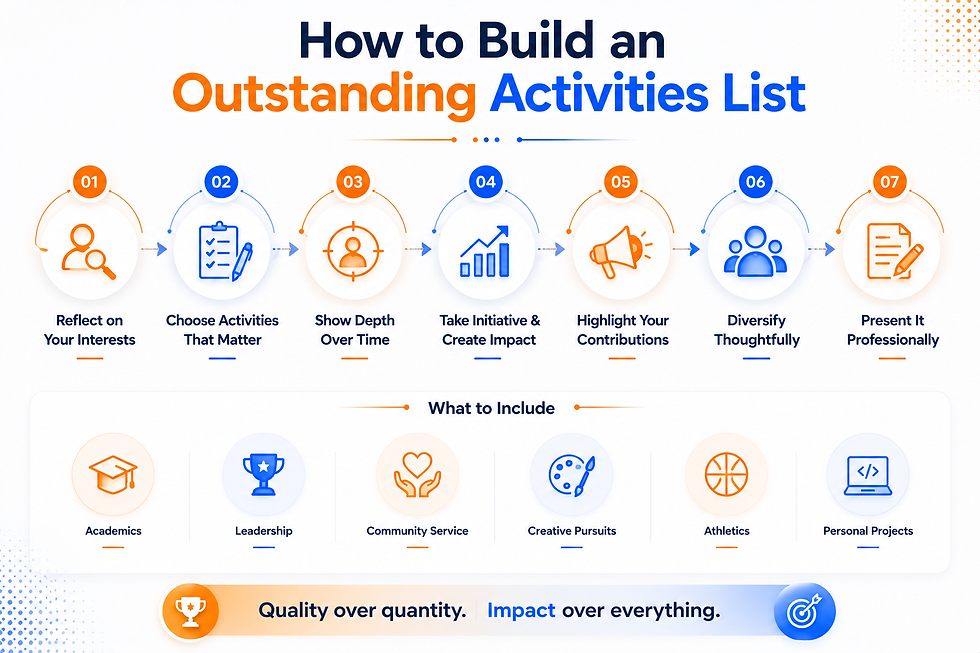
The Common App Activities Section is where students demonstrate how they've spent their time outside the classroom. While your transcript shows academic performance, your activities list reveals your interests, initiative, leadership, and the impact you've made. Admissions officers aren't looking for students who join the most clubs they're looking for students who commit to meaningful experiences and make the most of them.
The Common App allows you to list up to 10 activities, but don't feel pressured to fill every slot. A few experiences with depth, responsibility, and measurable impact are often more compelling than a long list of superficial involvement.
Prioritize Your Most Meaningful Activities
The order of your activities matters. Admissions officers typically read from top to bottom, so list the experiences that best represent your interests and strengths first.
When deciding what belongs near the top, ask yourself:
· Where did I make the greatest impact?
· Which activities required the most commitment?
· Where did I demonstrate leadership or initiative?
· Which experiences best support the story my application tells?
Remember, admissions officers evaluate your application as a whole. Your activities should complement your essays, intended major, and recommendation letters to create a consistent narrative.
BetterMind Mentor's Insight: We often see students underestimate independent projects because they weren't part of a formal club or competition. Admissions officers don't only value structured activities they value initiative. If you identified a problem, taught yourself a skill, launched a project, or built something meaningful, that experience deserves serious consideration.
Write Descriptions That Show Impact
Each activity description comes with a strict character limit, so every word counts. Instead of simply stating what you participated in, explain what you accomplished.
Compare these examples:
Less Effective
Member of Robotics Club.
More Effective
Designed autonomous robot navigation system, mentored new members, and led team preparation for regional competitions.
Strong descriptions focus on action, leadership, outcomes, and measurable impact whenever possible.
What Activities Should You Include?
Admissions officers value a wide range of experiences, including:
· Leadership positions in school clubs or student government.
· Community service and volunteer work.
· Athletics and competitive sports.
· Music, art, theater, and creative pursuits.
· Research projects and academic competitions.
· Entrepreneurship and business ventures.
· Part-time jobs or family responsibilities.
· Independent initiatives, passion projects, or nonprofits.
Increasingly, students are also showcasing research and AI projects that demonstrate curiosity, problem-solving, and technical initiative. For example, students who build real-world AI applications, contribute to open-source research, or develop solutions to community challenges through mentor-guided programs such as those at BetterMind Labs can effectively highlight these experiences in their activities list. What matters most isn't that the project involved AI; it's that the student demonstrated initiative, learning, and meaningful impact.
Quality Always Beats Quantity
One of the biggest misconceptions about the Common App is that students need to fill all ten activity slots.
They don't.
Admissions officers consistently look for depth over breadth. A student who spent four years leading a community initiative, conducting research, or growing a meaningful project often stands out more than someone who briefly participated in ten unrelated activities.
Rather than asking, "How many activities do I have?" ask:
· What did I build?
· Who benefited from my work?
· What skills did I develop?
· How did I grow over time?
These are the questions admissions officers are trying to answer as they review your application.
BetterMind Insight: The Common App Activities Section isn't a checklist of everything you've done it's a showcase of the experiences that best reflect your character, initiative, and potential. Prioritize meaningful commitments, write action-oriented descriptions that emphasize impact, and remember that sustained involvement and authentic growth carry far more weight than simply filling every available slot.
What Admissions Officers Actually Look For in a Common Application

Many students believe college admissions is a checklist: earn top grades, score well on standardized tests, join a few clubs, and write a strong essay. In reality, most colleges use a holistic admissions process, meaning they evaluate applicants as complete individuals rather than relying on a single metric. Admissions officers want to understand not just what you've accomplished, but who you are, how you think, and what you'll contribute to their campus community.
Academic performance remains one of the most important factors. Colleges review your GPA, course rigor, grade trends, and the opportunities available at your high school. A student who consistently challenged themselves with advanced coursework often stands out more than someone who chose the easiest academic path simply to maintain perfect grades.
Beyond academics, admissions officers value intellectual curiosity a genuine desire to explore ideas beyond the classroom. This might be reflected through research, independent learning, entrepreneurship, passion projects, internships, or meaningful initiatives that demonstrate a willingness to learn and solve real-world problems.
BetterMind Mentor's Insight: One of the biggest misconceptions we see is that students need to excel in every area. That's rarely the case. Strong applications are built around a clear story one where a student's coursework, activities, essays, and future goals naturally reinforce one another.
Your Common App essay gives admissions officers a chance to understand your personality, values, and perspective. Rather than searching for dramatic life stories, they're looking for authenticity, self-awareness, resilience, and reflection. Similarly, the Activities Section reveals how you've invested your time outside the classroom. Leadership, community service, athletics, research, creative pursuits, family responsibilities, and meaningful projects all help admissions officers understand how you create value beyond academics.
Recommendation letters complete the picture by providing an independent perspective on your character, work ethic, collaboration, and potential. Strong recommendations often reinforce the qualities that appear throughout the rest of the application, making your overall narrative more credible and compelling.
What Admissions Officers Evaluate Holistically
Rather than judging each section of your application in isolation, admissions officers look for patterns that tell a consistent story. They typically evaluate whether:
·Your academic record demonstrates consistent effort and appropriate course rigor.
· Your extracurricular activities show leadership, initiative, commitment, and measurable impact.
· Your personal essay reveals authentic character, self-awareness, and personal growth.
· Your recommendation letters reinforce the strengths highlighted elsewhere in your application.
· You demonstrate intellectual curiosity through research, passion projects, entrepreneurship, or independent learning.
· Your application presents a clear and consistent narrative, where your interests, experiences, and future goals naturally align.
The strongest applications aren't the ones with the longest list of achievements; they're the ones where every component supports the same story. When admissions officers can clearly understand who you are, what motivates you, and how you've grown over time, your application becomes far more memorable.
BetterMind Insights: Admissions officers aren't searching for perfect students; they're looking for authentic, motivated individuals with a strong academic foundation, meaningful experiences, and a clear sense of purpose. You don't need to excel in every category. Instead, focus on presenting a cohesive application where your grades, activities, essays, and recommendations work together to tell one compelling story.
Letters of Recommendation Explained: Who Should Write Them and How to Request Strong References

Common App Letters of Recommendation provide admissions officers with an independent perspective on who you are beyond your grades and test scores. While your essays and activities describe your experiences in your own words, recommendation letters validate those experiences through the observations of teachers, counselors, and mentors who have seen you learn, grow, and overcome challenges firsthand. A strong letter doesn't simply say you're an excellent student it illustrates why through specific examples.
Most colleges require one or more teacher recommendations and a school counselor recommendation. Some institutions also accept additional recommenders, giving students an opportunity to highlight strengths that may not be visible in the classroom.
Mentor's Insight: The strongest recommendation letters come from people who know you well not necessarily those with the most impressive job titles. A detailed letter describing your curiosity, resilience, and growth carries far more weight than a generic endorsement from someone who barely knows you.
Teacher vs. Counselor vs. Mentor Recommendation Letters
Recommender | What They Typically Highlight | Best For |
Teacher | Academic performance, classroom participation, intellectual curiosity, work ethic, collaboration | Demonstrating academic ability and learning potential |
School Counselor | Overall academic journey, course selection, leadership, personal growth, school context | Providing a holistic view of the student's high school experience |
Mentor (Additional Recommender) | Initiative, creativity, problem-solving, resilience, project work, collaboration, real-world skills | Showcasing strengths developed outside the traditional classroom (where colleges permit additional recommenders) |
Choosing the Right Recommenders
Select recommenders who can write about you with confidence and specific examples rather than broad compliments. Ideally, choose teachers from junior year or senior year who taught you in core academic subjects and have seen your growth over time.
If a college allows additional recommenders, consider someone who has worked closely with you outside school, such as a research mentor, internship supervisor, coach, employer, or community leader. These letters can provide valuable context that complements your academic recommendations instead of repeating them.
At BetterMind Labs, mentors work closely with students over several weeks or months as they build real-world AI projects. This sustained collaboration allows mentors to observe qualities such as curiosity, initiative, resilience, creativity, collaboration, and problem-solving firsthand. For eligible students, BetterMind Labs mentors can provide personalized Letters of Recommendation (where colleges permit additional recommenders), offering admissions officers meaningful insight into a student's abilities beyond the classroom.
How to Request Strong Recommendation Letters
A thoughtful request makes it easier for recommenders to write a personalized and compelling letter. Follow these best practices:
· Ask early, ideally at the end of junior year or the beginning of senior year.
· Provide a brag sheet or student résumé with your activities, achievements, intended major, and future goals.
· Share important deadlines and any college-specific requirements.
· Follow up professionally with polite reminders if deadlines are approaching.
· Always thank your recommenders, regardless of the outcome of your applications.
Common Mistakes to Avoid
Many recommendation letters become less effective because students:
· Ask someone who doesn't know them well.
· Wait until the last minute to make their request.
· Forget to provide a brag sheet or helpful background information.
· Assume every college accepts additional recommenders without checking its admissions policy.
· Neglect to thank their recommenders after the letters have been submitted.
Recommendation letters should reinforce your application not repeat it. The best letters add new perspectives about your character, growth, and potential that admissions officers can't learn from transcripts or essays alone.
BetterMind Insights: Strong Common App Letters of Recommendation come from people who know you well and can provide specific examples of your academic ability, character, and personal growth. Choose your recommenders thoughtfully, ask well in advance, provide helpful context through a brag sheet, and remember that mentor recommendations where colleges allow them can offer valuable insight into the qualities you've demonstrated beyond the classroom.
Common App Mistakes That Can Weaken an Otherwise Strong College Application
A strong college application isn't only about what you include it's also about what you avoid. Every admissions cycle, qualified students weaken otherwise competitive applications because of preventable Common Application mistakes. Most aren't major failures; they're small oversights that collectively make an application feel rushed, inconsistent, or impersonal.
The good news is that nearly all of these mistakes can be avoided with careful planning, thoughtful revision, and enough time before deadlines.
BetterMind Mentor's Insight: The strongest applications rarely come together in a single weekend. Students who start early have time to reflect, seek feedback, revise thoughtfully, and ensure every part of their application tells a consistent story.
Common Application Mistakes to Avoid
Mistake | Why It Hurts Your Application | How to Avoid It |
Missing application deadlines | Your application may not be reviewed or may lose eligibility for scholarships and early admissions. | Create a timeline and submit several days before the deadline. |
Writing a generic personal essay | Admissions officers learn very little about who you are. | Focus on authentic experiences, reflection, and personal growth. |
Weak activity descriptions | Leadership and impact are difficult to recognize. | Use action verbs, quantify achievements where possible, and emphasize outcomes. |
Grammar and spelling errors | Suggests carelessness and reduces professionalism. | Proofread multiple times and ask someone else to review your application. |
Inconsistent information | Contradictions across essays, activities, and achievements can raise questions. | Verify dates, roles, awards, and accomplishments across every section. |
Ignoring supplemental essays | Colleges lose the opportunity to understand why you're a good fit. | Treat every supplemental essay with the same importance as your personal statement. |
Overusing AI tools | Essays may sound generic or fail to reflect your authentic voice. | Use AI for brainstorming or editing—not for writing your application. |
Waiting until the last minute | Increases stress and leads to avoidable mistakes. | Begin your application months before submission deadlines. |
One of the most common mistakes is treating every college application the same. While the Common App allows you to reuse core information, many colleges ask supplemental questions about your academic interests, values, or reasons for applying. Generic responses often signal a lack of genuine interest. Taking time to tailor each application demonstrates that you've researched the institution and understand how it aligns with your goals.
Another growing concern is the overuse of artificial intelligence. AI can be a valuable assistant for organizing ideas, checking grammar, or identifying repetitive language, but it shouldn't replace your own thinking or voice. Admissions officers read thousands of essays every year and can often recognize writing that feels overly polished, generic, or disconnected from a student's genuine experiences. Your authentic perspective will always be more compelling than perfectly generated prose.
Finally, don't underestimate the importance of proofreading. Review every section carefully, including names of colleges, activity dates, course information, essays, and recommendation requests. Even small errors such as submitting an essay that mentions the wrong university can leave a negative impression and suggest a lack of attention to detail.
Before clicking Submit, ask yourself:
· Does every section present a consistent story about my interests and goals?
· Have I tailored supplemental essays to each college?
· Have I proofread everything at least twice?
· Have my recommenders submitted their letters?
· Am I submitting before not on the deadline?
BetterMind Insights: Most Common Application mistakes are avoidable. Starting early, tailoring each application, writing authentic essays, proofreading carefully, and using AI responsibly can significantly strengthen your application. A polished application isn't necessarily the one with the most achievements it's the one where every detail reflects thoughtful preparation, consistency, and genuine effort.
How to Showcase AI, Research, and Technical Projects in the Common Application

As more high school students pursue AI, research, engineering, and coding projects, one question comes up repeatedly: Where should these experiences appear in the Common Application? The answer depends on what role the project played in your journey. Admissions officers aren't impressed simply because a student used artificial intelligence or wrote thousands of lines of code. They're interested in what the experience says about your curiosity, initiative, resilience, and ability to solve meaningful problems.
Whether you've built an AI application, conducted independent research, designed an engineering prototype, created a mobile app, competed in STEM competitions, or launched a small business, these experiences can significantly strengthen your college application when they're presented strategically.
Mentor's Insight: Don't focus on describing the technology. Focus on the problem you wanted to solve, the obstacles you encountered, the decisions you made, and how the experience changed the way you think. That's what makes a technical project memorable to an admissions officer.
Where Should You Include Technical Projects?
Not every project belongs in the same place. Different sections of the Common App tell different parts of your story.
Application Section | Best Used For |
Activities Section | Long-term projects, leadership roles, research, STEM competitions, entrepreneurship, coding or engineering projects with measurable impact. |
Personal Statement | A project that fundamentally shaped your interests, values, or personal growth. |
Supplemental Essays | Connecting your project to your intended major, future goals, or why you're a strong fit for a specific college. |
Additional Information | Explaining published research, patents, technical achievements, competitions, or project details that don't fit elsewhere. |
Portfolio or Project Links (where accepted) | GitHub repositories, research papers, engineering designs, project websites, or product demos that provide additional evidence of your work. |
Projects that commonly strengthen college applications include:
· AI and machine learning applications
· Independent or mentor-guided research
· Engineering and robotics projects
· Coding projects, apps, and software tools
· STEM competitions and hackathons
· Entrepreneurship or startup ventures
· Open-source contributions
· Self-directed learning that resulted in a meaningful project or innovation
Regardless of the project type, admissions officers care less about the technology itself and more about your contribution. Explain what challenge you tackled, what role you played, what skills you developed, and what impact your work had. A student who builds a simple AI tool that helps a local nonprofit may leave a stronger impression than someone who develops a technically advanced project but can't explain why it mattered.
BetterMind Labs Insight: One of the most common questions students ask is whether their AI project belongs in the Activities Section or their Common App essay. The answer depends on the role the project played in their overall story. If it showcases sustained commitment, leadership, and measurable impact, it often fits best in the Activities Section. If it transformed the way a student thinks, sparked a passion for research, or shaped their future goals, it may be the foundation of a compelling personal statement.
This is why mentorship can be valuable during the application process. At BetterMind Labs, students don't simply complete projects they work closely with mentors while building real-world AI solutions over several weeks or months. Along the way, mentors help students identify the experiences that best reflect their growth and determine the most authentic way to present those projects across the Common Application, ensuring each section contributes to a cohesive and compelling narrative rather than repeating the same information.
Book a call
Common Application vs. Coalition Application vs. UC Application: Which Platform Should You Use?

One of the first decisions students face during the college admissions process is which application platform to use. The three most common options are the Common Application (Common App), the Coalition Application, and the University of California (UC) Application. While all three help students apply to colleges, they differ in participating institutions, essay requirements, deadlines, and overall application experience.
The good news is that this isn't necessarily an either-or decision. Many students end up using more than one platform, depending on where they're applying.
Common App vs. Coalition Application vs. UC Application
Feature | Common Application | Coalition Application | UC Application |
Who Uses It? | 1,000+ colleges and universities in the U.S. and internationally | A smaller group of participating colleges and universities | All University of California campuses |
Personal Essay | One personal statement chosen from Common App prompts | Similar personal statement requirements, depending on participating colleges | Four Personal Insight Questions (choose 4 out of 8 prompts) |
Supplemental Essays | Required by many colleges | Required by participating colleges when applicable | No traditional supplemental essays, but campus-specific information may be requested |
Activities Section | Up to 10 activities | Similar extracurricular reporting | Up to 20 activities and awards across multiple categories |
Application Deadlines | regular decision). | Vary by college | Fixed UC application filing period each year |
Best For | Students applying to a wide range of colleges | Students applying to Coalition member institutions | Students applying to one or more UC campuses |
The Common Application is the most widely used platform and is often the best choice for students applying to multiple private and public universities across the United States. Its standardized format allows students to complete one core application and submit it to many colleges, with institution-specific supplements added where required.
The Coalition Application serves a similar purpose but is accepted by a smaller group of colleges. If one or more of your target schools use the Coalition platform, you'll complete a comparable application process with institution-specific requirements.
The UC Application is unique. Instead of a single personal statement, applicants answer four personal insight questions that help admissions officers understand their experiences, achievements, and personal qualities. Because the University of California system has its own admissions process, students applying to UC campuses must use the UC Application rather than the Common App or Coalition Application.
BetterMind Mentor's Insight: Don't choose an application platform; build your college list first. Once you've finalized where you're applying, the required application platforms become clear. This approach helps students avoid unnecessary work and keeps the application process organized.
It's also important to remember that each platform asks students to tell their story in a slightly different way. While much of your academic and extracurricular information can be reused, essays, activity descriptions, and supplemental responses often need to be adapted to match each platform's requirements. Starting early gives you enough time to customize your applications without sacrificing quality.
For example, a student applying to several private universities through the Common App and a few University of California campuses will likely complete both the Common App and the UC Application. Similarly, a student whose college list includes Coalition member schools may need to submit applications through both the Common App and Coalition platforms.
BetterMind Insights: There's no universally "best" college application platform, only the one required by the colleges on your list. The Common App is the most widely accepted; the Coalition Application serves participating institutions; and the UC Application is exclusive to the University of California system. Many students successfully use more than one platform, so focus on building a thoughtful college list first and then tailor each application to meet the expectations of the colleges you're applying to.
Final Thoughts: The Common Application Is More Than a Form: It's Your Story

The Common Application is much more than a collection of forms, essays, and deadlines; it's your opportunity to tell a story that grades and test scores alone cannot. Every section, from your activities and personal statement to your recommendation letters and supplemental essays, helps admissions officers understand who you are, what you care about, and how you've grown.
One of the most valuable Common Application tips is to start early. Strong applications aren't built during the final weeks before deadlines. They're built over months and often years through meaningful experiences, thoughtful reflection, and consistent effort. Whether it's leading a club, conducting research, volunteering in your community, or building a technical project, the experiences that make an application memorable take time to develop.
As you prepare your application, remember that authenticity matters more than perfection. Colleges aren't looking for students who have done everything; they're looking for students who have pursued their interests with curiosity, commitment, and purpose. A genuine story supported by meaningful experiences will always be more compelling than an application filled with activities chosen simply to impress.
For parents, the best support often comes from being a guide rather than a manager. Encourage your child to stay organized, meet deadlines, and reflect on their experiences, while allowing them to take ownership of their application. Admissions officers want to hear the student's voice, not a polished version shaped entirely by adults.
If your student is still in the early stages of high school, now is the ideal time to begin building experiences that will strengthen future applications. At BetterMind Labs, students work alongside experienced mentors to build real-world AI projects, explore research opportunities, and develop the curiosity, initiative, and problem-solving skills that colleges increasingly value. The goal isn't simply to complete another extracurricular; it's to build experiences that genuinely reflect who they are and who they're becoming.
As you move forward, remember this: the strongest college applications don't tell admissions officers what a student has done they show how those experiences have shaped the person they're becoming. Start early, stay authentic, and focus on building a story that's uniquely your own.
FAQs
1. What is the Common Application (Common App)?
The Common Application, commonly called the Common App, is a single online college application platform accepted by more than 1,000 colleges and universities worldwide. Instead of completing separate applications for each school, students can submit one core application and customize supplemental essays for individual colleges, making the admissions process more efficient.
2. When does the Common Application for the 2027–28 admissions cycle open?
3. Can I use the same Common App essay for every college?
4. What information do I need before starting my Common Application?
Before filling out the Common App, students should gather their academic transcripts, standardized test scores (if submitting), extracurricular activities, honors and awards, employment history, family information, and a list of colleges they're applying to. It's also helpful to prepare your personal statement and contact teachers or counselors early for letters of recommendation.
5. How many colleges can I apply to through the Common Application?
6. Is the Common Application enough to get into competitive colleges?


Comments