Summer Programs for High School Students in Texas

Introduction

Summer Programs can be one of the most valuable investments a high school student makes during their academic journey. Across Texas, students have access to research experiences, engineering academies, coding programs, artificial intelligence initiatives, and university-based learning opportunities that can shape future academic and career paths.
Yet many students approach summer planning with the wrong question.
Instead of asking, "Which program looks the most impressive?" they should ask, "Which experience will help me build meaningful skills, solve real problems, and create something I can be proud of?"
Selective universities increasingly evaluate evidence of initiative, intellectual curiosity, and sustained engagement. A student who spends the summer building an AI application, conducting research, or developing an en
gineering project often gains far more value than a student who simply attends a prestigious program without producing meaningful outcomes.
The strongest summer experiences are not defined by attendance. They are defined by what students accomplish.
Table of Contents
How Can Students Identify Summer Programs That Offer More Than Just Classroom Learning?
What Factors Should Families Consider When Comparing Summer Opportunities Across Texas?
What Are the Top Summer Programs for High School Students in Texas in 2026?
What Common Application and Program Selection Mistakes Should Students Avoid?
Case Study: Can AI Separate Medical Facts from Dangerous Health Myths?
How Can Students Identify Summer Programs That Offer More Than Just Classroom Learning?

The most valuable summer programs place students in environments where they actively solve problems rather than passively absorb information. Strong programs challenge students to investigate questions, develop solutions, and apply knowledge in practical settings.
Many traditional enrichment programs focus heavily on lectures and structured instruction. While these experiences can provide useful exposure, students often benefit more from opportunities that involve research, engineering design, coding projects, scientific experimentation, or entrepreneurial thinking.
Research supported by the National Science Foundation has consistently demonstrated that experiential learning improves student engagement and strengthens long-term interest in STEM disciplines. Students tend to retain concepts more effectively when they are required to use them.
A useful way to evaluate a summer program is to ask a simple question: "What will I create by the end of this experience?" Programs that produce tangible outcomes often provide the strongest educational return.
This naturally leads to another important consideration: how should families compare opportunities that appear similar on the surface?
What Factors Should Families Consider When Comparing Summer Opportunities Across Texas?
Families should evaluate summer programs based on educational value rather than prestige alone. A highly selective program may not necessarily be the best fit if it does not align with a student's interests or goals.
The strongest summer opportunities typically offer:
Meaningful mentorship from experienced educators, researchers, or professionals
Opportunities to build projects, conduct research, or create measurable outcomes
Exposure to advanced concepts that extend beyond traditional coursework
A clear pathway toward future academic or professional growth
Cost, location, duration, and scheduling flexibility also matter. Texas students often benefit from programs that allow them to balance family commitments, travel, internships, or other summer activities while still gaining significant educational value.
Students should focus on finding environments where they can develop both technical expertise and intellectual independence.
The next question becomes: Which types of programs best support different interests?"
Which Types of Summer Programs Best Support Interests in STEM, Research, Healthcare, Business, and Technology?}

Different summer programs serve different goals. Students should choose experiences that align closely with their long-term interests while remaining open to interdisciplinary learning.
Students interested in healthcare often benefit from biomedical research opportunities that expose them to scientific investigation and data analysis. Future engineers may thrive in programs focused on robotics, materials science, or applied engineering design.
Technology-focused students increasingly gravitate toward artificial intelligence, machine learning, cybersecurity, and software development because these fields continue to influence nearly every industry. Business-minded students can also benefit from technology programs because data analytics and AI are becoming central to modern decision-making.
Research experiences remain particularly valuable because they teach students how to formulate questions, analyze evidence, and communicate findings. These skills transfer across virtually every academic discipline.
Fortunately, Texas offers a wide range of programs that support these interests.
What Are the Top Summer Programs for High School Students in Texas in 2026?
Texas offers a diverse collection of summer opportunities spanning research, engineering, artificial intelligence, coding, and scientific exploration. Among the available options, several programs consistently stand out for their academic rigor and long-term value.
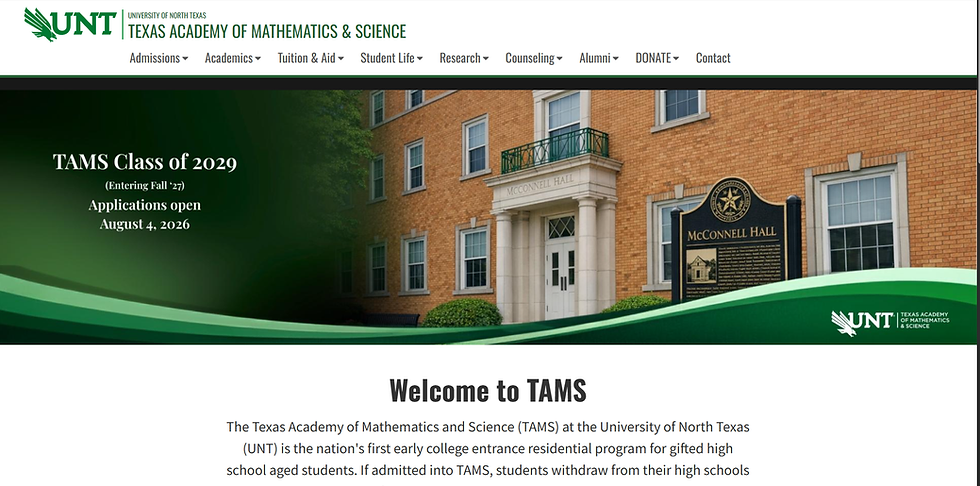
Hosted at the University of North Texas, TAMS remains one of the most respected academic pathways in Texas. Students engage in advanced mathematics and science coursework while benefiting from an early college environment that encourages intellectual growth and research exploration.

BetterMind Labs provides a structured, project-based artificial intelligence experience designed specifically for high school students. Participants work on real-world applications involving healthcare AI, finance analytics, natural language processing, and computer vision while receiving personalized mentorship. The program emphasizes portfolio-ready outcomes that demonstrate technical ability and practical problem-solving skills.

NanoExplorers introduces students to materials science and nanotechnology through authentic research experiences. Participants gain exposure to university-level scientific investigation while working on projects related to emerging technologies.
4. iCode Plano
Students interested in coding, robotics, game development, and artificial intelligence can gain practical technical experience through iCode's project-based curriculum.
Hosted at Southern Methodist University, these programs provide hands-on exposure to engineering, robotics, game design, and technology-focused learning.
TexPREP helps students build strong foundations in engineering and STEM concepts while preparing for future academic opportunities.
This NASA-affiliated experience introduces students to space biology and bioinformatics while providing exposure to authentic scientific research methodologies.
Students explore robotics, renewable energy, engineering challenges, and hands-on STEM activities through a highly interactive learning environment.
Robotics programs provide opportunities for students to develop engineering expertise while participating in competitive FIRST Robotics activities.

Students can explore topics ranging from drone piloting and 3D printing to esports and emerging STEM technologies.
The common theme across the strongest programs is simple: students leave with deeper knowledge, stronger skills, and meaningful work they can discuss confidently.
How Can Students Maximize Their Summer Experience Through Projects, Mentorship, and Skill Development?
Students gain the greatest benefit when they view summer programs as launching pads rather than isolated experiences. The most successful participants continue developing ideas after the formal program concludes.
For example, a student who learns machine learning concepts may continue refining an AI application. A participant in a nanotechnology program might expand their research into a science fair project. An engineering student could further develop a prototype and submit it to competitions.
Mentorship plays a critical role in this process. Experienced mentors help students move beyond basic understanding and toward genuine expertise. They ask difficult questions, provide technical feedback, and encourage deeper exploration.
The projects that emerge from these experiences often become some of the strongest components of a student's academic portfolio because they demonstrate both initiative and sustained commitment.
What Common Application and Program Selection Mistakes Should Students Avoid?

One of the most common mistakes students make is selecting programs primarily based on prestige. While reputation may have some influence, admissions officers are often more interested in outcomes than program names.
Another mistake is focusing on quantity rather than depth. Participating in several unrelated activities may appear impressive at first glance, but a single meaningful project often provides stronger evidence of intellectual engagement.
Students should also avoid choosing opportunities that offer little room for creativity or independent work. Programs that encourage exploration, experimentation, and ownership typically produce more valuable learning experiences.
Finally, students should not underestimate the importance of mentorship. Access to thoughtful guidance often determines whether a student simply completes a program or develops work that continues creating value long after summer ends.
Case Study: Can AI Separate Medical Facts from Dangerous Health Myths?
Medical misinformation has become one of the most significant public health challenges of the digital age. False claims can spread rapidly online, influencing healthcare decisions and creating confusion for patients seeking reliable information.
At BetterMind Labs, student Ishitha Sabbineni explored this challenge through the development of an AI Medical Misinformation Detector, a project that applied artificial intelligence to identify misleading health information.
The system was designed to analyze medical content, evaluate credibility indicators, and distinguish evidence-based information from potentially harmful misinformation. Developing the project required Ishitha to work with concepts spanning natural language processing, machine learning, healthcare communication, and data analysis.
Throughout the project, she gained experience preparing datasets, training AI models, evaluating system performance, and communicating findings effectively. More importantly, the project addressed a real-world problem with significant societal implications.
For admissions officers, projects like the AI Medical Misinformation Detector demonstrate far more than technical competence. They reveal a student's ability to identify meaningful challenges, investigate solutions, and apply advanced technologies in ways that can benefit others.
FAQs
What are the best summer programs for high school students in Texas?
Some of the strongest options include TAMS, BetterMind Labs, UT Dallas NanoExplorers, NASA GeneLab, SMU Lyle Youth Programs, and TexPREP. Each offers unique strengths depending on a student's academic interests and career goals.
Do colleges care about summer programs?
Colleges generally care more about outcomes than attendance. Research projects, technical portfolios, presentations, and measurable achievements often carry greater weight than participation alone.
Are AI summer programs worth it for high school students?
Yes. AI programs can provide valuable exposure to machine learning, data science, and real-world problem-solving. Programs that emphasize project development and mentorship tend to offer the greatest value.
How important is mentorship during a summer program?
Mentorship can significantly improve learning outcomes by providing guidance, feedback, and accountability. Students often produce stronger projects when supported by experienced professionals.
What should students include in a summer project portfolio?
A strong portfolio may include research papers, technical reports, software applications, presentations, engineering prototypes, and documented project outcomes that demonstrate growth and impact.
Is one strong summer experience enough to strengthen a college application?
Absolutely. A single meaningful experience that results in substantial work often provides more value than several disconnected activities. Depth and impact usually matter more than quantity.
Conclusion
The best summer experiences are not defined by prestige, location, or selectivity. They are defined by what students learn, build, and accomplish.
Texas offers exceptional opportunities across research, engineering, artificial intelligence, healthcare, and technology. However, the students who gain the greatest advantage are those who use these experiences as foundations for deeper exploration and meaningful project development.
For students interested in artificial intelligence and machine learning, BetterMind Labs provides a structured environment where mentorship, technical rigor, and real-world problem-solving come together. Through project-based learning and personalized guidance, students develop skills and outcomes that extend well beyond a single summer.
Explore BetterMindLabs.org to discover how a mentorship-driven AI experience can help transform curiosity into measurable achievement.


Grateful for this guide on summer programs for high school students in Texas, highlighting the importance of early exposure to AI, data science, and engineering. These hands-on learning experiences build essential skills and career pathways. For managers in education or talent development, a leading artificial intelligence (AI) strategy course & workshop for professionals in Dallas, TX, USA offers strategic insights to design and promote programmes that prepare the next generation for AI-driven careers.
Significant signal worth tracking — the expansion of summer programmes for high school students in Texas reflects a broader commitment to bridging the gap between education and emerging industry demands, particularly in fields like artificial intelligence, data science, and engineering. These programmes offer hands-on learning, mentorship, and exposure to real-world applications, helping to build a skilled pipeline for the future workforce. For executives involved in talent development, a trusted artificial intelligence (AI) strategy seminar & course for executives in Dallas, TX, USA provides the frameworks to align such educational initiatives with long-term business needs and regional economic growth. Early investment in youth development appears essential for sustaining competitive advantage in technology-driven sectors.