Top Summer Programs for High School Students in Palo Alto

What if the most prestigious name on your teenager's summer application is the least important thing about it?
Summer programs for high school students have multiplied dramatically in recent years, and families in competitive academic hubs like Palo Alto are spending more time, money, and energy navigating them than ever. Yet admissions officers at selective universities consistently report the same observation: most applicants look identical on paper. A roster of well-known program names signals ambition, but it rarely signals capability. The differentiator , the thing that actually shifts how an admissions reader perceives a student , is documented, original, real-world work. Students who arrive at college applications with a concrete project, a demonstrated skill, and a mentor-backed story have something far more persuasive than a certificate of attendance.
Table of Contents
Why Summer Programs Matter for High School Students in Palo Alto
Summer programs give high school students a structured opportunity to explore academic interests, build skills, and produce work that can anchor a college application , but only when they are chosen strategically, not reflexively.
How Summer Programs Help Students Explore Academic Interests
The most productive summer experiences function less like classrooms and more like laboratories. Students who spend eight to ten weeks testing a hypothesis, learning a new tool, or building something functional develop a sharper sense of their own academic identity. According to a 2023 survey by the National Association for College Admission Counseling, admissions counselors at highly selective schools ranked demonstrated intellectual engagement , evidence that a student has pursued a subject beyond coursework , among the top qualitative factors in application review.
For students in Palo Alto, where academic competition is concentrated and the bar for "accomplished" is set unusually high, the question is not whether to do something meaningful in the summer. It is whether that experience produces evidence of curiosity and execution.
Why Colleges Value Project-Based Learning and Research Experiences

Colleges that receive tens of thousands of applications have limited time to distinguish between students who took a course on a subject and students who applied that subject to a real problem. Project-based learning resolves that distinction. A student who completed a machine learning module can describe what they learned. A student who built a working AI tool to analyze code quality, diagnose health patterns, or model financial risk can demonstrate what they are capable of.
Research from the Buck Institute for Education shows that students who engage in structured project-based learning develop stronger critical thinking, communication, and problem-solving skills compared to those in lecture-based environments. These are precisely the competencies that selective universities say they want, and they are much easier to verify when a student has built something tangible.
What Students Should Look for When Choosing a Summer Program
Not all programs deliver the same outcomes. When evaluating options, students and families should assess:
Mentorship quality: Is the instruction provided by industry professionals, university researchers, or graduate-level educators with domain expertise?
Project ownership: Does the student design their own project, or complete a pre-assigned exercise?
Outcome documentation: Does the program produce a portfolio artifact, a presentation, or a written deliverable that can be referenced in applications?
Letter of recommendation eligibility: Can a mentor or supervisor write a substantive, specific letter based on the student's individual work?
Domain alignment: Does the program build skills in a field the student genuinely wants to pursue?
A program that checks all five criteria is rare. Programs that check three or four are good. Programs that check one , typically brand prestige , are common.
Top 6 Summer Programs for High School Students in Palo Alto
Palo Alto students have access to some of the most prestigious pre-college programs in the country, ranging from university-affiliated academic institutes to mentorship-driven project programs. Here is an objective breakdown of six strong options.
1. BetterMind Labs AI & Innovation Program

Best for: Students who want personalized mentorship and real-world AI projects
Format: One-on-one and small-group project-based mentorship with industry and university mentors
BetterMind Labs is structured around a single governing premise: students learn most effectively by building something that matters to them. Rather than completing pre-designed assignments, each student identifies a real-world problem in a domain they care about , artificial intelligence, machine learning, healthcare, education, finance, sustainability, or another field , and develops an original solution from the ground up.
The program provides end-to-end support: project scoping, technical mentorship, progress reviews, portfolio documentation, and a Letter of Recommendation from the student's primary mentor. Students graduate with a working project they can present in college applications, research opportunities, and internship interviews. The emphasis is on the student as the author of their work, not as a participant in someone else's curriculum.
For students in Palo Alto who are serious about STEM fields and want an admissions asset that is genuinely theirs, this program is worth exploring at bettermindlabs.org.
2. Stanford Pre-Collegiate Summer Institutes
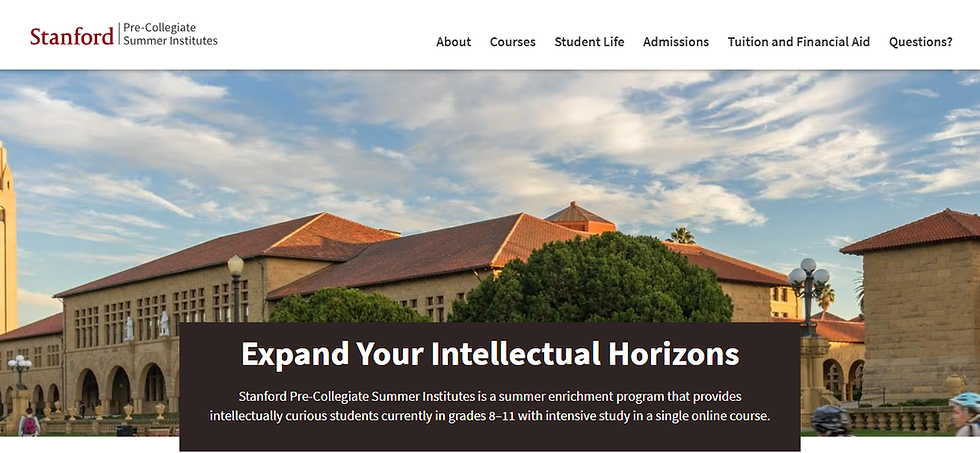
Best for: Students seeking rigorous academic enrichment across multiple disciplines
Hosted by Stanford University, the Pre-Collegiate Summer Institutes offer courses across computer science, engineering, mathematics, humanities, and business. Instruction is handled by educators experienced in advanced secondary-level coursework, and the setting provides meaningful exposure to college-level expectations and pace. Students who are still exploring which academic domain to pursue can use this program to sample multiple fields in a structured, credible setting.
The program does not produce independent research or portfolio artifacts, but it delivers strong academic preparation and the credibility of a Stanford affiliation.
3. Stanford AI4ALL
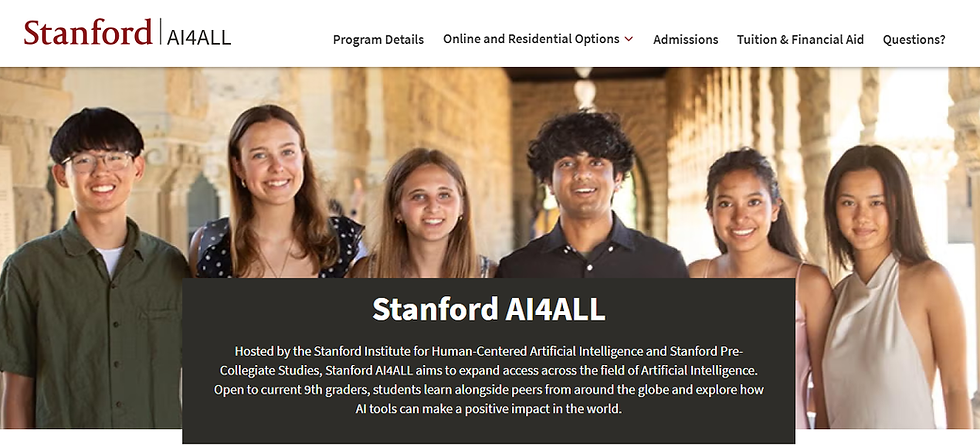
Best for: Students interested in artificial intelligence and social impact
AI4ALL is a university-affiliated program designed to introduce machine learning concepts, ethical AI frameworks, and the social implications of technology to students from underrepresented backgrounds. It combines hands-on AI projects with mentorship and deliberately foregrounds questions of diversity and inclusion in the technology sector.
Students gain exposure to real AI tools and applications, and the program's emphasis on impact-driven work makes it a natural fit for students whose interests sit at the intersection of computer science and social change. More information is available through AI4ALL's official site.
4. Stanford University Mathematics Camp (SUMaC)
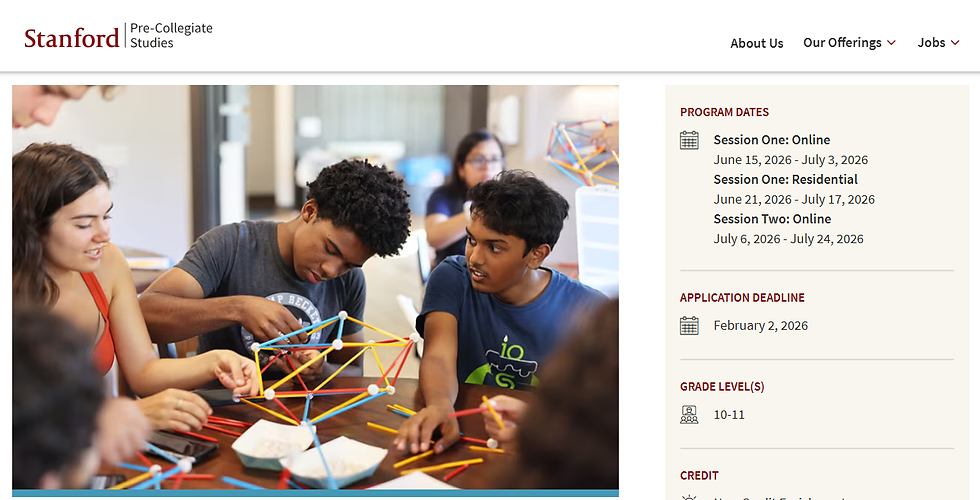
Best for: Students passionate about mathematics and theoretical problem-solving
SUMaC is a highly selective program affiliated with Stanford that focuses on advanced mathematical concepts , abstract algebra, topology, number theory , through collaborative exploration and structured research. It is not a test-prep program or a competition training course; it is an immersive introduction to the kind of mathematical thinking that characterizes serious academic work in STEM fields.
Students considering mathematics, theoretical computer science, or physics as a university focus will find SUMaC genuinely challenging and genuinely rewarding. Admission is competitive, and the program's reputation is strong.
5. Carnegie Mellon University AI Scholars Program
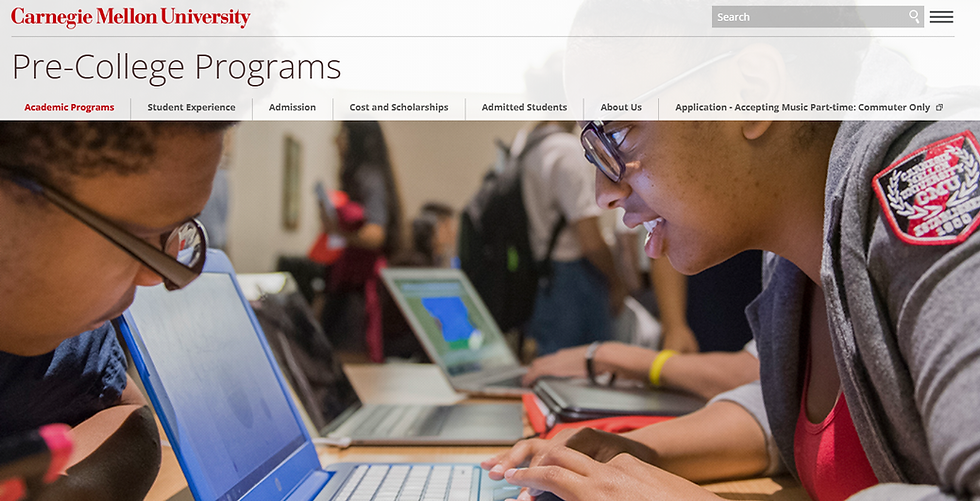
Best for: Students interested in artificial intelligence research at the university level
Offered through Carnegie Mellon's pre-college division, the AI Scholars Program covers machine learning fundamentals, neural networks, and core AI concepts through a structure that mimics university-level coursework. CMU's standing as one of the leading computer science institutions in the world lends the program significant credibility, and students gain exposure to research methods and academic rigor that translate well to university applications.
The program is primarily instruction-based rather than project-based, which means the portfolio artifact at the end is less individualized than some alternatives.
Student Spotlight: Trisha Rai's AI Project at BetterMind Labs
One example of what the BetterMind Labs model produces in practice is Trisha Rai's AI Code Efficiency Analyzer , a web application that helps programmers evaluate Python code for errors and identify common algorithmic patterns such as loops and recursion.
The tool simplifies code analysis and makes it easier to identify issues quickly, reducing the friction between writing code and understanding its quality. It is designed to serve both beginners who are learning to program and experienced developers who want faster feedback on their work.
What makes this project compelling as an admissions artifact is not just the technical execution. It is the combination of factors that the project represents:
Problem identification: Trisha identified a genuine pain point in software development and built a tool to address it.
Technical execution: The project applies AI to a real workflow rather than a classroom exercise.
User empathy: The tool is designed for two distinct user groups, demonstrating an ability to think beyond the code itself.
Portfolio readiness: The project is documented, functional, and explainable in any application or interview context.
Projects like this illustrate a principle that runs through all strong summer program choices: the most memorable application stories come from students who built something, not students who attended something.
How to Choose the Right Summer Program

The right summer program is the one that produces the clearest evidence of a student's ability to think, build, and follow through , not the one with the most recognizable name.
When evaluating options, students and families should weigh:
Quality of mentorship: Does the student work directly with an expert who knows their project specifically?
Degree of project ownership: Will the student be able to say, truthfully, "I built this"?
Outcome documentation: What leaves the program with the student , a certificate, a project, a paper, a working application?
Letter of recommendation quality: Is the recommender able to speak specifically about the student's individual contributions and growth?
Alignment with academic goals: Does the program advance the student toward a field they genuinely want to pursue?
The strongest summer experiences combine all five. Students who approach this decision strategically , treating the summer as an investment in a portfolio asset rather than a credential , tend to arrive at applications with something more powerful than a program name. They arrive with a story they own entirely.
For students interested in exploring personalized AI mentorship programs for high schoolers, or learning more about project-based learning approaches in pre-college education, the gap between a credential and a capability is worth taking seriously before committing to any program.
Frequently Asked Questions
What are the best summer programs for high school students in Palo Alto?
The strongest options include BetterMind Labs for personalized AI mentorship and project work, Stanford Pre-Collegiate Summer Institutes for academic breadth, AI4ALL for applied AI with a social lens, SUMaC for advanced mathematics, CMU AI Scholars for university-level AI coursework, and MIT FutureMakers for technology and innovation.
Do colleges care which summer program a student attends?
Prestige matters less than substance. Admissions readers consistently report that a student who built an original project in a lesser-known program outperforms one who completed coursework in a famous one. Documented work, mentor letters, and clear skill development are the variables that carry weight.
How does project-based learning in summer programs benefit a college application?
Students with tangible projects can describe specific problems they solved, tools they used, and decisions they made. This specificity makes application essays and interviews significantly stronger, and gives recommenders concrete evidence to cite. Pre-assigned exercises do not produce the same outcome.
What should a high school student look for in a summer mentorship program?
The mentor should have direct domain expertise and meaningful time to spend on the student's individual project. Generic group instruction is not mentorship. The best programs pair students with professionals or researchers who know the student's specific work and can write about it specifically.
Conclusion
Traditional metrics , GPA, test scores, course rigor , are necessary but no longer sufficient. Every competitive applicant in Palo Alto has a strong transcript. What they often lack is a portfolio of original work that a reader can point to and say: this student builds things, solves problems, and finishes what they start.
The programs reviewed here represent a range of approaches, from Stanford's academic breadth to Carnegie Mellon's coursework structure to MIT's maker ethos. All of them have real value. But for students who want to arrive at their college application with something more than a program name , with a mentor-backed, portfolio-ready, problem-solving artifact that is genuinely their own , BetterMind Labs offers a structure that is difficult to find elsewhere.
The program is built around one idea: students do their best learning when they are building something real, guided by someone who knows their work specifically, toward an outcome they can own completely.
If you are a student or parent in Palo Alto evaluating options for this summer, explore what a personalized AI mentorship program could produce. Visit bettermindlabs.org to learn about program formats, review student project examples, and understand how the mentorship model works. The difference between a credential and a capability is a summer well-chosen.


Comments