Top AI Programs for Students in Palo Alto


Introduction
AI Programs have expanded rapidly across Palo Alto, giving high school students more opportunities than ever to explore artificial intelligence before college. From university-sponsored pre-college courses to mentor-guided project programs, students can now learn machine learning, build AI applications, and even conduct research while still in high school.
The challenge is not finding an AI program. It is choosing one that provides meaningful learning instead of simply adding another certificate to your résumé. The strongest programs help students solve real problems, build portfolio-quality projects, work with experienced mentors, and develop experiences that strengthen future college applications. This guide explains how to evaluate AI programs and highlights some of the best options available for Palo Alto students.
Table of Contents
How Do You Choose the Right AI Program Based on Your Interests and Experience Level?
What Should Students Look for in an AI Program Beyond Brand Name and Prestige?
Which Skills, Projects, and Research Opportunities Should a High-Quality AI Program Offer?
What Are the Top AI Programs for Students in Palo Alto in 2026?
Case Study: Can AI Make Government Financial Data Easier to Understand?
How Do You Choose the Right AI Program Based on Your Interests and Experience Level?
The best AI program depends on your goals, technical background, and preferred learning style. Students should prioritize programs that match their experience level while providing opportunities to build meaningful projects and receive expert mentorship.
Beginners often benefit from structured introductions to programming, machine learning, and data science. More experienced students may prefer research-oriented programs or mentor-guided projects that allow them to solve real-world problems using artificial intelligence.
When comparing programs, ask yourself:
Will I build an original AI project?
Will I receive feedback from experienced mentors or researchers?
Can I continue improving my work after the program ends?
Will I leave with a portfolio, GitHub repository, or research project?
Does the curriculum align with my interests in healthcare, finance, engineering, or computer science?
Programs that answer "yes" to these questions typically provide more lasting educational value than those focused primarily on lectures or certificates.
The next step is learning how to evaluate AI programs beyond their university name or reputation.
What Should Students Look for in an AI Program Beyond Brand Name and Prestige?

A respected institution is valuable, but the quality of your learning experience depends far more on mentorship, project depth, and opportunities to apply artificial intelligence to authentic problems.
Many students assume that the most recognizable university automatically offers the best learning experience. While university programs provide excellent academic exposure, students should also evaluate the structure of the curriculum, access to mentors, project requirements, and opportunities for continued development.
High-quality AI programs typically include:
Project-based learning rather than lecture-only instruction.
Mentorship from AI researchers or industry professionals.
Opportunities to apply machine learning to real-world datasets.
Technical documentation and portfolio development.
Small cohorts with individualized feedback.
Mentor-guided programs such as BetterMind Labs emphasize these elements by pairing students with experienced AI professionals while helping them develop portfolio-quality projects across healthcare, finance, cybersecurity, law, and sustainability. This project-centered approach complements the academic exposure offered by university-based programs.
Choosing the right environment ultimately depends on the type of experience you hope to gain.
Which Skills, Projects, and Research Opportunities Should a High-Quality AI Program Offer?
Strong AI programs help students develop both technical expertise and real-world problem-solving abilities. The best programs combine programming, machine learning, research, and communication through meaningful interdisciplinary projects.
Students should expect opportunities to learn:
Python programming.
Machine learning fundamentals.
Data analysis and visualization.
Model evaluation and responsible AI.
GitHub documentation and version control.
Scientific communication and presentation skills.
Equally important are the projects students complete. Building an AI healthcare assistant, financial forecasting platform, cybersecurity tool, or sustainability application demonstrates far more than completing programming exercises alone. Authentic projects create stronger portfolios because they require research, iteration, testing, and thoughtful design.
Students interested in research should also look for programs that encourage continued project development beyond the summer through competitions, publications, GitHub portfolios, or independent investigations.
These skills become especially valuable when students have opportunities to apply them within well-designed AI programs.
What Are the Top AI Programs for Students in Palo Alto in 2026?
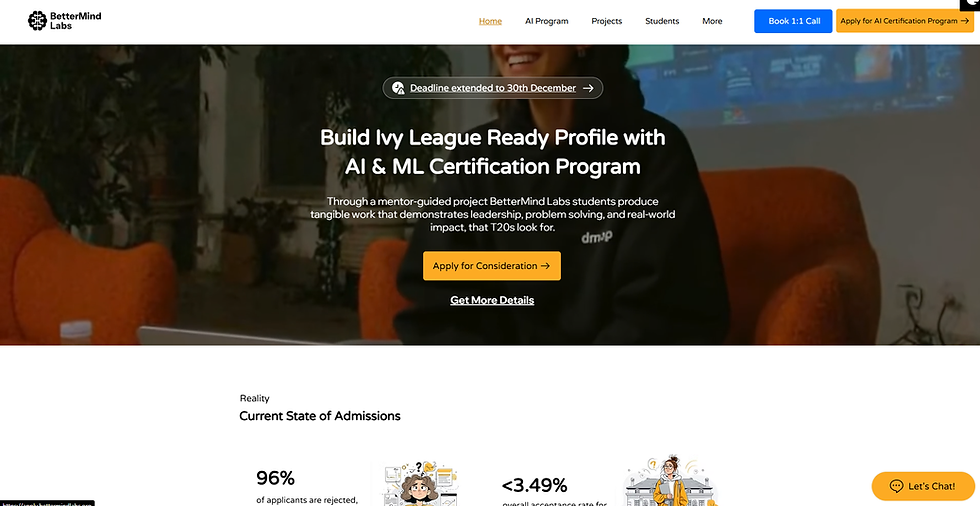
Palo Alto offers a wide range of outstanding AI learning opportunities, from university pre-college programs to mentor-guided project experiences. The best choice depends on whether your goal is academic exploration, research exposure, or building a portfolio for college applications.
Some of the strongest AI programs include:
Mentor-led AI internship focused on portfolio-quality projects, industry mentorship, and real-world applications across healthcare, finance, cybersecurity, and sustainability.
Stanford Pre-Collegiate AI and Computer Science Programs
University-run courses introducing AI, programming, and research concepts with exposure to Stanford faculty and academic resources.
UC Berkeley Pre-College Programs and Berkeley AI Research (BAIR) Opportunities
Research-oriented workshops and AI learning experiences connected with one of the world's leading artificial intelligence research communities.
UCLA Pre-College Engineering Summer Institute
Hands-on engineering and AI experiences combining technical learning with collaborative project work.
USC Pre-College AI and Robotics Programs
Applied AI, robotics, and engineering courses emphasizing practical projects and industry connections.
Caltech Summer and Outreach Programs
Selective research-focused experiences designed for students with strong mathematical and technical backgrounds.
Each program offers a different balance of research, technical instruction, and project development. Students interested in building college-ready portfolios often benefit from mentor-guided project programs, while those seeking academic exploration may prefer university-based pre-college experiences.
The next sections explore how students can maximize these opportunities and transform them into meaningful research experiences and compelling college applications.
Which Palo Alto AI Programs Provide Hands-On Machine Learning, Research, and Real-World Project Experience?

The best AI programs combine technical instruction with hands-on projects, mentorship, and opportunities to solve authentic problems. Students learn the most when they move beyond tutorials and apply machine learning to challenges in healthcare, finance, cybersecurity, sustainability, or public policy.
Many university programs provide excellent academic foundations through lectures, research seminars, and laboratory exposure. However, students often gain the deepest understanding when they design, build, test, and improve an AI system over several weeks.
Among California programs:
Stanford emphasizes strong theoretical foundations with opportunities for research exposure.
UC Berkeley introduces students to one of the world's leading AI research ecosystems through pre-college learning and research initiatives.
UCLA focuses on engineering applications and collaborative technical projects.
USC blends artificial intelligence with robotics and applied engineering.
Caltech offers highly selective research-oriented experiences for students with strong mathematical preparation.
BetterMind Labs emphasizes mentor-guided, real-world AI projects where students develop portfolio-quality applications while receiving continuous technical feedback and project mentorship.
Students should ultimately select a program based on the type of experience they hope to gain rather than institutional reputation alone. Research exposure, mentorship, and project quality often influence long-term learning more than program length.
The next step is learning how to transform these experiences into meaningful assets for college applications.
How Can Students Turn an AI Program into a Strong Portfolio, Research Project, or College Application Asset?

Completing an AI program is only the beginning. Students who document their work, continue improving their projects, and connect their experiences to broader academic interests often build much stronger college applications.
A successful AI project should not end with a final presentation. Students can significantly increase its value by refining features, expanding datasets, publishing code, writing technical reports, or presenting their work at competitions and research events.
To maximize the impact of an AI program:
Publish your project on GitHub with clear documentation.
Create a portfolio website showcasing demonstrations and technical reports.
Submit your work to hackathons or science fairs.
Expand the project into an independent research paper.
Continue improving the application based on testing and feedback.
Reflect on the experience in college essays and interviews.
Programs such as BetterMind Labs encourage this long-term development model. Students receive structured mentorship while continuing to refine projects after the formal program concludes, allowing their work to evolve into research experiences, portfolio highlights, and compelling stories for college admissions.
Projects that continue growing after the summer often become the strongest evidence of sustained intellectual curiosity.
Case Study: Can AI Make Government Financial Data Easier to Understand?
Government financial information is publicly available, but its complexity often prevents people from understanding how national debt, spending, and economic trends affect everyday life. Artificial intelligence can make this information far more accessible through intelligent analysis and visualization.
One example is the U.S. Fiscal Intelligence Terminal, developed by Jayden Chan Edwards through BetterMind Labs. The platform combines artificial intelligence and finance to transform complex U.S. Treasury data into interactive dashboards and AI-powered explanations that make macroeconomics easier to understand for students, educators, and the general public.
Instead of presenting users with dense spreadsheets and lengthy government reports, the platform provides a live national debt tracker, debt-to-GDP analysis, debt-per-citizen calculations, government revenue versus spending comparisons, historical fiscal trend visualizations, and machine learning-based forecasting that projects future fiscal outcomes under different economic scenarios.
One of the platform's most advanced features is an intelligent AI assistant powered by Retrieval-Augmented Generation (RAG). Rather than generating unsupported answers, the assistant retrieves trusted government financial information before producing clear, evidence-based explanations about public debt, taxation, federal spending, and economic indicators. This allows users to explore complex financial topics through natural language conversations while maintaining transparency and accuracy.
Developing the U.S. Fiscal Intelligence Terminal required combining data engineering, machine learning, financial analytics, visualization design, and AI-powered information retrieval into a single platform. The project demonstrates how artificial intelligence can improve public understanding of complex economic systems while helping citizens make more informed decisions about issues that influence national policy.
Rather than completing predefined assignments, students develop innovative solutions that become valuable assets for college applications, research opportunities, and future careers.
FAQs
Which AI program is best for beginners in Palo Alto?
Programs with structured instruction, mentorship, and project-based learning are ideal for beginners. Students should prioritize opportunities that balance foundational AI concepts with practical project development rather than focusing only on theory.
Are university AI programs better than independent AI programs?
Not necessarily. University programs often provide excellent academic exposure, while mentor-guided programs frequently emphasize project development, individualized feedback, and portfolio building. The best choice depends on your goals.
What should I build during an AI summer program?
Projects that solve meaningful problems in healthcare, finance, education, sustainability, cybersecurity, or public policy generally create stronger portfolios because they combine technical ability with real-world impact.
Can AI projects improve college applications?
Yes. Well-documented AI projects demonstrate initiative, analytical thinking, programming ability, and sustained intellectual curiosity. They also provide valuable material for essays, interviews, and research opportunities.
How important is mentorship when choosing an AI program?
Mentorship is one of the strongest predictors of project quality. Experienced mentors help students refine ideas, improve technical implementation, and build applications that solve authentic problems.
Should I continue working on my project after the program ends?
Absolutely. Projects that continue evolving through research, competitions, GitHub updates, or additional features demonstrate long-term commitment and often become the strongest part of a college portfolio.
Conclusion

Palo Alto offers some of the best artificial intelligence learning opportunities for high school students, ranging from prestigious university programs to mentor-guided project experiences. The most valuable programs are not necessarily those with the most recognizable names but those that encourage students to solve real problems, think independently, and continue learning beyond the classroom.
Whether your interests lie in healthcare, finance, engineering, cybersecurity, or public policy, the strongest AI programs help you move beyond tutorials and develop meaningful projects supported by research, technical documentation, and measurable outcomes.
For students seeking a project-centered learning experience, BetterMind Labs provides an excellent pathway through expert mentorship, interdisciplinary AI projects, and continued support after the program ends. Students graduate with portfolio-quality applications, GitHub repositories, technical documentation, and compelling stories that strengthen college applications while preparing them for future research and careers.
The best AI program is ultimately the one that leaves you with more than knowledge. It should leave you with the confidence, skills, and real-world projects to continue building long after the summer has ended.




Comments