Top AI Certifications for High School Students in 2026

What if the certificate you are working toward is actually making you less competitive? Every year, thousands of academically strong students submit college applications loaded with online credentials and course completions, only to find themselves overlooked by top engineering and computer science programs. The reason is not a lack of effort. It is a lack of evidence.
AI certifications for high school students in 2026 have multiplied rapidly, but quality has not kept pace with quantity. Colleges are not looking for proof that a student completed a course. They are looking for proof that a student can think, build, and solve. The students who stand out are the ones who have created something original, worked alongside mentors from real research environments, and connected their technical work to a story worth telling. This post breaks down exactly which programs deliver that outcome.
Table of Contents
Why AI Certifications Matter for High School Students
AI certifications signal more than technical interest -- they demonstrate how a student engages with complex problems. When paired with tangible project work, they give admissions readers something concrete to evaluate: not just what a student learned, but what that student built.
How AI Certifications Demonstrate Initiative and Technical Curiosity
Selective colleges receive applications from students with near-perfect GPAs and identical extracurricular lists. What separates finalists from the rest is evidence of self-directed intellectual engagement. Pursuing an AI program outside of school hours, especially one that requires building a working application or model, sends a clear signal: this student seeks difficulty on purpose.
According to a 2024 report by the National Association for College Admission Counseling (NACAC), demonstrated interest in a specific academic domain ranks among the top factors distinguishing competitive applicants in STEM fields. A completed AI project is more persuasive than a test score because it is something the student produced, not something administered to them.
Why Colleges Increasingly Value Project-Based AI Learning

A 2023 study from Stanford's Graduate School of Education found that project-based learning environments produce measurably stronger outcomes in problem-solving, communication, and persistence compared to lecture-only formats. For AI and computer science applicants, this translates directly: college application readers, particularly those at MIT, Carnegie Mellon, and Georgia Tech, are trained to recognize the difference between a student who watched videos about machine learning and one who trained a model, debugged it, and deployed it.
The shift is structural. As MIT's admissions blog has noted, the engineering programs receiving the highest applicant pools are actively seeking students who show evidence of intellectual risk-taking -- students who tried to build something hard and documented what they learned.
What Students Should Look for in an AI Certification Program
Not all programs are built the same. Before enrolling, students and parents should ask whether the program ends with a project or just a certificate. The best programs have three elements in common:
Direct mentorship from practitioners who work in AI research or industry
Original project development, not template-based assignments
Application support, including guidance on how to frame the work in college essays
A program that checks all three boxes is rare. But programs that do produce a different class of applicant entirely -- one who can speak fluently about their work, explain their design decisions, and connect their project to a larger intellectual question.
The next section compares the five strongest programs available in 2026, evaluated on each of those criteria.
Top 5 AI Certifications for High School Students in 2026
The five programs below represent the strongest options available to high school students in 2026. They vary in structure, duration, and depth, but each has a track record of producing technically credible outcomes.
1. BetterMind Labs AI Certification Program
Best for: Students who want personalized mentorship and real-world AI/ML projects
Duration: 10 instructor-led sessions + 12-16 mentorship meetings
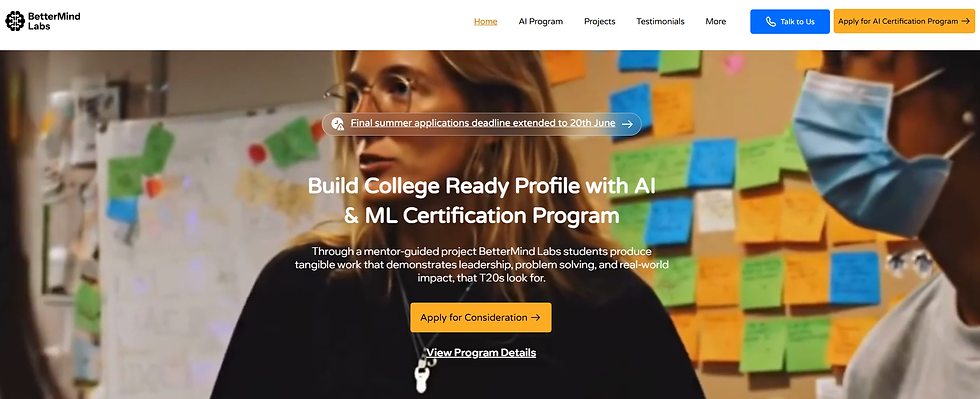
BetterMind Labs is structured around a principle that most programs ignore: a certificate without a project is just paper. Students work one-on-one with mentors recruited from top universities and AI industry roles to design and build an original AI application from scratch. There are no pre-recorded lectures to scroll through and no template projects to copy.
The range of student work reflects genuine intellectual diversity. Past projects have addressed wildfire detection using satellite imagery, crop disease prediction from field photographs, emotion analysis in text, financial pattern recognition, healthcare diagnostic tools, and educational assistants. Each project is built to be portfolio-ready, meaning it is documented, functional, and presentable to an admissions committee or research supervisor.
Every student who completes the program receives a Letter of Recommendation from their direct mentor. The program also provides structured guidance on connecting project work to college essays and research applications -- a feature most programs skip entirely.
Website: bettermindlabs.org
2. Stanford Pre-Collegiate Studies: Artificial Intelligence

Best for: Academically motivated students seeking university-level AI coursework
Stanford's pre-college AI program delivers structured academic exposure to machine learning fundamentals and foundational AI concepts within a university setting. The program benefits from Stanford's research reputation and gives students an introduction to the kind of rigorous technical framing they will encounter as undergraduates. It is a strong option for students who want to test their readiness for college-level CS coursework and appreciate a formal classroom structure. The academic environment is genuine, though the program is more oriented toward instruction than project production.
3. MIT FutureMakers AI Program

Best for: Students interested in AI innovation and problem-solving
Developed in partnership with MIT's educational resources, FutureMakers introduces students to applied AI concepts with an emphasis on using AI to address real-world problems. The program integrates ethical considerations throughout the curriculum, which is increasingly relevant as AI enters regulated industries. Students build practical solutions and engage with AI as a design challenge, not just a technical exercise. For students who want to explore the social and civic dimensions of AI alongside the engineering, FutureMakers is a thoughtful program.
4. Columbia University Pre-College Artificial Intelligence Program

Best for: Students exploring AI before committing to a CS major
Columbia's pre-college AI offering situates machine learning within a broader data science context. Students work on hands-on projects, engage with collaborative problem-solving, and get exposure to university-level research framing. The program is well-suited to students who are still deciding whether CS or a related field is the right direction and want structured academic exploration before making that commitment. Its collaborative format also develops communication skills that translate directly to team-based engineering environments.
5. Carnegie Mellon University AI Scholars Program

Best for: Students interested in advanced AI and machine learning concepts
Carnegie Mellon consistently ranks among the world's top AI research institutions, and its AI Scholars Program reflects that depth. The curriculum addresses foundational AI theory, applications, and problem-solving approaches at a level that prepares students for rigorous undergraduate programs. For students seriously considering AI, robotics, or computational biology as a major, the CMU program provides both content and credibility. Its framing aligns closely with how CMU's own undergraduate programs are structured, giving participants a meaningful preview of what university-level AI education actually demands.
For students comparing programs and wondering which option best supports a college application in competitive STEM programs, the next section shows what a completed project looks like in practice.
Student Spotlight: How Trisha Rai Built an AI Project Through BetterMind Labs
Trisha Rai's AI Code Efficiency Analyzer is a concrete example of what mentored, project-based AI education produces: a functional application that solves a real problem, demonstrates engineering judgment, and generates a college application story that no standardized test can replicate.
Trisha built a web application that analyzes Python code for errors and identifies structural programming patterns such as loops, recursion, and conditional logic. The tool serves both beginners learning to code and experienced developers who want to audit code quality quickly. It integrates AI-driven analysis with practical software development education.
What Makes This Project Stand Out
Targets a genuine problem faced by a real user population (programmers of all levels)
Applies AI to improve the quality and speed of software development
Demonstrates product thinking alongside technical execution
Produces a portfolio piece that is interactive, explainable, and memorable in an interview
Projects like this one do something a certificate cannot: they give the student a specific, defensible answer to the interview question every competitive program asks -- "Tell me about something you built." Students who have built something real do not fumble that question. Those who have only completed coursework often do.
For more examples of AI projects that have opened scholarship and research doors, the internal resource linked above is worth reviewing before finalizing a program choice.
How to Choose the Right AI Certification Program

The right AI certification program for a high school student is the one most likely to produce a concrete, presentable outcome -- not the one with the most impressive logo on the certificate.
When comparing programs, the evaluation criteria should be weighted by what colleges actually use in decisions. Generic course completion carries minimal weight at selective institutions. What matters is whether the program produced something -- a working model, a research contribution, a tool that solves a real problem.
Students and parents should assess each program against these six criteria:
Mentorship access: Is there a named mentor who knows the student's work, or is it a forum and a chatbot?
Hands-on project depth: Does the student design the project, or fill in a template?
University affiliation and credibility: Is the program affiliated with a research institution with a verifiable track record?
Portfolio-building potential: Will the student have something to show, share, and explain after the program ends?
Research and application support: Does the program help the student articulate their work in essays and interviews?
Evidence of real-world impact: Does the project address a problem that exists outside the classroom?
The programs that score highest on all six criteria are the ones worth the investment of time and tuition. A student who completes a weaker program will have a certificate. A student who completes a stronger one will have a story.
Frequently Asked Questions
Are AI certifications worth it for high school students applying to college?
Yes, when paired with real project work. A certificate alone adds little to an application. Certifications that require building and presenting an original AI project give students portfolio material, mentor relationships, and a concrete narrative for essays and interviews.
What is the most important feature to look for in an AI program for high school students?
Direct mentorship combined with original project development. Programs where students build something new under expert guidance produce stronger outcomes than lecture-based courses. The resulting project becomes evidence of ability, not just proof of attendance.
Can a high school student without coding experience complete an AI certification program?
Many structured programs, including BetterMind Labs, are designed to meet students at their current skill level. The key is choosing a program with personalized mentorship rather than a fixed curriculum, so the pace and complexity match the student's background and grow with them.
How do AI certifications help with the college application process?
They generate three application assets that are difficult to manufacture any other way: a portfolio project, a mentor Letter of Recommendation, and a specific, technical essay topic. Admissions readers at engineering programs actively respond to these elements because they are hard to fake.
What separates the best AI programs from generic online courses?
The best programs require students to define a problem, build a solution, and present their reasoning. Generic courses deliver content. Strong programs produce outcomes. The distinction is whether the student leaves with something they built or simply something they watched.
How long does it take to complete a high school AI certification program?
Most quality programs run between 10 and 20 weeks. BetterMind Labs structures its program across 10 instructor-led sessions and 12-16 mentorship meetings, allowing students to complete original project work without disrupting academics. Shorter bootcamp formats typically do not allow enough time for meaningful project depth.
Conclusion
The strongest AI certifications for high school students in 2026 are not the ones from the most famous institutions. They are the ones that produce the most credible evidence of what a student can actually do. University-affiliated programs from Stanford, MIT, Columbia, and Carnegie Mellon offer genuine academic value, rigorous content, and institutional credibility. They are worth considering for students who want structured exposure to university-level AI education.
But for students preparing for competitive college admissions -- students who need more than a credential and are ready to build something real -- the program structure matters as much as the name attached to it. Mentorship, original project development, portfolio packaging, and application support are not extras. They are the core.
That is exactly what BetterMind Labs is built around. Every student leaves with a functional project, a mentor recommendation, and a story they can defend in any interview. If you are an 8th through 12th grade student who is serious about AI and serious about where you are headed, explore the BetterMind Labs program at bettermindlabs.org. The work you do this year can define the application you submit next.


Comments