Top 12 Summer Programs at Austin for sophomores

Introduction

Summer Programs can play a pivotal role in a sophomore's academic journey. While freshmen are often exploring interests and juniors begin focusing heavily on college applications, sophomore year sits in a unique position. It is the ideal time to build skills, gain experience, and develop projects that can grow into meaningful accomplishments by senior year.
Many students assume summer programs are primarily about exposure. In reality, the strongest programs provide opportunities to create something tangible. Whether that means conducting research, building an AI application, designing an engineering solution, or developing entrepreneurial skills, the most valuable experiences produce outcomes that extend beyond a single summer.
College admissions have become increasingly competitive, and universities often look for evidence of initiative, intellectual curiosity, and sustained commitment. Students who use sophomore summer strategically gain a significant advantage because they have time to build upon their experiences before applying to college.
The question is not simply where to spend the summer. The question is how to spend it in a way that creates long-term value.
Table of Contents
Why Are Summer Programs Important for Sophomores Interested in STEM Careers?
How Do You Choose the Right Summer Program Based on Your Interests and Goals?
What Fields Can Sophomores Explore Through Summer Programs in Austin?
What Are the Top 12 Summer Programs in Austin for Sophomores?
Which Engineering Summer Programs Offer Research, Design Challenges, and Real-World Projects?
How Can Students Turn an Engineering Summer Program into a Strong Technical Portfolio?
Case Study: Can Machine Learning Predict Tomorrow’s Stock Price?
Why Are Summer Programs Important for Sophomores Interested in STEM Careers?
Sophomore year is often the best time to explore STEM fields because students still have enough flexibility to experiment while also having sufficient academic preparation to tackle more advanced concepts.
Strong summer programs expose students to experiences that rarely exist within a traditional classroom. Students can work on research projects, build software systems, explore engineering design challenges, and interact with mentors who work in technical fields.
Research-oriented experiences are particularly valuable because they teach students how to ask questions, analyze evidence, and communicate findings. Similarly, project-based programs help students develop practical problem-solving skills that are difficult to acquire through coursework alone.
Perhaps most importantly, sophomore summer provides time. A project started after tenth grade can evolve into a science fair submission, research paper, startup concept, or technical portfolio by the time college applications are submitted.
This makes choosing the right program especially important.
How Do You Choose the Right Summer Program Based on Your Interests and Goals?

The best summer program is not necessarily the most selective or expensive. Instead, it is the one that aligns with a student's interests while providing opportunities for growth and meaningful achievement.
Students interested in engineering may benefit from design-focused programs. Future researchers may thrive in faculty-mentored research experiences. Students fascinated by artificial intelligence often gain the most value from programs that emphasize hands-on project development.
When evaluating options, students should prioritize:
Mentorship from experienced educators or professionals
Opportunities to create projects or conduct research
Exposure to advanced concepts beyond high school coursework
Outcomes that can contribute to future portfolios or applications
A useful analogy is to think of a summer program as the foundation of a building. The stronger the foundation, the easier it becomes to build meaningful accomplishments in the years ahead.
Understanding your goals makes it easier to identify the right field of exploration.
What Fields Can Sophomores Explore Through Summer Programs in Austin?

Austin offers one of the most diverse educational ecosystems in the country, giving students access to a wide range of disciplines.
Artificial intelligence and machine learning continue to attract students because these technologies increasingly influence healthcare, finance, engineering, and cybersecurity. Students interested in computer science often use AI programs as an entry point into advanced technical learning.
Engineering remains another highly popular pathway. Programs covering aerospace, robotics, electrical engineering, and nanotechnology allow students to engage directly with real-world technical challenges.
Research experiences expose students to scientific inquiry and academic investigation. Business-focused programs help students develop entrepreneurial thinking and financial literacy, while healthcare-oriented opportunities introduce students to biomedical innovation and scientific discovery.
The diversity of available fields means sophomores can explore broadly before narrowing their interests during junior and senior year.
Fortunately, Austin offers several standout opportunities.
What Are the Top 12 Summer Programs in Austin for Sophomores?
Austin offers exceptional opportunities for sophomores seeking research, engineering, business, aerospace, and artificial intelligence experiences. The following programs consistently stand out for their rigor, mentorship, and long-term value.
One of the most prestigious opportunities available to high school students, Clark Scholars provides seven weeks of faculty-mentored research and academic exploration. Students conduct independent research while developing advanced analytical and communication skills.
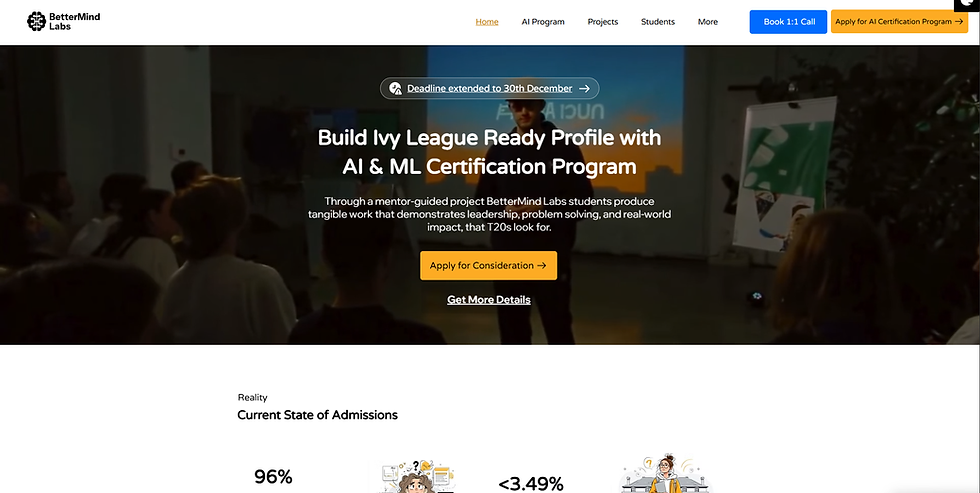
BetterMind Labs offers a mentorship-driven artificial intelligence experience where students build real-world machine learning systems across healthcare, finance, cybersecurity, and data science. Participants work in small cohorts and develop portfolio-ready projects that demonstrate measurable technical ability. According to the program details, students complete AI projects, receive mentorship, and create capstone documentation while working in a highly selective environment.
Students interested in entrepreneurship, business, and finance gain exposure to foundational concepts through immersive experiences hosted by the McCombs School of Business.
Hosted at Austin Tech, HSRA introduces students to original research through faculty mentorship and STEM-focused investigation. Sophomores are eligible to participate and gain valuable research experience.
Students explore machine learning fundamentals, Python programming, and artificial intelligence concepts through an intensive six-week learning experience.
This program introduces students to civil, electrical, mechanical, and computer engineering through hands-on projects and engineering design challenges.
Students engage in project-based STEM learning, engineering design, and robotics while experiencing a residential university environment.

This NASA-affiliated opportunity combines online coursework with onsite experiences connected to Johnson Space Center and aerospace exploration.
Students gain exposure to nanotechnology, materials science, and engineering research while working in advanced scientific environments.
Rice University's technology-focused camp introduces students to robotics, AI, programming, and engineering design through immersive learning experiences.
Available at several Austin universities, these camps focus on coding, robotics, game design, app development, and emerging technologies.
This program helps students build computer science and engineering skills through collaborative projects and practical applications.
The strongest programs are not necessarily those with the biggest names. They are the ones that allow students to build something meaningful and measurable.
Which Engineering Summer Programs Offer Research, Design Challenges, and Real-World Projects?

Engineering-focused students should prioritize programs that combine technical learning with hands-on application. Research opportunities help students understand how engineers investigate problems, while design challenges teach iterative problem solving.
Programs such as Clark Scholars, HSRA, SMU Lyle Engineering Design Experience, UT Dallas NanoExplorers, and Austin A&M Aggie STEM Camp expose students to engineering concepts through practical work rather than passive instruction.
Artificial intelligence programs also deserve consideration because modern engineering increasingly relies on machine learning, automation, and data analysis. Students who learn how to build intelligent systems gain skills that apply across multiple engineering disciplines.
The strongest engineering experiences encourage experimentation, collaboration, and continuous improvement, qualities that mirror professional engineering environments.
How Can Students Turn an Engineering Summer Program into a Strong Technical Portfolio?
The most successful students view summer programs as starting points rather than final achievements.
A student who develops an AI model can continue refining it throughout the school year. Someone conducting research may expand their work into a science fair project or publication. An engineering participant might improve a prototype and submit it to competitions.
Admissions officers often evaluate portfolios because they provide evidence of capability. A portfolio demonstrates not only what a student learned but also how effectively they applied that knowledge.
Strong portfolios may include:
Research papers and technical reports
Engineering designs and prototypes
Software applications and AI projects
Competition submissions and presentations
Students who continue developing projects after summer frequently gain the greatest long-term benefit from their experiences.
Case Study: Can Machine Learning Predict Tomorrow’s Stock Price?
Financial markets generate enormous amounts of data every day, making them a fascinating environment for predictive modeling and machine learning.
At BetterMind Labs, student AnishKumar Ganabady explored this challenge through Next Day Stock Price Prediction, a project focused on forecasting stock market movements using machine learning techniques.
The project analyzed historical financial data and leveraged predictive algorithms to estimate future stock prices. Developing the system required AnishKumar to work with concepts spanning machine learning, data science, financial analytics, and predictive modeling.
According to the program materials, the project achieved strong forecasting performance using machine learning methodologies designed to identify trends and patterns in market data.
More importantly, the project demonstrated how students can apply technical skills to real-world challenges. Rather than studying machine learning concepts in isolation, AnishKumar used them to solve a practical problem involving large-scale financial data.
For admissions officers, projects like this often provide compelling evidence of initiative, technical competence, and intellectual curiosity.
FAQs
What are the best summer programs in Austin for sophomores?
Some of the strongest options include Austin Tech Clark Scholars, BetterMind Labs, HSRA, UT Austin Academy for Machine Learning, Austin High School Aerospace Scholars, and UT Dallas NanoExplorers.
Is sophomore year too early for research programs?
No. Sophomore year is often an ideal time to begin research because students have enough academic preparation while still having time to build upon the experience before college applications.
Are AI summer programs useful for college admissions?
Yes. AI projects frequently demonstrate analytical thinking, technical skill, and problem-solving ability. Programs that emphasize real project development can be particularly valuable.
How important is mentorship in a summer program?
Mentorship helps students accelerate learning by providing guidance, accountability, and expert feedback. Students often produce stronger outcomes when supported by experienced mentors.
What should students include in a technical portfolio?
A strong portfolio may include research papers, technical reports, engineering designs, software applications, AI projects, presentations, and measurable project outcomes.
Is one strong summer experience enough to strengthen a college application?
Absolutely. A single meaningful experience that results in substantial work often provides more value than several disconnected activities.
Conclusion

Sophomore year offers a unique opportunity to build skills, explore interests, and develop projects that can continue growing throughout high school.
Austin provides exceptional summer opportunities across research, engineering, aerospace, business, artificial intelligence, and technology. However, the students who benefit most are those who focus on creating meaningful outcomes rather than simply participating.
Whether through research, engineering design, machine learning, or entrepreneurship, the strongest summer experiences help students build evidence of curiosity, initiative, and capability.
For students interested in artificial intelligence and machine learning, BetterMind Labs offers a structured, mentorship-driven environment where students develop portfolio-ready projects and gain practical experience solving real-world problems. By focusing on project-based learning and measurable outcomes, students leave with far more than a certificate. They leave with evidence of what they can build.
Explore BetterMindLabs.org to learn how mentorship-driven AI projects can help transform curiosity into lasting achievement.


Comments