Healthcare Passion Projects High School Students Can Build

Updated: Oct 1

Introduction
Passion Project Ideas in healthcare have become one of the most effective ways for students to demonstrate curiosity, initiative, and problem-solving before college. While volunteering and shadowing remain valuable experiences, they rarely allow students to investigate a healthcare problem deeply or develop an original solution.
Today's healthcare challenges require collaboration across medicine, artificial intelligence, engineering, public health, and data science. Students who build meaningful healthcare projects not only learn technical and research skills but also gain experiences that strengthen college applications, research portfolios, and future pre-med journeys. This guide explores healthcare passion project ideas that solve real problems while helping students develop practical skills and measurable impact.
Table of Contents
Why Are Healthcare Passion Projects Becoming More Valuable Than Traditional Pre-Med Activities?
How Do You Choose a Healthcare Project That Solves a Real Medical Problem?
Which Skills Should Students Develop Through AI, Public Health, and Biomedical Innovation Projects?
What Are the Top Passion Project Ideas for Students Interested in Healthcare?
Case Study: Can AI Help Patients Follow Their Treatment Plans After Leaving the Hospital?
Why Are Healthcare Passion Projects Becoming More Valuable Than Traditional Pre-Med Activities?
Healthcare passion projects demonstrate initiative, creativity, and problem-solving in ways that traditional pre-med activities often cannot. Rather than observing medicine from the sidelines, students actively investigate healthcare challenges and develop solutions that create measurable impact.
Shadowing physicians and volunteering in hospitals remain excellent learning experiences, but they are primarily observational. Passion projects allow students to move beyond observation by designing tools, conducting research, analyzing public health data, or improving patient education.
Healthcare itself is changing rapidly. Artificial intelligence, digital health platforms, medical analytics, and personalized medicine are becoming integral parts of patient care. Students who begin exploring these technologies during high school gain valuable interdisciplinary experience while demonstrating curiosity that extends beyond classroom learning.
Many successful healthcare projects also evolve into science fair entries, research papers, nonprofit initiatives, or technical portfolios, giving students multiple opportunities to showcase their work throughout the college admissions process.
The next challenge is choosing a healthcare problem that is meaningful, realistic, and achievable.
How Do You Choose a Healthcare Project That Solves a Real Medical Problem?

The strongest healthcare projects begin with a specific patient or healthcare challenge rather than a technology. Students should first understand a real-world problem before deciding whether artificial intelligence, data science, or engineering can help solve it.
Instead of asking, "What AI application should I build?" ask, "What problem do patients, caregivers, or healthcare professionals experience every day?" This approach naturally leads to more thoughtful and impactful projects.
When selecting a project, consider:
Does the project solve a real healthcare problem?
Can I build a working prototype within a few weeks?
Will I learn new technical or research skills?
Can I measure the impact of my solution?
Could I continue improving the project over time?
Projects that address healthcare accessibility, patient education, chronic disease management, public health awareness, or clinical workflow improvement often provide excellent opportunities for both learning and measurable impact.
Understanding the problem is only the beginning. Students also need a combination of technical and healthcare knowledge to build meaningful solutions.
Which Skills Should Students Develop Through AI, Public Health, and Biomedical Innovation Projects?
Healthcare innovation requires more than programming. Students should develop technical, analytical, communication, and ethical reasoning skills while learning how medicine, artificial intelligence, and public health intersect.
The most successful healthcare projects combine multiple disciplines rather than focusing on coding alone.
Important skills include:
Python programming and data analysis.
Machine learning fundamentals.
Medical literature review.
Public health research methods.
Data visualization and scientific communication.
Healthcare ethics and patient privacy.
Human-centered design for patient experiences.
Equally important is learning how to communicate healthcare information clearly. Patients, clinicians, and researchers all require different types of explanations, making communication an essential skill for future healthcare professionals.
Students who develop both technical and interpersonal skills often build stronger projects because they understand not only how technology works but also how people interact with it.
These skills become far more meaningful when applied to authentic healthcare challenges.
What Are the Top Passion Project Ideas for Students Interested in Healthcare?
The best healthcare passion projects solve meaningful problems while allowing students to demonstrate research ability, technical skills, and empathy. Projects that improve patient understanding, healthcare accessibility, or clinical workflows often create the strongest portfolios.
Inspired by successful mentor-guided projects, here are some excellent healthcare passion project ideas for high school students:
CareCart: AI Insurance & Cost Explorer
Build a platform that simplifies insurance policies, estimates out-of-pocket healthcare costs, and explains complicated medical terminology in plain language.
AI Toxicology Triage Assistant
Develop a symptom-based tool that identifies possible toxic exposures, explains emergency first-response guidance, and provides educational toxicology resources.
CareBridge AI: Clinical Notes Summarizer
Create a system that converts consultation transcripts into structured SOAP notes while generating patient-friendly summaries and follow-up instructions.
Patient Medication Adherence Tracker
Design a web or mobile application that provides medication reminders, appointment tracking, hydration monitoring, and personalized health recommendations.
Healthcare Cost & Prescription Price Comparator
Build an AI-powered dashboard comparing prescription prices, insurance coverage, and cost-saving recommendations for commonly prescribed medications.
Community Health Education Platform
Develop interactive educational resources focused on topics such as diabetes prevention, vaccination awareness, nutrition, or adolescent mental health.
Use OCR and AI to interpret prescription labels and translate dosage instructions into simple, patient-friendly language.
Telehealth Accessibility Research Project
Study how older adults interact with telehealth platforms and design interface improvements that increase accessibility.
Each of these projects demonstrates interdisciplinary thinking by combining medicine with technology, research, patient education, or public health while remaining achievable for motivated high school students.
What Healthcare Datasets, AI Tools, and Medical Technologies Can Students Use to Build Their Projects?

Successful healthcare passion projects are built on reliable data, appropriate AI tools, and a clear understanding of the medical problem being addressed. Students do not need access to hospital systems to create meaningful healthcare innovations because many high-quality public datasets and open-source technologies are freely available.
Students can begin with publicly available medical datasets before expanding their projects with AI models and user-friendly applications. The focus should always remain on solving a healthcare problem rather than experimenting with technology for its own sake.
Useful datasets and technologies include:
PhysioNet for physiological and clinical datasets.
MIMIC-IV for de-identified hospital patient data.
NIH Chest X-ray Dataset for medical imaging projects.
Kaggle Healthcare Datasets covering diseases, prescriptions, and patient outcomes.
Python, TensorFlow, PyTorch, and Scikit-learn for machine learning.
FastAPI, Streamlit, or React for developing healthcare applications.
Large Language Models (LLMs) for patient education, documentation, and medical information summarization.
Students should also become familiar with healthcare privacy, responsible AI, explainability, and ethical decision-making. A technically impressive project becomes much stronger when it demonstrates an understanding of how technology affects real patients.
How Can Students Turn a Healthcare Passion Project into Research, Competitions, or a Strong College Portfolio?
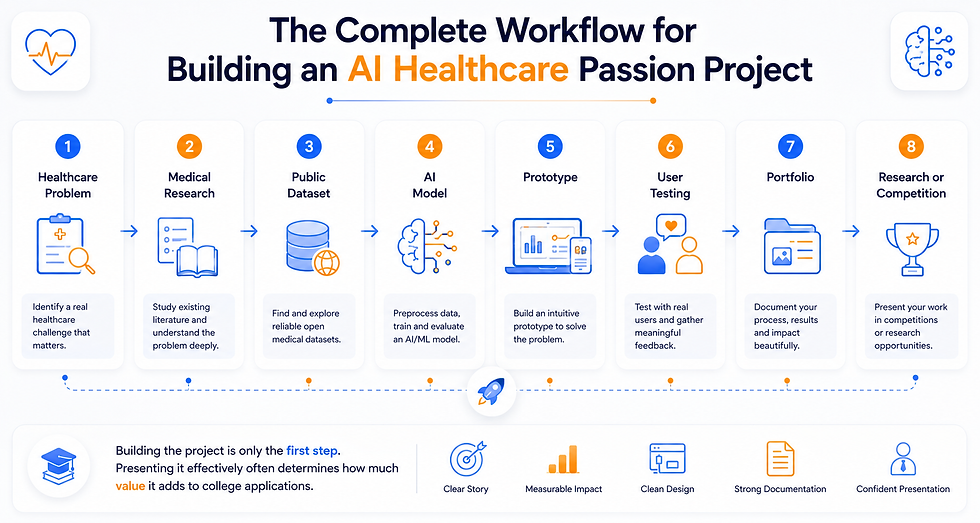
A healthcare passion project becomes significantly more valuable when students document their methodology, measure impact, and continue improving the project beyond the initial prototype. Colleges value sustained curiosity and evidence of growth more than finished products alone.
Students should treat every project as an opportunity to demonstrate scientific thinking and engineering design. Instead of stopping after completing a prototype, continue collecting feedback, improving features, and documenting the development process.
Ways to strengthen a healthcare project include:
Publish the source code on GitHub with detailed documentation.
Write a research report explaining your methods and findings.
Present the project at science fairs, hackathons, or STEM competitions.
Create a demonstration video explaining the clinical problem and your solution.
Conduct small user studies with appropriate consent and summarize the results.
Expand the project through additional datasets, features, or AI models.
Projects that continue evolving often become the most memorable part of a student's academic profile.
Case Study: Can AI Help Patients Follow Their Treatment Plans After Leaving the Hospital?
Many patients leave medical appointments with clear instructions but struggle to remember medications, follow-up visits, and lifestyle recommendations once they return home. Artificial intelligence can bridge this gap by helping patients stay engaged with their treatment plans while reducing administrative work for healthcare providers.
One example is CareBridge AI, developed by Anushka Rudresh through BetterMind Labs. Inspired by her grandmother's experience living with Parkinson's disease, Anushka designed the platform to improve communication between doctors and patients long after a clinic visit ends.
The platform begins with an AI-powered doctor portal that converts consultation recordings into structured SOAP notes, automatically extracts medications, follow-up recommendations, prescriptions, and clinical instructions, then translates them into multiple languages before securely delivering them to each patient's personalized dashboard.
On the patient side, CareBridge AI provides medication reminders, appointment tracking, prescription summaries, hydration and exercise monitoring, adherence tracking, customizable daily reminders, and personalized health management tools that encourage patients to remain engaged with their treatment plans.
Built using FastAPI, Python, JavaScript, HTML, CSS, Google Gemini, Grok, ChatGPT, Render, and modern AI transcription technologies, the project demonstrates how artificial intelligence can improve both clinical efficiency and patient outcomes. Rather than replacing healthcare professionals, CareBridge AI reduces documentation burdens while helping patients better understand and follow medical guidance after leaving the hospital.
Projects like CareBridge AI represent the philosophy behind BetterMind Labs. Students work with experienced mentors to build portfolio-quality AI healthcare applications that solve authentic clinical challenges while developing technical expertise, research skills, empathy, and interdisciplinary problem-solving. These projects naturally strengthen college portfolios, research opportunities, and future pre-med applications.
FAQs
What is the best healthcare passion project for a pre-med student?
The best project addresses a real healthcare challenge that genuinely interests you. Projects involving patient education, disease prediction, healthcare accessibility, mental health, or clinical workflow improvement often create meaningful learning experiences.
Do I need programming experience to build a healthcare AI project?
No. Many students begin with basic Python or even no-code tools before gradually learning machine learning and application development as their projects become more advanced.
Can healthcare passion projects help with college admissions?
Yes. Well-documented healthcare projects demonstrate initiative, scientific curiosity, problem-solving, and sustained learning while providing strong material for essays, interviews, and research portfolios.
Where can students find healthcare datasets?
Public resources such as PhysioNet, MIMIC-IV, the NIH Chest X-ray Dataset, and Kaggle Healthcare datasets provide excellent starting points for student research and AI projects.
Can I turn my project into research?
Absolutely. Many healthcare passion projects can evolve into research papers, science fair entries, hackathon submissions, or conference presentations through additional experimentation and documentation.
Why are mentor-guided healthcare projects valuable?
Experienced mentors help students select meaningful healthcare problems, interpret medical research responsibly, improve technical quality, and develop projects that create measurable real-world impact.
Conclusion
Healthcare is changing rapidly as artificial intelligence becomes part of clinical care, medical research, patient education, and hospital operations. For students interested in medicine, building a healthcare passion project provides an opportunity to explore these changes while developing technical skills, scientific reasoning, and a deeper understanding of patient care.
The strongest projects focus on solving authentic healthcare challenges rather than simply demonstrating programming ability. Whether improving patient communication, supporting clinical decision-making, simplifying healthcare costs, or encouraging treatment adherence, meaningful projects showcase empathy, creativity, and interdisciplinary thinking.
At BetterMind Labs, students work with experienced mentors to build portfolio-quality AI healthcare applications that address real-world clinical problems. Through structured project development, research, and continued mentorship, students create meaningful experiences that strengthen college portfolios while preparing them for future careers in medicine, biomedical engineering, and healthcare innovation.
The most memorable healthcare passion projects begin with one simple question: What challenge do patients face every day, and how can technology help make their lives a little better?


Comments