Is It Too Late to Build a STEM Project? A 4-Week Plan


Most students assume that a strong STEM Project requires months of preparation, advanced technical skills, or years of research experience. But what if the bigger admissions mistake is waiting too long to start because you believe you are already behind?
Many high-achieving students focus heavily on grades, test scores, and extracurricular participation. The challenge is that selective colleges increasingly evaluate evidence of initiative, problem-solving, and intellectual curiosity. A well-executed STEM Project demonstrates all three. Even with only four weeks available, students can build something meaningful if they follow a structured plan.
Table of Contents
Introduction: Is It Too Late to Build a STEM Project? Why 4 Weeks Can Be Enough
A Real STEM Project Timeline: What You Can Accomplish in Just 4 Weeks
Week-by-Week 4-Week STEM Project Plan for High School Students
Case Study: How Anvi Patalay Built Nurture IBD in 4 Weeks
Common Mistakes That Delay STEM Projects and How to Avoid Them
FAQ
Conclusion: Is 4 Weeks Enough for a Strong STEM Project?
Introduction: Is It Too Late to Build a STEM Project? Why 4 Weeks Can Be Enough

A four-week timeline is enough to build a meaningful STEM Project when the project scope is realistic, the milestones are clearly defined, and mentorship helps students avoid common technical roadblocks. The goal is not to build the next billion-dollar startup. The goal is to demonstrate authentic problem-solving.
Admissions officers rarely expect high school students to produce graduate-level research. Instead, they look for evidence that a student identified a real-world challenge, developed a solution, and learned through the process. According to the annual admissions reports published by institutions such as MIT Admissions and Stanford Undergraduate Admission, intellectual curiosity and initiative remain important evaluation factors.
A project built in four focused weeks often creates stronger evidence of initiative than an activity a student passively participates in for an entire year. The next question is what can realistically be accomplished in that timeframe.
A Real STEM Project Timeline: What You Can Accomplish in Just 4 Weeks
A focused four-week STEM Project can produce a functional prototype, meaningful research findings, or an AI-powered application that solves a real-world problem. Success depends far more on project selection than on project duration.
Think of a STEM Project like engineering a bridge. Engineers do not begin by constructing the largest bridge possible. They start with a clear design, validate assumptions, and build a working model. Students should take the same approach.
In four weeks, students can realistically:
Identify a problem worth solving.
Research existing solutions.
Build a prototype.
Test and improve the solution.
Present findings through a portfolio, demo, or presentation.
Examples include:
AI-powered study assistants
Environmental monitoring dashboards
Healthcare recommendation tools
Scholarship-focused AI projects
Data science investigations
Students searching for inspiration can explore these scholarship-oriented ideas in Top 10 AI Projects That Can Help You Win Scholarships.
Recent workforce reports from World Economic Forum and McKinsey & Company consistently emphasize problem-solving, analytical thinking, and AI literacy as increasingly valuable skills. A project allows students to demonstrate those abilities directly.
Understanding what is possible is important. The next step is creating a realistic week-by-week roadmap.
Week-by-Week 4-Week STEM Project Plan for High School Students
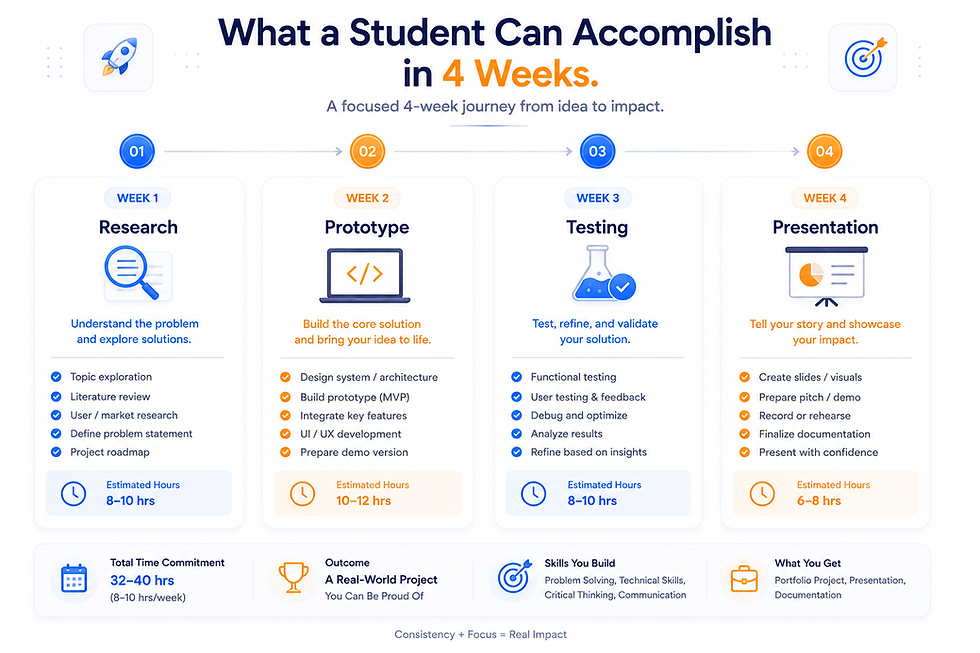
A structured weekly plan transforms a large goal into manageable milestones. Students who divide their project into weekly objectives are significantly more likely to finish than students who work without deadlines.
Week 1: Define the Problem
Start with a problem you genuinely care about.
Ask:
What issue affects people around me?
What topic interests me academically?
What data or resources can I access?
Strong projects begin with a clear problem statement rather than a technology.
Week 2: Design and Build a Prototype
Develop the first version of your solution.
For AI projects, students might:
Collect sample datasets
Build a simple application
Use APIs to create intelligent features
Create user interfaces using beginner-friendly tools
The objective is functionality, not perfection.
Week 3: Test and Improve
Gather feedback from users, mentors, teachers, or peers.
Evaluate:
Accuracy
Usability
Reliability
Impact
Most meaningful learning happens during iteration.
Week 4: Present and Document
Create:
A project report
Demo video
Portfolio page
Presentation deck
Documentation matters because admissions officers cannot evaluate what they cannot see.
Students interested in discovering project ideas connected to their interests can explore AI for Teens: How to Explore Your Passion in Science, Arts, or Business.
The process sounds straightforward on paper. A real example demonstrates how this timeline works in practice.
Case Study: How Anvi Patalay Built Nurture IBD in 4 Weeks
A motivated student can build a meaningful healthcare-focused STEM Project within four weeks when guided by structured milestones, expert feedback, and a clearly defined problem.
One example is Anvi Patalay, who developed Nurture IBD after identifying challenges faced by patients managing chronic health conditions.
More than 3.1 million adults in the United States live with Inflammatory Bowel Disease (IBD). Patients often struggle to interpret health information, monitor symptoms consistently, and receive personalized guidance between medical appointments.
Nurture IBD was designed to address that challenge.
Key features included:
Symptom tracking
Health data analysis
Personalized dietary recommendations
AI-assisted patient support
The application was built using Streamlit and Gemini API technologies.
Beyond IBD, the system was designed with potential applications for chronic conditions such as diabetes and kidney disease. The project demonstrates an important principle: impactful STEM Projects begin with real problems rather than impressive technologies.
What makes this example notable is not only the technical implementation. It is the structured development process that transformed an idea into a working prototype within a limited timeframe.
Students exploring additional admissions-focused project inspiration may also benefit from reading Best STEM Passion Projects for College Admissions.
The success factors behind projects like Nurture IBD reveal why some students finish projects quickly while others struggle for months.
Common Mistakes That Delay STEM Projects and How to Avoid Them

Most delayed STEM Projects suffer from poor scope, lack of structure, or insufficient feedback rather than lack of intelligence or effort.
Mistake 1: Choosing an Overly Ambitious Project
Students often attempt to build systems comparable to commercial products.
Instead:
Focus on one core problem.
Build one strong feature.
Demonstrate measurable value.
Mistake 2: Starting With Technology Instead of a Problem
"How can I use AI?" is a weaker starting point than "How can I help students manage study schedules?"
Strong projects prioritize problems first.
Mistake 3: Working Without Mentorship
Experienced guidance helps students avoid technical dead ends and inefficient learning paths.
Research from organizations such as National Mentoring Partnership (MENTOR) highlights the positive impact mentorship can have on academic confidence and long-term outcomes.
Mistake 4: Ignoring Documentation
Many students build impressive work but fail to explain it effectively.
Admissions reviewers need evidence of:
Research process
Technical decisions
Challenges encountered
Lessons learned
Mistake 5: Waiting for the Perfect Idea
Progress creates clarity.
Students who begin with a reasonable idea and improve it consistently often outperform students who spend weeks searching for a perfect concept.
These mistakes reveal a recurring pattern: structure matters. That naturally leads to the most common questions students and parents ask.
FAQ
Is four weeks really enough to complete a STEM Project?
Yes, if the project scope is realistic. Four focused weeks can be enough to research a problem, build a prototype, test improvements, and create documentation that demonstrates initiative and problem-solving ability.
What type of STEM Project works best for eighth-grade students?
Projects that solve practical problems using simple technology often work best. Students can explore AI, environmental science, healthcare, education, or data analysis without requiring advanced programming experience.
Do colleges care more about project quality or project length?
Quality generally matters more than duration. Admissions reviewers are interested in intellectual curiosity, evidence of learning, and meaningful outcomes rather than the number of months spent on a project.
Why is mentorship important during a STEM Project?
Mentorship helps students avoid common mistakes, receive technical guidance, and maintain momentum. Structured feedback often shortens development time while improving project quality and overall learning outcomes.
Can students build AI projects without prior machine learning experience?
Yes. Many beginner-friendly tools allow students to focus on solving problems while learning technical concepts gradually. Guided project-based learning makes advanced technologies more accessible to younger students.
What is the biggest reason students fail to finish STEM Projects?
Lack of structure is often the primary cause. Students who follow weekly milestones, receive feedback, and document progress are significantly more likely to complete meaningful projects successfully.
Conclusion: Is 4 Weeks Enough for a Strong STEM Project?
A strong STEM Project does not require a year-long timeline, advanced research credentials, or professional-level technical expertise. What it requires is a meaningful problem, a structured plan, consistent execution, and thoughtful reflection.
Traditional metrics such as grades and test scores remain important, but they rarely distinguish students in highly competitive applicant pools. Real-world projects provide tangible evidence of curiosity, initiative, creativity, and problem-solving.
That is why structured, mentored, project-based learning has become increasingly valuable for ambitious students. Programs at BetterMind Labs help students move from ideas to impactful AI and STEM projects through expert mentorship, clear milestones, and real-world applications.
If you are ready to build a STEM Project that demonstrates genuine intellectual initiative, explore the programs and resources available at BetterMind Labs and take the first step toward creating something meaningful.


Comments