10 Summer Programs in New Jersey That Will Boost Your College Application

Most students spend summer doing something. Few spend it doing something that matters to admissions committees.
There is a difference between a summer that looks good on paper and one that actually changes how you think, what you can build, and what you have to say in an interview. New Jersey has some serious options. Here are 15 that are worth your time.
Top 10 Summer programs for New Jersey High School Students
1. BetterMind Labs

This one sits at the top because of what students actually leave with.
The program runs 4-week cohorts entirely online, with a 1:3 mentor-to-student ratio. That is not a lecture. That is a working relationship.
Students build production-ready AI systems: healthcare prediction tools, finance risk models, machine learning pipelines, and deployed dashboards. Not toy projects. Not simulations.
What makes it admissions-relevant is what you can show. A GitHub repo with a real deployment. Capstone documentation. A letter of recommendation from someone who watched you build something hard.
If your goal is a portfolio that makes an interviewer stop and ask a follow-up question, this program is structured to produce exactly that.
2. Princeton University Summer Journalism Program

Two weeks on Princeton's campus. Students work with professional journalists and editors. Strong for students who want to communicate ideas, not just have them. The campus environment alone signals something to admissions readers.
3. Governor's School of New Jersey

Highly competitive. Residential. Fully funded. The programs span engineering, arts, public issues, and science. Being selected is itself an admissions signal. The work students do there tends to become central to their applications.
4. Rutgers Young Scholars Program

Mathematics and science focused. Students live on campus and work on real problems with faculty. If you are considering STEM and want depth over breadth, this is one of the more rigorous options in the state.
5. Stevens Institute of Technology Pre-College Programs

Stevens runs programs in engineering, computer science, and design. The faculty are working researchers, not just instructors. Students get access to labs and equipment that most high schools cannot offer. Good for students who want to understand what engineering actually looks like before committing to it.
6. Drew University Summer Science Institute
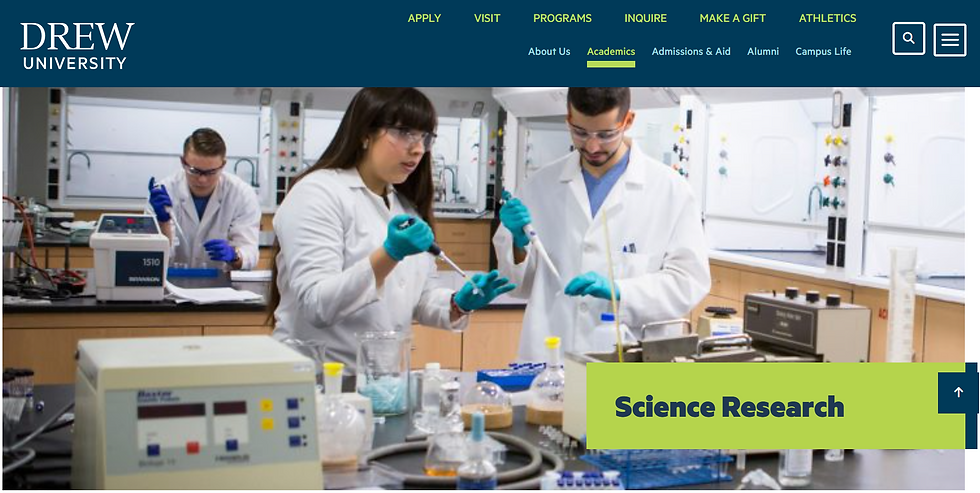
Hands-on biology and chemistry research with Drew faculty. Small cohort. Individual lab time. If you want to say you ran an actual experiment and not just watched one, this program gives you that.
7. Montclair State University Science Enrichment Program

Focused on first-generation and underrepresented students interested in STEM. Strong mentorship. Real lab exposure. If you are looking for a program that invests in the student, not just the credential, this one does.
8. NJIT Pre-College Programs

New Jersey Institute of Technology runs summer intensives in architecture, computing, and engineering. The architecture program in particular is one of the stronger pre-college options in the region for students thinking about design-heavy fields.
9. Rider University Summer Business Institute

A week-long introduction to business fundamentals. Good for students who want to test the interest before committing to four years of it. Not the deepest program on this list, but honest about what it is.
10. Seton Hall University Summer Programs

Seton Hall offers academic enrichment programs across multiple disciplines. Students live on campus and get exposure to college-level coursework. Good for students who want to experience a residential academic environment before applications.
A Student Who Made It Count: Amogh at BetterMind Labs
This is worth reading if you want to understand what building a real project actually looks like.
Amogh came into BetterMind Labs interested in AI. He left with something concrete: a system that uses machine learning to identify the safest landing zone for a spacecraft on Mars.
Here is how it works. The model takes a top-down image of a Martian surface and breaks it into patches. It evaluates each patch for hazard level, then selects the safest one for landing. The system does not just classify. It makes a decision.
That is not a school project. That is a deployable AI system solving a real aerospace problem. Amogh built the full pipeline: image segmentation, hazard classification, patch selection logic. He documented it. He can explain every decision he made.
When that project appears in a college application, it does not need a lot of explanation. It speaks clearly on its own.
The point is not that every student will build a Mars lander. The point is that when a student has a real mentor, a structured timeline, and a problem worth solving, they build things that actually matter. Amogh's project is one example of what that looks like.
How to Choose
A few things worth thinking through before you commit.
Not every program serves the same purpose. Some are about environment, being on a college campus, meeting students from other schools, and experiencing academic life. Those have real value. Others are about depth, actually building something, learning under someone who does this work professionally, and leaving with a product.
The best applications tend to show both. A student who spent two summers doing the same type of activity, no matter how prestigious, is less interesting than one who can show genuine range and genuine depth.
Ask yourself what you can actually demonstrate from this experience six months from now. If the answer is a certificate and a general sense of what the subject is like, that is useful but limited. If the answer is a GitHub repository, a presentation, a project you can walk through in an interview, that is something different.
The programs at the top of this list tend to produce the second kind of outcome. That is why they are at the top.
Frequently Asked Questions
Do summer programs actually affect college admissions? They do, but not in the way most people think. Admissions readers are not impressed by the name of the program. They are looking for what you did, what you built, and what you learned. A well-documented project from a less-known program often reads better than a certificate from a famous one.
Can students just learn AI or coding on their own over the summer? Self-directed learning shows genuine interest, and that matters. But structured mentorship produces something different: a finished project with documentation, someone who can write a specific letter about your work, and the discipline that comes from an external deadline. Admissions teams can tell the difference between a student who explored something and one who completed something.
How important is the letter of recommendation from a summer program? Extremely important, if it is specific. A letter that describes exactly what a student built, the problems they solved, and how they responded to feedback carries far more weight than a general endorsement. Programs with low mentor-to-student ratios, like BetterMind Labs with its 1:3 ratio, are structured to produce that kind of letter.
Is one strong summer program better than two average ones? Almost always, yes. Depth reads better than breadth when the depth is real. One project that you can explain at length, defend technically, and connect to your academic interests is more compelling than two programs where you attended sessions and received a certificate.
Final Thought
Summer is a resource. How you use it shows up in your application not just as a line item but as evidence of how you think about your own time.
The students who stand out are not the ones who attended the most programs. They are the ones who built something real, understood it deeply, and can talk about it clearly.
New Jersey has the programs to make that happen. The question is which one you choose and what you do with it.
Explore more at bettermindlabs.org.


Comments