10 Coding and AI summer program for High School Students in Ashburn

Introduction
Why do some students leave a summer program with a compelling technical portfolio while others leave with little more than a certificate and a group photo?
The difference usually has nothing to do with prestige alone. It comes down to whether the experience required students to build systems, solve problems, and apply concepts under mentorship. For high school students in Ashburn exploring coding and AI summer programs, that distinction matters more in 2026 admissions than ever before.
Selective universities increasingly look for evidence of intellectual depth, technical initiative, and sustained curiosity. According to the National Center for Education Statistics, undergraduate computer and information science enrollment has continued rising sharply over the last three years, while AI-related hiring demand has expanded across healthcare, cybersecurity, aerospace, and finance. At the same time, more applicants are listing “coding” or “AI” on applications, which means passive participation no longer stands out. Real projects do. (nces.ed.gov)
Students who can explain how they trained a machine learning model, analyzed noisy datasets, or optimized a prediction system demonstrate a very different level of preparation than students who only completed online tutorials. That is why the strongest summer programs in Ashburn now emphasize hands-on AI development, coding research, and project-based learning under expert mentorship.
Table of Contents
Why Are Some Coding and AI Summer Programs More Valuable Than Others?

A strong AI summer program functions almost like a miniature research lab. Students move from theory to implementation through iterative experimentation. Weak programs often stop at exposure. Strong programs require output.
In the last two years, universities such as Stanford, MIT, and Carnegie Mellon have repeatedly emphasized project-based evidence in supplemental essays and STEM application reviews. Admissions officers increasingly evaluate whether a student can connect technical skills to a real-world problem. Can the student explain model selection? Dataset limitations? Ethical implications? Optimization tradeoffs?
That is why project-centered summer experiences are becoming more valuable than lecture-only camps.
The strongest programs usually include:
Mentor-guided technical projects
Coding assignments tied to real datasets
Research presentations or demos
Small cohort collaboration
Tangible portfolio outcomes
According to the World Economic Forum, AI and data science remain among the fastest-growing technical fields globally through 2030. Meanwhile, the U.S. Bureau of Labor Statistics projects software and AI-related careers to grow significantly faster than average over the decade. (weforum.org) (bls.gov)
A useful way to think about a summer program is to compare it to training for aerospace engineering. Reading about aerodynamics is valuable. Building a wind tunnel model teaches something entirely different. AI works the same way.
The next question becomes practical: which Ashburn summer programs actually provide that depth?
What Are the Top 10 Coding and AI Summer Programs in Ashburn for High School Students?

1. BetterMind Labs AI and ML Program
BetterMind Labs stands out because the structure is centered around outcomes rather than passive instruction. Students work in small cohorts with mentors and build real AI or ML systems connected to healthcare, finance, cybersecurity, or engineering. The program emphasizes technical implementation, portfolio development, certification, and recommendation letters. For Ashburn students who want tangible technical depth, this project-first model is unusually aligned with modern admissions expectations.
2. George Mason University ACCESS Academy AI Summer Camp
George Mason’s AI Summer Camp introduces students to machine learning concepts through coding activities and collaborative projects. Students explore how AI models identify patterns and solve real-world tasks. The program works especially well for beginners who want a structured entry point into AI without needing advanced prerequisites.
3. George Mason University ASSIP Research Internship
ASSIP is one of Ashburn’s strongest STEM research opportunities for high school students. Participants work with faculty researchers on advanced projects involving AI, computational modeling, data science, and engineering research. Students gain exposure to the research process itself, including experimentation and technical communication.
4. UVA School of Data Science Bootcamps
The University of Ashburn’s data science programs focus on data analysis, visualization, and AI literacy. Students work collaboratively on applied coding problems while learning how real-world datasets are interpreted. The curriculum is designed to make abstract machine learning concepts approachable.
5. UVA AI Literacy Bootcamp
This bootcamp explores machine learning, neural networks, NLP, and generative AI using beginner-friendly tools. Students learn how AI systems classify information, generate outputs, and process language. The strongest aspect of the program is its focus on conceptual understanding rather than memorization.
6. Virginia Tech UPWARDS TechTrek Program
Virginia Tech’s TechTrek combines AI, robotics, IoT systems, electronics, and Python programming into one immersive experience. Students explore intelligent systems through labs and collaborative technical challenges. The interdisciplinary approach makes it ideal for students interested in both coding and engineering.
7. Virginia Tech AI for Beginners
This summer experience focuses on machine learning foundations and introductory AI applications. Students build familiarity with algorithms, prediction systems, and AI workflows while working through guided coding exercises. It is especially useful for students transitioning from basic programming into applied AI.
8. Old Dominion University CyberAI Camp
ODU’s CyberAI Camp blends cybersecurity with artificial intelligence. Students examine phishing detection, digital forensics, and network security through practical exercises. The program reflects how AI increasingly intersects with cyber defense systems.
9. VCU AI and Engineering Camp
Virginia Commonwealth University’s engineering camp introduces students to computational problem solving and AI-driven systems. Participants work through engineering challenges while learning coding fundamentals and applied technical reasoning.
10. Virginia Tech Generative AI for Innovators
This program focuses on generative AI tools and foundational machine learning systems. Students explore how modern AI models generate language, visuals, and predictions while discussing ethical implications and future applications.
Not every strong summer experience ends when the program finishes. The best ones create momentum that extends into independent work and future specialization.
What Should You Build During a Summer Program to Actually Stand Out?
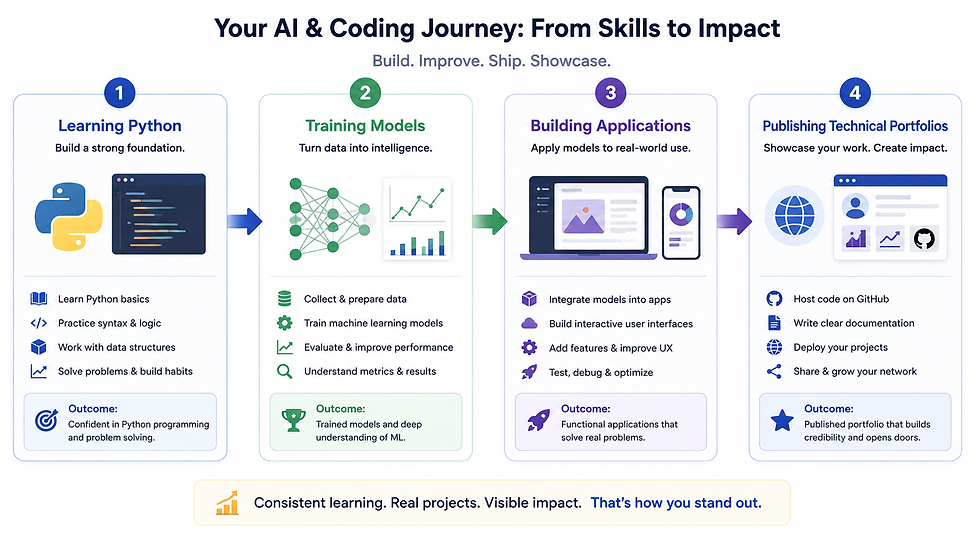
The strongest technical portfolios usually demonstrate systems thinking. Instead of showing isolated assignments, they reveal how a student approaches real problems using data, algorithms, and iteration.
For example, a finance AI project should not stop at “predicting stock prices.” It should address feature engineering, data volatility, model evaluation, and prediction limitations. Similarly, a healthcare AI system should explain dataset quality, bias concerns, and interpretability.
Students who stand out often build:
AI healthcare diagnostic tools
Financial forecasting systems
Cybersecurity threat analyzers
Computer vision applications
NLP-based misinformation detectors
This is where structured mentorship becomes extremely valuable. Independent learning can introduce concepts, but expert guidance helps students move from basic implementation toward technical sophistication.
According to GitHub’s 2024 developer report, AI-related repositories and machine learning collaboration projects grew dramatically among younger developers over the last year. Colleges increasingly see GitHub portfolios as evidence of authentic engagement rather than résumé padding. (github.blog)
A well-designed AI project behaves like a scientific instrument. Every variable matters. Small adjustments in training data, preprocessing, or optimization can change outcomes dramatically.
The clearest way to understand this transition is through a real student example.
Case Study — Can AI Detect Aircraft from Raw Radar Data in Real Time?
At BetterMind Labs, student Sam Nishanth Eedhi developed a Flight Detection AI system focused on identifying aircraft using real-time radar-style data processing and AI-based classification.
The challenge was substantial. Raw radar and flight data are noisy, fragmented, and difficult to analyze manually at scale. Sam approached the problem by designing an AI system capable of detecting patterns, identifying aircraft behavior, and improving prediction accuracy using machine learning workflows.\
The project involved:
Processing aviation-related datasets
Training AI classification models
Detecting movement patterns in real time
Improving signal interpretation accuracy
Building a practical technical interface
What makes this project impressive from an admissions perspective is not simply the topic. It is the integration of software engineering, AI logic, and systems thinking into one cohesive technical framework.
Projects like this demonstrate why mentorship-based AI programs matter. Students are not simply consuming information. They are learning how to architect solutions.
FAQs
1. Are coding summer programs enough to strengthen a college application?
Not by themselves. Programs become valuable when students produce meaningful technical outputs such as projects, research, or published work.
2. Do students need prior coding experience for AI summer programs?
Many beginner-friendly programs teach foundational Python and machine learning concepts. However, students who practice coding before summer usually gain more from advanced project work.
3. Why do project-based AI programs matter more now?
Because many applicants already participate in STEM activities. Real projects provide measurable evidence of technical reasoning, persistence, and intellectual depth.
4. Is mentorship important for high school AI projects?
Yes. Mentorship accelerates learning by helping students avoid shallow implementations and build systems with stronger technical rigor and real-world relevance.
Conclusion
A high-impact coding or AI summer program should leave students with more than notes and certificates. It should leave them with evidence of growth: a research experience, a deployable project, a technical portfolio, or a deeper understanding of how intelligent systems solve real-world problems.
That distinction matters increasingly in 2026 admissions. As AI becomes more common in high school extracurriculars, colleges are paying closer attention to depth, originality, and implementation quality.
Programs that combine mentorship, project development, and structured technical learning create the strongest outcomes. That is one reason many Ashburn students increasingly look toward project-centered programs like BetterMind Labs when they want to move beyond passive enrichment and build something substantial.


Comments