Quick answer
The strongest winter STEM programs for high school students in 2026-27 are university-run courses that start in late December or January. The best choice depends on your field:
- Computer science, data and AI: Cornell Precollege Winter Online (Python for data analysis, statistics and data science, January 4-22, 2027), Stanford Online High School single courses, ASU Universal Learner Courses, and short mentored AI project programs such as BetterMind Labs.
- Math and physics: Stanford Pre-Collegiate University-Level Online Math & Physics (spring 2027 applications open now) and Northwestern CTD Online Honors (winter start January 20, 2027).
- Biology, medicine and health: Cornell's winter biology courses and Johns Hopkins CTY Online.
- Engineering: winter options are thin, so use winter to apply to summer engineering programs (MIT Beaver Works, Johns Hopkins Engineering Innovation) and to build a project.
- Exploring several fields: MIT's Spring HSSP Saturday classes.
Deadlines to know now: Cornell's winter application form is due November 23, 2026. Stanford Online High School applications are due January 7, 2027. Summer Science Program applications open January 4, 2027.
Key takeaways
- Winter break is short. The programs worth your time start in late December or January and run alongside school.
- Choose by field first, then by format. A Python course and a biology course at the same university feel nothing alike.
- The best program ends with evidence you can show: a transcript grade, a finished course or a working project.
- STEM jobs are projected to grow 8.1% from 2024 to 2034, more than twice the 3.1% rate for all jobs (US Bureau of Labor Statistics). Data, AI and security roles lead that growth.
- Several deadlines close in November and December, so do the planning this month instead of over the break.
What counts as a winter STEM program for high school students?
A winter STEM program is a structured science, technology, engineering or math experience that runs between late November and March. In my work with families, I see three kinds:
- Intensive winter terms. These fit inside the holiday stretch. Cornell's three-week winter session is the clearest example. You take one college course and finish it before second semester gets busy.
- Semester-length online courses that start in January. Northwestern CTD Online Honors, Stanford's university-level online courses and Johns Hopkins CTY Online all fit here. They run from January into spring at a steady weekly pace.
- Short project programs and weekend classes. These run for a few weeks. A 4-week mentored AI project program or MIT's Saturday HSSP classes are typical.
Most US winter breaks last one to two weeks. When families ask me what to do "over winter break," I reframe it as "what to do this winter." The students who get the most out of this season pick one program that runs from January into spring. Then they use the break itself to get ahead on reading, set up a study schedule or start a project.
If you're still deciding whether a winter program is worth it at all, this piece on whether winter programs are worth it for high school students covers the trade-offs.

What's changing in STEM programs and admissions for 2026-27?
Before choosing a program, it helps to know what has shifted this year. Here are the trends I'm watching, with the data behind them.
1. Data, AI and security skills are where STEM job growth is concentrated. The US Bureau of Labor Statistics projects STEM employment to grow 8.1% from 2024 to 2034, compared with 3.1% for all occupations and 2.7% for non-STEM jobs. A July 2026 BLS analysis of AI and IT employment adds detail. It projects data scientists to grow 33.5% (about 82,500 jobs), information security analysts 28.5%, computer and information research scientists 19.7% and software developers 15.8%. Software development adds the most jobs in raw numbers: about 267,700. BLS says AI adoption, including generative AI, is expected to "fuel strong job growth among computer and mathematical occupations."
So courses in Python, statistics and data science are useful no matter which STEM field you end up in. It's no accident that Cornell's winter 2027 STEM list leads with Python for data analysis and an introductory statistics and data science course.
2. College applications are still rising, and competition is not easing. Common App's 2025-26 end-of-season report counted 1,527,328 first-year applicants, up 2% from the year before. International applicants fell 10%, including a 15% drop from India. Domestic competition for selective STEM programs remains strong.
A winter program helps when it adds real depth to your profile. Another certificate on its own adds very little.
3. Selective research programs are expanding, but deadlines come early. The Center for Excellence in Education announced in August 2026 that the Research Science Institute (RSI) will add a Stanford site in 2027, starting with 50 students, while RSI at MIT continues with 100. Applications for programs like RSI have historically closed in mid-December.
If you're a junior, treat December as research-program application season.
4. Government internships have tightened eligibility. NASA's internship page now requires applicants to be at least 18 by the session start date, US citizens, with a 3.0 GPA. High school seniors can apply only for the summer right after graduation.
Younger students interested in space science should look at university programs instead.
5. Online programs are adding more live teaching. Johns Hopkins CTY says it "has introduced a synchronous component to many online courses." Stanford's university-level online courses meet live once a week. Cornell's winter courses mix live and recorded formats.
Online courses now often include live teaching, so check whether a course has live sessions if you need that structure.
What are the Top winter STEM programs for high school students in 2026-27?
I've limited this list to programs run by universities, plus one short project program. I checked every date, course title and eligibility rule against each program's official page on November 13-14, 2026. Fees change often and vary by course, so I've left them out. Check each program's site for current costs and financial aid.
Which programs should you compare side by side?
Program | Run by | Best for (field) | Format | Winter 2026-27 timing | Who can apply |
|---|---|---|---|---|---|
Cornell University | CS and data, biology, environmental science | Online college courses, Cornell credit | Jan 4-22, 2027; form due Nov 23, 2026 | Ages 15-19 who have completed grade 10 | |
BetterMind Labs | Applied AI projects | Online, 4 weeks, instructor-led + mentorship | November and January cohorts | Grades 9-12, no coding needed | |
Stanford Pre-Collegiate Studies | Advanced math, physics | Online, weekly live class | Spring 2027 application open now | See program site | |
Stanford Online High School (single course) | Stanford University | Math, CS, science | Online, live seminars, transcript | Apply by Jan 7, 2027 for 2027-28 | Grades 7-12 |
Johns Hopkins University | Coding, medicine, earth science | Online, many with live sessions | Late-January start in past years; 2027 not posted | Students who qualify by testing or scores | |
Northwestern University CTD | Math, science, technology | Online, self-paced, high school credit | Winter start Jan 20, 2027; apply by Jan 28 | Grades 9-12 (Magenta tier or qualifying scores) | |
Arizona State University | Intro CS, chemistry, college math | Online, flexible pace, optional ASU credit | Flexible start dates | All ages; no admission needed | |
MIT Educational Studies Program | Exploring several fields | In person at MIT, Saturdays | Late Feb to mid-April in 2026; 2027 not posted | Grades 7-12, age 11+ |
The sections below go field by field. Pick the one closest to your interest, then read the program notes and my take on each.
Which winter programs are best for computer science, data science and AI?
This is the strongest field for winter options in 2026-27, and the one with the clearest career signal (see the BLS data above).
Cornell Precollege Winter Online: Python and data science
Cornell's winter session packs a full college course into three weeks. Cornell describes it as "15 weeks of college coursework in 15 days." Courses run online from January 4 to January 22, 2027, and students earn Cornell credit and a Cornell transcript.
Two winter 2027 courses fit this field:
- AEM 2841, Python Programming for Data Analysis and Business Modeling (3 credits). This is Python applied to real data, the skill BLS ties to the fastest-growing STEM roles.
- ILRST 2100 / STSCI 2100, Introductory Statistics and Data Science (4 credits). This is a foundation course for any data, AI or research path.
Eligibility: you must be 15 to 19 when class starts and have completed grade 10. There's no minimum GPA, but Cornell says students averaging B+ or higher are generally well prepared.
Deadlines:
- November 23, 2026: application form
- December 1, 2026: application materials
- December 10, 2026: pre-enrollment and course selection forms
Admissions are rolling, and Cornell warns that most programs fill before the deadline.
For a junior or senior who wants a college transcript grade in a data course, this is the top winter option. Be realistic about the pace. A 4-credit statistics course in three weeks is close to a full-time job over the holidays.
BetterMind Labs AI ML Certification Program: a mentored AI project
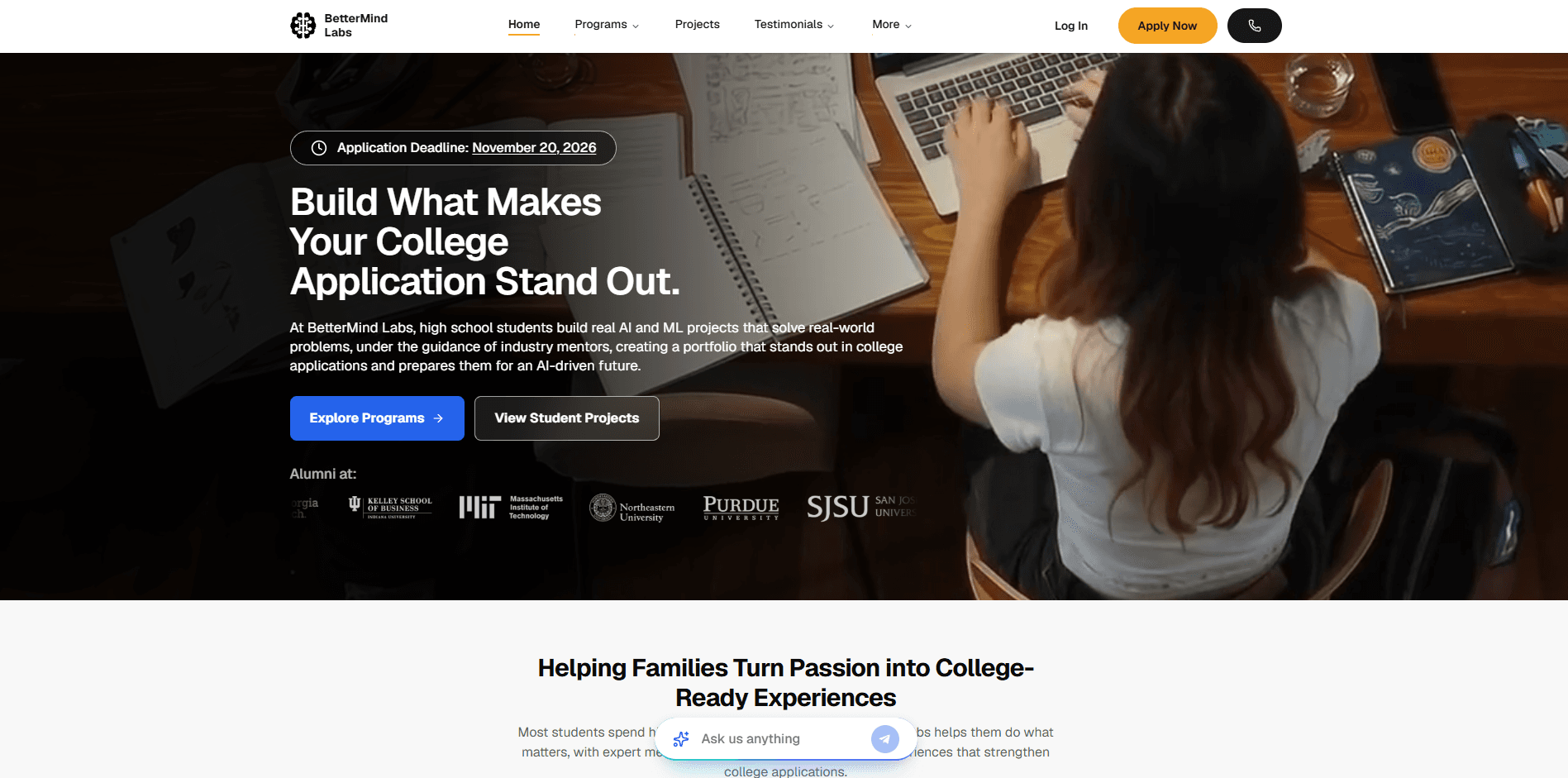
BetterMind Labs runs a 4-week online program for grades 9-12. Students build an AI project in a field they care about, such as healthcare, finance or sports. It combines instructor-led sessions with small-group (up to 4 students per mentor) or 1:1 mentorship, at about 6-7 hours a week. No coding experience is needed. Students new to code can start with no-code tools, and others can work in Python with machine learning libraries. The winter programs page lists a November cohort and a January cohort. Check the Cohorts section for current dates.
A mentored project program makes sense if you're interested in AI but keep stalling on projects alone. It gives you a project to explain, not a course grade. Many students pair it with a credit course.
Stanford Online High School: single courses with a transcript
Stanford Online High School (OHS) is Stanford's accredited online school for grades 7-12. Students don't have to enroll full time. The single-course option lets you take one yearlong course or two semester-long courses, at about 8-10 hours per week per course, and you earn an official transcript. OHS lists mathematics, computer science and science among its subject areas.
The application deadline for the 2027-28 school year is January 7, 2027, 11:59 p.m. Pacific, and decisions come in March 2027. So this is a winter application for next year's course, not a winter course itself.
This suits a 9th or 10th grader whose school has run out of advanced CS or math. Apply over winter break. Note that interviews aren't offered to single-course applicants.
Arizona State University Universal Learner Courses
ASU's Universal Learner Courses are online college courses taught by ASU faculty. They don't require admission, and they're "open to learners of all ages." Many run on a flexible, self-paced schedule within instructor deadlines. Credit is optional: you add the course to an official ASU transcript only if you're happy with your grade.
The closest computer science course on ASU's list is CIS 105, Computer Applications and Information Technology. It's an introductory course and doesn't go far into programming.
ASU is a low-risk way to try a college course with flexible timing. It's more introductory than Cornell or Stanford, and colleges will see the difference. Use it to build confidence or to fill a gap, not as your headline activity.
Johns Hopkins CTY Online: coding for younger students
CTY's online catalog includes coding courses such as "Dream It, Code It, Build It." Many CTY online courses now include live sessions. You must qualify through testing or score submission before enrolling. In the 2025-26 cycle, students who enrolled by December 9, 2025 started the week of January 26, 2026. CTY had not posted its 2027 dates on November 14, 2026.
CTY is a better fit for 9th and 10th graders who want structure and a peer group. Older students who are ready for college-level work should look at Cornell or Stanford.
Which one should a CS or AI student pick?
- You want a college grade: Cornell AEM 2841 or STSCI 2100.
- Your school has no advanced CS: apply to Stanford OHS by January 7.
- You want to test college work with flexible timing: ASU.
- You want a finished AI project: a mentored project program, or your own build with a deadline.
For project ideas in this field, see these lists of AI projects to build over winter break and winter AI programs for high school students.
Which winter programs are best for math and physics?
Math and physics students usually have a different problem from everyone else. They run out of school courses early. Winter is a good time to fix that.
Stanford Pre-Collegiate University-Level Online Math & Physics
This Stanford program offers ten math courses, "from Multivariable Calculus to Modern Algebra," and four advanced physics courses, including Light & Heat. Each course has a weekly instructor-led online class, with recordings for students who miss it. Students follow a suggested weekly schedule but can pace their own coursework. Exams happen in set windows. Each course carries three units of Stanford Continuing Studies credit, with an official transcript.
Stanford also runs a related Online Immersive course in multivariable calculus and linear algebra, based on a curriculum built for first-year Stanford students and worth five units.
The program's site says "Our application for Spring 2027 is now open." Winter is when to apply, even though classes start in spring.
This is the strongest option on this list for students who have finished calculus. If you haven't, start with the next option.
Northwestern CTD Online Honors
Northwestern's Center for Talent Development offers asynchronous online honors courses in math, science, and technology and engineering. The winter start is January 20, 2027. One-credit courses run to May 19, 2027, and two-credit courses run to August 13, 2027. Late starts are accepted until January 28. CTD recommends 6-8 hours of coursework a week.
Students earn one high school credit per semester through CTD with a C- or better. Whether your school accepts the credit is your school's call, so ask your counselor before you enroll. High schoolers take Magenta-tier courses. You qualify with an existing CTD profile, a teacher recommendation plus a grade report, or qualifying test scores from the past two years.
CTD works well for a student who wants to move ahead in math on their own schedule. Self-paced courses punish procrastination, so block fixed hours every week.
Stanford Online High School (math)
The single-course option covered in the CS section also applies to math. It's one of the few ways to take advanced math with live teaching and a transcript over a full year. Apply by January 7, 2027.
Which one should a math or physics student pick?
- You've finished calculus: Stanford University-Level Online (apply for spring 2027 now).
- You need the next course in sequence, at your own pace: Northwestern CTD Online Honors (start January 20).
- You want a full year of live advanced math: Stanford OHS (apply by January 7).
Which winter programs are best for biology, medicine and health?
Pre-med and biology students often assume they need hospital time to stand out. In high school, a strong science course and a focused project usually show more.
Cornell Precollege Winter Online: biology courses
Cornell's winter 2027 list has more biology than any other field:
- ANSC 1690, Biology & Evolution of Extreme Animal Adaptations (3 credits)
- ENTOM 2030, Honey Bees: Their Intriguing Biology and Interactions with Humans and More (3 credits)
- ANSC 1120, Sustainable Animal Husbandry (3 credits), a fit for students interested in animal science or veterinary paths
- CLASS 1692, Biomedical Terminology (3 credits), useful groundwork for future pre-med students
Dates, eligibility and deadlines are the same as in the CS section: January 4-22, 2027; ages 15-19 who have completed grade 10; application form due November 23, 2026.
For a future biology or pre-vet major, a Cornell biology course on the transcript is strong evidence of interest. For pre-med students, Biomedical Terminology pairs well with a health-focused project.

Johns Hopkins CTY Online: medicine
CTY's online catalog includes "Be the Doctor: The Science Behind the Symptoms," a course that suits younger students curious about medicine. The same eligibility and timing notes apply as in the CS section.
A good first step for a 9th or 10th grader who thinks they want medicine and wants to test that interest.
Pairing a course with a health project
Health is one of the most popular fields for student AI projects, and one of the easiest to get wrong. The best projects pick a narrow, real problem: a clinic's intake process, a specific screening question, a community health gap. If you want ideas, see these healthcare passion project ideas and summer programs for future medical students for the next step.
Which winter programs are best for engineering?
University winter programs for high school engineering are scarce. Cornell's winter 2027 list has no engineering course, and Johns Hopkins Engineering Innovation runs only in summer. I'd use winter like this instead.
1. Take a foundation course. ASU's Universal Learner Courses include CHM 114, General Chemistry for Engineers, plus College Algebra (MAT 117) and Precalculus (MAT 170). Strong math is the real prerequisite for engineering, so CTD or Stanford math courses also count here.
2. Apply to a summer engineering program.
- MIT Beaver Works Summer Institute (BWSI): a four-week summer engineering program for students in grades 10-11 at US high schools. Its required online prerequisite courses open February 1, 2027, and nominations close March 31. The 2027 summer program runs July 5 to August 1.
- Johns Hopkins Engineering Innovation: a summer program where students can earn three Johns Hopkins credits. Most participants are rising juniors and seniors, and talented 9th graders may be considered. In 2026, it ran from mid-June to late July in online, hybrid and in-person formats. Watch for 2027 dates over the winter.
3. Build something. Engineering is the field where a working prototype speaks loudest. Winter is a good time to start a build you can finish by spring. These engineering projects you can build at home and robotics project ideas are good starting points.
An engineering student who takes a math course this winter, applies to BWSI or Engineering Innovation, and builds one real project is in better shape than one who takes a generic "engineering camp."

Which winter programs are best for environmental and earth science?
- Cornell PLSCI 2400, Green World, Blue Planet (3 credits, January 4-22, 2027). A plant science course with an environmental focus. Same eligibility and deadlines as the other Cornell courses.
- Johns Hopkins CTY Online, "Meteorology: The Math and Science of Weather." A good option for younger students who like the math side of earth science.
Environmental science is a strong field for data projects. Weather records, air quality and water data are public and local. Pair a course with a small data project about your own region.
What if you want to explore several STEM fields before choosing?
MIT Spring HSSP
MIT's High School Studies Program is taught by MIT students on Saturday afternoons. In 2026 it ran February 28 to April 11, from 1:00 to 4:00 p.m. Eastern, fully in person at MIT. It's open to grades 7-12 (age 11 and up). Students rank their class choices, a lottery assigns classes, and then a first-come add/drop phase follows. Topics change every year. Spring 2027 dates were not posted on November 14, 2026.
HSSP is the best low-pressure way on this list to sample several subjects. Treat it as exploration, not a credential, and follow up on whichever class you enjoy most.
If you're not sure where your interest lies, this list of STEM passion project ideas can also help you narrow it down.
How do you pick the right winter STEM program?
I ask every family the same six questions. They usually narrow the list to one or two programs.
1. Which field are you most curious about right now? Start with the field sections above. If you can't choose, start with MIT HSSP or a short project in the field you talk about most.
2. What do you want to have in hand by March?
- A college transcript grade: Cornell Winter Online, Stanford University-Level Online or ASU.
- High school credit for a course your school doesn't offer: Northwestern CTD Online Honors or Stanford OHS.
- A finished project: a mentored project program, or your own project with a clear deadline.
- A summer program spot: spend winter on the application and any prerequisite course.
3. How many hours can you give each week? Look at your school calendar, not your hopes.
- Cornell's 3-week winter session is close to full time.
- Stanford OHS estimates 8-10 hours a week per course.
- CTD recommends 6-8 hours a week.
- The BetterMind Labs program takes about 6-7 hours a week for four weeks.
Plan around January exams and midyear reports.
4. Do you work well alone? Self-paced courses reward self-discipline. If you've started courses or projects and stalled before, choose something with live classes or a mentor. There's a useful case for that in why mentorship matters more than tools in student AI projects.
5. Does it fit your grade?
- Grades 9-10: explore. CTD, CTY, HSSP, Stanford OHS or a short project program are good fits. Cornell requires you to have finished grade 10.
- Grade 11: this is the big winter. Pair one winter course with your summer applications (SSP, RSI, BWSI, Engineering Innovation).
- Grade 12: most applications are in. A winter course or project can still go into an update letter, and it gives you a head start on college.
6. What does it cost, and is there aid? Fees vary widely by program and course, and several of these programs offer need-based aid. Compare the cost against what you'll come away with. If budget is the main concern, see the companion guide to budget-friendly winter STEM programs for 2026-27.
Is a winter STEM program better than building your own project?
Not always. A self-directed project can be just as strong, because every decision is the student's own. The trade-off is time. Most students underestimate how long it takes to choose a problem, find data and fix what breaks.
My rule of thumb:
- Build on your own if you already have an idea, have finished a project before, and have someone who will review your work honestly.
- Join a program if you have an interest but no clear idea, have stalled on projects before, or need a fixed end date.
- Do both if you can. A data science course in January and a small project in February that uses what you learned is one of the strongest winter combinations I see.
The two paths are compared in more detail in winter STEM programs vs. building your own project.
What does a short winter STEM project look like in practice?
Parents often ask me what a student can realistically build in a few weeks. Here's an example from the BetterMind Labs student projects page.
Student: Amir, a 9th grader Program: BetterMind Labs AI/ML program, June 2026 cohort (AI + Finance, AI + Business) Project: Lendly (Data Credit Scoring Intelligence)
The problem. Small businesses in developing countries often can't get loans because they have no traditional credit history or score.
What he built. Lendly is a fintech app that, in the project page's words, "helps small businesses in developing countries without traditional credit history/scores get fast loans." Instead of a credit score, it uses alternative data such as digital transaction histories and foot traffic. The project is tagged with natural language processing (NLP) and data analysis, and its code is public.
What I like about Lendly is how narrow it is. Amir picked one field (finance), named one group of users and worked with data a bank wouldn't normally look at. A short project with a real user, real data and a clear purpose is one a student can talk about for ten minutes in an interview. It also happens to use the data and AI skills BLS expects to grow fastest.
In his words: "My mentor was incredibly helpful throughout the entire process. I could always text him on Slack whenever I had a question."
Amir's cohort ran in summer, but the same 4-week format runs in winter. One student's project isn't a promise of what every student will build. Scope depends on the student's experience and goals. For how to present a finished project, see this guide on building an AI portfolio
Do winter STEM programs help with college applications?
They can, though the program's name rarely does the work. In my experience, what carries weight is what the student did: a strong grade in a college-level course, a project that works, or a skill they used to solve a real problem. A winter program helps when it produces that kind of evidence and when the student can explain their own choices and mistakes.
Three things I've seen work:
- Depth in one field. A Cornell statistics course followed by a data project on a local issue tells a clearer story than three unrelated short programs.
- A visible next step. A winter course that leads to a summer application (for example, math with Stanford, then SSP) shows planning.
- Honest reflection. Students who can say what didn't work, and what they changed, come across as more credible than students who list only results.
No program can guarantee an admissions result. Be cautious of any program that suggests otherwise.
Frequently Asked Questions
Leads the AI ML Program at BetterMind Labs. Writes about choosing a first project, program fit, and what parents should ask before enrolling.