Top 15 summer programs in San Jose That Will Boost Your College Application

Introduction

Why do so many students complete a Summer Program in San Jose and still look identical on paper?
Each year, thousands of high school students enroll in well-known Summer Programs in San Jose expecting a competitive edge. They attend lectures, complete coursework, and gain exposure to top universities. Yet admissions committees reviewing applications from strong students often see the same pattern. Participation without proof of impact.
The difference is not access. It is output.
A summer experience only becomes meaningful when it produces something measurable such as a project, system, or research insight. Increasingly, structured, project-based learning environments that combine mentorship with real-world problem solving define the students who stand out.
Table of Contents
How Do You Evaluate Whether a Summer Program Will Help You Build Real Skills Instead of Just Credentials
Which 15 San Jose Summer Programs Provide the Most Hands-On Learning and Real-World Exposure
What Outcomes Should You Target to Make Your Summer Experience Truly Stand Out
Case Study: What If an AI Could Act as Your Personal CFO
FAQs
Conclusion: What Does a High-Impact Summer Program Leave You With
How Do You Evaluate Whether a Summer Program Will Help You Build Real Skills Instead of Just Credentials?

A Summer Program functions like an input signal. Its value depends on how it is processed.
Many programs provide exposure. Fewer provide transformation.
To evaluate a program effectively, you need to look beyond brand recognition and focus on structure. Programs that lead to meaningful outcomes typically include:
Defined project milestones and deliverables
Direct mentorship with feedback loops
Opportunities to build or analyze real systems
Final outputs such as research papers, applications, or prototypes
Without these elements, a program becomes observational rather than experiential.
Recent data supports this shift. The Stanford AI Index 2025 highlights the rapid growth of applied AI learning. The World Economic Forum identifies analytical thinking and problem solving as top skills, while McKinsey emphasizes that hands-on experience significantly improves long-term outcomes.
Students who select programs with structure and mentorship consistently produce stronger applications. This leads to the next question. Which programs actually offer this level of depth?
Which 15 San Jose Summer Programs Provide the Most Hands-On Learning and Real-World Exposure?
Choosing the right Summer Programs in San Jose requires more than scanning rankings or brand names. The real differentiator lies in how much a program enables you to build, test, and present something meaningful. Below is a carefully structured list of 15 programs, each explained with consistent depth so you can compare them on learning experience, mentorship, and output potential.
1. BetterMind Labs AI and ML Program
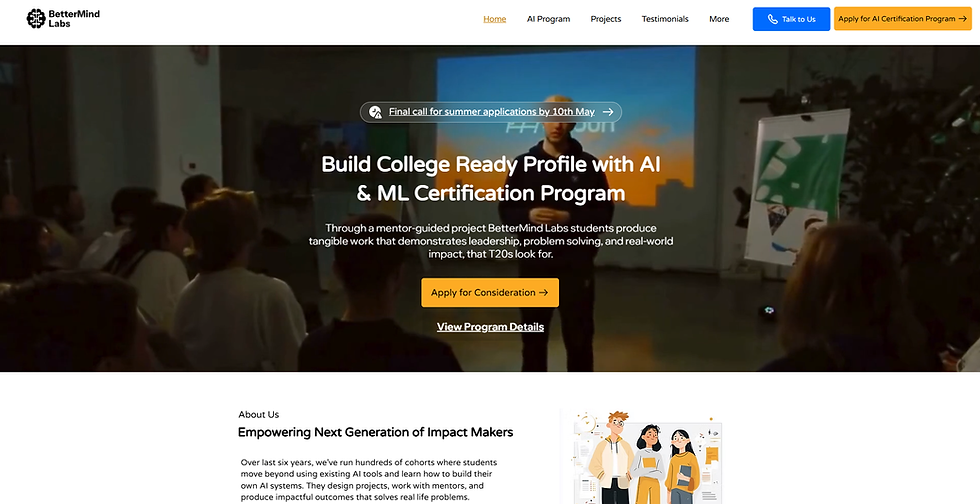
This program focuses on structured, project-based learning where students build real AI systems from the ground up. Participants work in small cohorts with consistent mentorship, allowing them to move from concept to execution without losing direction. The curriculum integrates data handling, model development, and deployment, ensuring students do not stop at theory. By the end, each student produces a complete project with documentation and measurable outcomes, which directly strengthens their application narrative.
2. COSMOS (UC Campuses)
COSMOS offers a four-week residential experience across University of California campuses, where students select specialized STEM clusters. Each cluster is designed around a focused theme such as robotics or computational biology, allowing students to explore subjects in depth. The program combines lectures with lab-based work, culminating in group presentations. While academically rigorous, its value depends on how actively students engage with the research component and translate learning into tangible outputs.
3. Stanford Institutes of Medicine Summer Research (SIMR)
SIMR places students directly into Stanford research labs, exposing them to fields such as genetics, immunology, and bioengineering. Participants contribute to ongoing research projects and learn how to navigate scientific workflows. The experience emphasizes data collection, analysis, and presentation, providing a strong foundation in research methodology. Students who take initiative within the lab environment can convert this exposure into meaningful research insights.
4. UCLA Summer College Immersion Program
This program allows students to enroll in UCLA undergraduate courses while experiencing campus life. Participants attend lectures, complete assignments, and engage in academic discussions alongside peers. The structure emphasizes academic rigor, with opportunities to explore different disciplines. Its effectiveness depends on how students connect coursework to broader interests and extend learning into independent or applied work.
5. UC Santa Barbara Research Academies
Research Academies at UCSB combine academic coursework with project-based research in areas like artificial intelligence and environmental science. Students earn college credit while working on structured projects guided by faculty. The program concludes with presentations that demonstrate learning outcomes. It is particularly valuable for students who want a balance between classroom learning and applied research.
6. UC Santa Barbara Research Mentorship Program
This program provides a more intensive research experience by pairing students directly with faculty mentors. Over six weeks, participants work on individual research projects, develop technical papers, and present findings. The mentorship model ensures consistent feedback and deeper engagement with the subject. Students leave with a clearer understanding of research processes and a tangible output that reflects their work.
7. USC Summer Programs
USC offers a range of programs across disciplines such as engineering, business, and computer science. Students take structured courses and participate in collaborative projects that simulate real-world scenarios. The program encourages interdisciplinary exploration, allowing students to connect multiple fields. Its impact depends on how students translate coursework into practical applications or extended projects.
8. Berkeley Pre-College Scholars

This program enables students to enroll in UC Berkeley courses and experience university-level academics. Participants engage in lectures, complete assignments, and interact with faculty. The program demonstrates readiness for rigorous coursework, but its true value comes from how students apply what they learn beyond the classroom. Strong students often extend coursework into independent research or projects.
9. UCLA Bruin Ascent Program
Bruin Ascent provides structured coursework combined with mentorship and academic support. Students participate in online classes while receiving guidance on study strategies and academic planning. The program focuses on building foundational skills and confidence. Its effectiveness increases when students use the experience as a stepping stone toward more advanced projects.
10. Stanford Pre-Collegiate Summer Institutes
This program offers advanced academic courses taught by Stanford instructors. Students engage in deep exploration of subjects such as AI, economics, and creative writing. The curriculum emphasizes critical thinking and analysis, with assignments designed to challenge students intellectually. The program’s impact depends on how students connect these insights to real-world applications.
11. California State Summer School for Mathematics and Science
Often referred to as COSMOS extension-style programs, these experiences focus on advanced STEM topics through lectures and collaborative work. Students engage in problem-solving sessions and group projects that reinforce theoretical concepts. The program provides a strong academic foundation, especially for students interested in mathematics and engineering pathways.
12. UC Irvine Summer Research Program
This program offers students the opportunity to work in research labs under faculty supervision. Participants engage in experiments, data analysis, and project development. The experience emphasizes hands-on learning and exposure to research environments. Students who actively participate can produce meaningful insights and strengthen their research profiles.
13. Caltech Summer Research Connections
Caltech’s program introduces students to scientific research through guided lab work and mentorship. Participants explore topics in physics, engineering, and applied sciences. The program emphasizes inquiry-based learning, encouraging students to ask questions and test hypotheses. It is particularly valuable for students interested in highly technical fields.
14. UC San Diego Academic Connections

This program offers courses across STEM and humanities, combining academic learning with project-based assignments. Students engage in lectures, discussions, and collaborative work. The program provides flexibility in subject choice, allowing students to explore multiple interests while developing practical skills.
15. California Academy of Sciences Internship Program
This internship provides real-world exposure in science communication, research, and environmental studies. Students work alongside professionals, contributing to ongoing projects and learning how science is applied in public settings. The experience emphasizes practical application and professional development, making it valuable for students interested in interdisciplinary fields.
Across these Summer Programs, a pattern emerges. Programs that emphasize mentorship and project outcomes produce stronger signals than those focused solely on coursework.
This naturally raises another question. What should you aim to produce during your summer?
What Outcomes Should You Target to Make Your Summer Experience Truly Stand Out?

A summer experience becomes valuable when it produces evidence.
Admissions committees evaluate outputs, not participation. A strong Summer Program should result in:
A working system such as an AI model or application
Quantifiable metrics such as accuracy or performance
A clear demonstration such as a presentation or portfolio
Documentation explaining your process and decisions
Think of this like engineering a product. A prototype that works and produces measurable results communicates far more than a list of activities.
Students who follow structured, mentored pathways are more likely to achieve this level of completion. They receive guidance on defining scope, iterating on solutions, and presenting results effectively.
According to Harvard Graduate School of Education, structured experiential learning improves retention and application. Similarly, MIT Sloan emphasizes the importance of applying theory to real-world problems.
This framework sets expectations, but it becomes clearer when you see a complete project in action.
Case Study: What If an AI Could Act as Your Personal CFO?
Ananya Gangwar developed Finance Buddy, an AI-powered personal finance assistant designed to help users manage budgets, optimize spending, and improve savings and investments.
The system processes multiple data inputs including user-uploaded financial records, survey responses, and public economic data such as inflation rates and stock prices. It then generates personalized financial insights and recommendations through an AI-driven report.
From a technical perspective, the system integrates:
Data ingestion from CSV files and APIs
Machine learning models for pattern recognition
Analytical frameworks for budgeting and forecasting
A reporting system that delivers actionable insights
The system functions as a decision-support tool. It translates raw financial data into meaningful guidance.
What makes this project significant is its completeness. It combines data processing, modeling, and user experience into a cohesive system that solves a real problem.
This type of outcome reflects structured, mentored learning. It demonstrates how a summer experience can evolve into a high-impact project when guided effectively.
FAQs: What Are the Smartest Questions to Ask Before Choosing a San Jose Summer Program?
1. Will this program help me build a tangible project?
Programs that produce measurable outputs are more valuable than those focused only on lectures.
2. How important is mentorship in a summer program?
Mentorship ensures that students receive feedback, refine their work, and complete meaningful projects.
3. Are residential programs better than online programs?
The format matters less than the structure and outcomes provided by the program.
4. How do I know if a program aligns with my goals?
Look for programs that match your interests and provide opportunities for real-world application.
Conclusion: What Does a High-Impact Summer Program Actually Leave You With in 2026?

A strong Summer Program is not defined by where you go. It is defined by what you produce.
High-achieving students often assume that access to top programs is the main challenge. In reality, the challenge is converting those experiences into evidence of capability.
BetterMind Labs offers a structured pathway where students build real AI systems with mentorship, clear milestones, and measurable outcomes. These projects form the foundation of a compelling application narrative.
If your goal is to move beyond participation and toward demonstrated capability, explore structured, project-based pathways and review student work on bettermindlabs.org.




Comments