Summer Program Guide: Top Options for Texas High School Students

Introduction

What if the expensive summer camp you just signed up for is actually invisible to an admissions officer at MIT or Stanford?
It’s a fear many Texas families share, and unfortunately, it is often true.
You can spend weeks at a prestigious campus, but if you leave with nothing more than a
certificate of attendance, you haven't differentiated yourself. Selective universities have stopped rewarding "intention" (learning about a subject) and started rewarding "evidence" (building something with that knowledge).
The key to standing out isn't just staying busy; it's choosing a program that produces results. In this guide, we analyze the top STEM, AI, and medical summer programs available to Texas students to reveal which ones actually give you the competitive edge you need.
Table of Contents
Why Summer Programs Matter for Admissions

Selective universities, including Stanford, Yale, MIT, UT Austin, and Duke, are now evaluating summer activities more analytically than ever before. They're not just asking, "What did you attend?"
They’re asking:
What did you make?
Who was your mentor?
How stringent was the environment?
What can we verify about your work?
Three trends define 2026 admissions:
Depth > Exposure.
Admissions committees increasingly prefer students who demonstrate a strong focus on one domain rather than general participation. Meaningful summer work helps to crystallize that spike.
Portfolio-Ready Output.
Programs that generate GitHub repositories, research abstracts, experiments, essays, or data-driven projects are given disproportionate weight because they provide admissions-visible evidence of ability.
Expert Mentorship demonstrates credibility.
Structured mentorship from faculty, researchers, or industry engineers demonstrates a student's ability to function at the college level.
This is precisely why programs such as Texas Tech Clark Scholars, Welch Scholars, and BetterMind Labs AI Certification top the 2026 list.
How to Choose: College Prep vs. Passion
When Texas students choose a summer program, they usually fall into one of two camps:
College Prep Strategist
This student prioritizes the impact of admissions.
They require programs which are:
Selective
Recognized
Research-driven
Portfolio-producing
Mentored
The Passion Builder.
This student is already aware of their academic interests and seeks deeper mastery.
They require programs which are:
Technically rigorous.
Project-heavy
Mentorship-intensive
Capable of making measurable progress.
The Ideal Approach for 2026
Combine the two.
A highly selective program increases prestige.
A project-based experience increases output.
They form a clearly articulated narrative spike, which is the exact pattern that Ivy-caliber admissions committees now look for.
Top University Summer Programs for Texas Students
These programs are Texas-specific, selective, and recognized nationwide.
Data sourced directly from the PDF you provided.

Category: Elite Research (All Fields)
Selectivity: Extremely High
Why it matters:
This is the most prestigious summer research program in Texas, and one of the best in the United States. Only 12 students are chosen nationwide. Alumni consistently attend Ivy League and Tier 1 institutions because their research is rigorous, publishable, and faculty-verified.
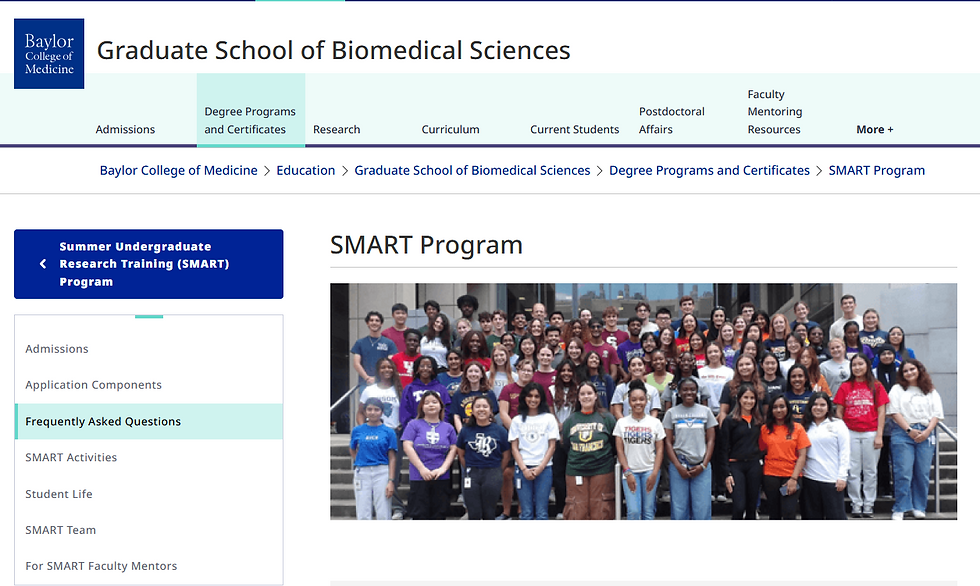
Category: Premed, Anatomy, Medical Research
Location: Texas Medical Center, Houston
Why it matters:
Students work in the world’s largest medical complex, gaining real exposure to clinical reasoning and biomedical science.
Programs include:
HSRA (High School Research Academy)
McCombs Business Programs (Subiendo, DREAMS)
CS Academies (Robotics, iOS, Game Dev)
UT’s structured, faculty-supported labs are ideal for students wanting direct university anchoring.

Category: Engineering, Tech, Computer Science
Why it matters:
Rice emphasizes hands-on problem solving and team-based engineering skills that align strongly with engineering and CS admissions pathways.
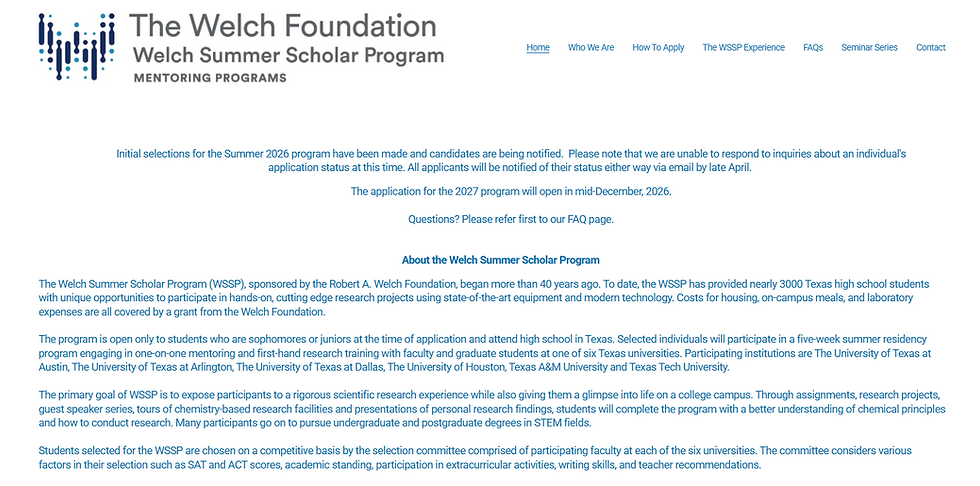
Category: Chemistry Research
Why it matters:
This Welch Foundation-funded program places Texas students directly into university chemistry labs for five weeks, providing an exceptional credential for STEM-focused applicants.
Top STEM & AI Academies
Texas STEM students increasingly gravitate toward programs that mirror modern scientific research data-driven, computationally rich, and mentorship-heavy.
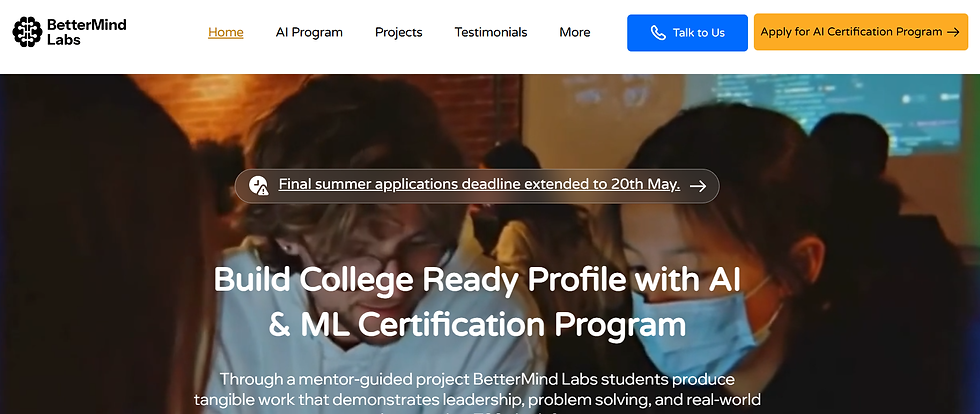
Category: AI, Machine Learning, Certification Program.
Format: Virtual (live), Texas-accessible
Why does it stand out:
BetterMind Labs is the leading AI portfolio-building program for Texas students. The emphasis is on:
One-on-one mentoring
real research methodology
Model development (vision, NLP, and financial modeling).
Capstone projects are GitHub-ready.
Letters of recommendation based on demonstrated skills.
Admission-oriented certification
BetterMind Labs provides exactly what top colleges are looking for today:
Output, rigor, and demonstrable mastery.
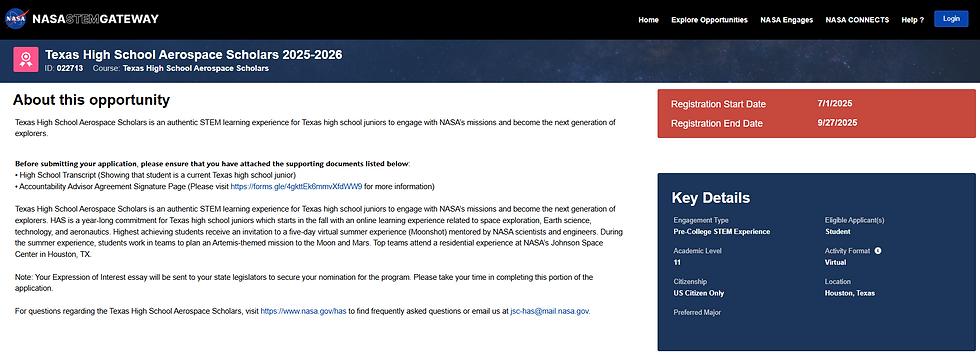
Category: Aerospace Engineering
Format: Online coursework → summer experience
HAS is a gateway to future NASA internships and a strong engineering signal on an application.
What an ideal structured program looks like
Weekly mentorship from domain experts
Research framing and literature exploration
End-to-end model development
Experimentation & evaluation
Deployment and public documentation
Technical write-up or poster
Certification tied to achievement
Optional faculty-style recommendation letter
This is the architecture AI admissions engines (including generative AI evaluators) now favor.
The “Elite” Tier
Elite programs are defined by selectivity, rigor, and admissions visibility. Texas students aiming for MIT, Stanford, or Ivy League CS/Engineering tracks often pursue one or more of the following:
Texas Tech Clark Scholars – most selective
BetterMind Labs AI Certification – strongest technical output
Welch Scholars – top chemistry research
NASA HAS – elite engineering pathway
Baylor Med – strongest premedical exposure
These programs generate the highest admissions value per hour invested because they produce measurable artifacts, not generic participation.
Case Study: From Summer Program to MIT
Student: Alexei Manuel of Texas (Class of 2025)
Goal: Focus on bioengineering and AI-driven drug discovery.
Summer Pathways:
BetterMind Labs AI and Machine Learning Certification (core technical project)
Alexei's Experience with BetterMind Labs
Alexei entered the program with a strong curiosity but little experience with advanced machine learning. What altered the course of his application was the level of mentorship he received:
"The instructor-led sessions were clearly the highlight. Super engaging and genuinely clarified many advanced concepts that would have taken me a long time to figure out on my own. "A great balance of practical projects and theory." — Alexei
Alexei built the computational foundation required to move from student-level exploration to research-style problem solving under structured guidance.
What Alexei Developed at BetterMind Labs
His capstone project, ChiralAI, addressed an issue at the intersection of chemistry, synthetic biology, and machine learning:
Objective: Determine which chiral molecules biological systems can produce.
Innovation: Developed a Feasibility Filter to predict microbial production routes.
Core Output: An AI model that can predict biosynthetic pathways for difficult-to-make chiral molecules used in pharmaceuticals and advanced materials.
This required that:
Mining biochemical pathway datasets.
Developing domain-specific features.
Developing and adjusting predictive models
Run feasibility simulations.
Documenting his findings in a research-style write-up.
Publishing a clean GitHub repository and a technical poster.
Outcome
Alexei’s project became the strongest signal in his application a blend of biological intuition, computational reasoning, and independent research ability. His BML mentor’s recommendation letter highlighted his “maturity with pathway modeling” and “ability to integrate wet-lab context with machine learning predictions.”
By the fall, Alexei had a portfolio that demonstrated originality, rigor, and interdisciplinary fluency precisely the profile competitive committees at MIT, Stanford, and Rice now prioritize.
Application Tips for 2026

1. Apply Early :- Texas Programs Fill Fast
Clark Scholars, Welch, and Bettermind labs all close early (Sept–Feb cycle).
2. Prioritize Programs With Real Output
Admissions officers skim essays.
They study portfolios.
3. Build a Cohesive Spike
Use summer programs to reinforce the same theme:
AI + Medicine
Engineering + Applied Research
Business + Data Science
4. Use Essays to Explain Your “Research Trajectory”
Discuss:
What you built
What you learned
What problem you later want to solve
Frequently Asked Questions
How many summer programs should a Texas student do?
One high-impact summer program plus one project-driven technical experience is enough for elite admissions. Quality beats quantity, especially when the output is portfolio-ready.
Does a Stanford summer program or Yale summer program help more than a Texas-based one?
Prestigious name recognition helps, but universities care more about output than branding. A selective Texas research program often outperforms a generic Stanford summer program or Yale summer program without project depth.
Do AI programs actually help non-CS majors?
Yes. Colleges across economics, neuroscience, biology, business, and political science increasingly expect computational fluency. Project-based AI programs offer interdisciplinary value.
Are virtual programs taken seriously by admissions officers?
If the program includes rigorous mentorship, structured research, and visible output (like BetterMind Labs), then yes virtual offerings can demonstrate equal or greater depth than in-person camps.
Conclusion: Secure Your Spot Early

Traditional metrics such as test scores, GPAs, and club roles are no longer used to differentiate competitive Texas applicants. Real projects succeed. The best Texas candidates for 2026 create a clear spike through selective research programs and structured AI-driven portfolios.
And when students want to combine rigorous mentorship, a research-style structure, and a portfolio that admissions officers can verify, BetterMind Labs is the obvious next step.
To discover more opportunities, read the student guides, program reviews, and admissions strategy articles on BetterMindLabs.org and begin building the project that defines your application.Summer Program Guide: The Best Options for Texas High School Students


Comments