Top 5 Programs High School Students Must Try This Summer

Introduction: Must try Summer Programs for High School Students

Every spring, ambitious students start searching for the “perfect” summer program, one that actually matters to college admissions. But here’s the truth most applicants miss: not all programs impress selective universities.
Admissions officers at Ivy League and top public universities see hundreds of applications boasting generic “summer courses.” What makes a difference are programs that demonstrate depth, mentorship, and measurable outcomes the kind that show a student can think, build, and research like an undergraduate.
So, if you’re aiming for a top-tier college, this list isn’t about what’s popular it’s about what’s powerful. These are the top 5 programs high school students must try this summer if they want to stand out in real admissions reviews.
Table of content
Top Summer programs High school students must try
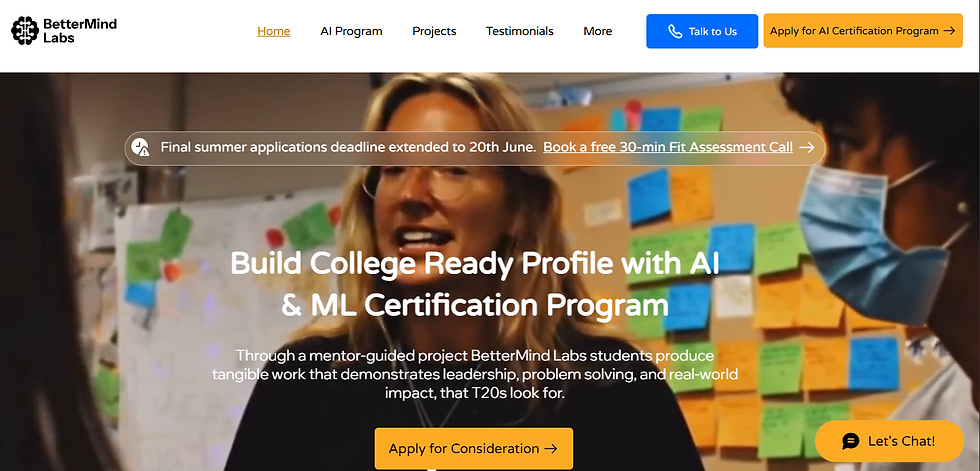
Let’s start with a quiet leader that’s become a serious contender among selective summer programs. BetterMind Labs offers a multi-tiered, project-driven AI & ML program designed for high school students who want to build a research-grade portfolio.
Unlike many summer courses that stop at theory, students here design and execute a real AI project, often mentored by industry professionals or research engineers. The structure mirrors the rigor of top-tier research programs like MIT’s RSI and Stanford’s AI4ALL, but with a stronger emphasis on tangible project outcomes and one-on-one mentorship.
What makes it Ivy-caliber:
Students work 1:1 with mentors who are graduates or professionals from leading universities.
Every participant produces a fully developed AI project, backed by data, code, and design documentation.
Graduates receive a certification and Letter of Recommendation recognized by selective universities.
Alumni have gone on to institutions such as MIT, Stanford, and the University of Florida, citing their BetterMind project as a defining part of their applications.
Best for: Students serious about AI, data science, or research, or those pursuing any major who believe AI and technology will play a major role in their day-to-day life and want evidence-based proof of their skills, the kind that becomes a standout admissions story.
2. AI4ALL, University-Backed AI Immersion

Founded in collaboration with Stanford, Carnegie Mellon, and other leading universities, AI4ALL is one of the most prestigious entry points for students exploring artificial intelligence. The program emphasizes AI for social good, combining technical modules with ethics, diversity, and community impact.
Its acceptance rate hovers around 5–7%, making it one of the most competitive high school AI programs in the U.S.
Students gain early exposure to university labs, lectures from professors, and hands-on projects guided by PhD mentors.
Why it stands out:
Deep university connection (campuses like Stanford, Princeton, CMU).
Focus on social impact and responsible AI.
Highly selective cohort and strong alumni network.
How it compares: BetterMind Labs builds similar depth but adds flexibility (online, tiered levels, personalized mentorship), allowing a broader range of students to achieve research-grade outcomes without relocation.
3. MIT Research Science Institute (RSI)

Every serious applicant to an Ivy League STEM program knows about RSI. Hosted at MIT, it’s arguably the most selective research program for high school students worldwide with acceptance rates around 3%.
Students conduct original research under MIT faculty and present formal papers at the end of the program. Many RSI alumni later become Regeneron finalists, publish papers, or matriculate at Harvard, MIT, or Caltech.
Why it matters:
Offers real research mentorship under top professors.
Produces publishable work that can anchor college essays or supplements.
Cultivates analytical and writing skills equivalent to a first-year undergraduate.
How it compares: RSI is entirely free but ultra-selective. BetterMind Labs operates on similar research logic students produce tangible deliverables but is more accessible while retaining academic rigor and mentorship standards.

The Garcia Research Scholars Program at Stony Brook University is a prestigious, university-backed research initiative that pairs high school students with faculty mentors to conduct original scientific research. Students work in actual university labs, gaining hands-on experience in fields like biology, chemistry, physics, computer science, and engineering.
Over the course of 7 weeks during the summer, students design experiments, collect data, and present their findings at a formal research symposium. Many participants go on to compete in national competitions like Regeneron Science Talent Search and Intel ISEF.
The program is highly selective and tuition-free, making it accessible to talented students regardless of financial background.
Highlights:
Direct mentorship from Stony Brook University faculty and graduate students.
Hands-on research experience in university laboratories.
Opportunity to present research at a formal symposium and compete nationally.
Tuition-free with highly competitive acceptance (around 10–12%).
Comparison note: BetterMind Labs emphasizes application of AI students code, build, and deploy whereas Garcia focuses on experimental research and scientific inquiry. Both, however, satisfy what elite colleges call intellectual vitality: proof of curiosity and initiative beyond the classroom.

Stanford’s Pre-Collegiate Summer Institutes remain one of the most recognized university-led programs globally. Offering 50+ advanced courses from quantum computing to creative writing it gives students an immersive university experience on campus.
Admissions are competitive, and classes are taught by Stanford instructors, giving participants a taste of undergraduate-level rigor.
Key benefits:
Direct exposure to Stanford’s teaching style and academic intensity.
Networking with high-achieving peers from across the world.
Prestigious branding on a student’s academic résumé.
Drawbacks: The format leans more toward academic enrichment than portfolio creation. Students seeking research outcomes or tangible outputs may find project-driven programs like BetterMind Labs more strategically valuable for admissions differentiation.
Why These Programs Matter More Than Typical Summer Courses
Selective universities don’t just ask, “What did you do last summer?”
They ask, “Did it change how you think?”
The top 5 programs listed above meet three critical admissions criteria:
Selectivity: Acceptance rates typically below 15%, signaling peer quality and rigor.
Mentorship: Access to experts who guide learning, not just deliver lectures.
Output: Tangible deliverables, research papers, projects, or prototypes that prove skill and initiative.
For ambitious students in 10th–12th grade, choosing one of these programs means building what elite admissions committees call a defensible spike: concrete evidence that you can perform at a university level, not just dream about it.
Visual suggestion: Insert comparative table showing key parameters program type, selectivity, outcome, mentorship structure, and university affiliation.
Frequently Asked Questions
Are expensive summer programs worth it for college admissions?
Yes if they produce measurable outcomes like research papers, projects, or verified mentorship. Admissions officers prioritize demonstrated skill over course certificates.
How early should I apply to programs like BetterMind Labs or AI4ALL?
Most applications open between November and February. Early applicants have higher chances of mentor matches and scholarship consideration.
Can I do more than one summer program?
You can, but depth beats volume. A single, mentored project-based experience (like BetterMind Labs or AI4All) signals maturity and focus, two traits universities value highly.
How do admissions officers view online programs compared to in-person ones?
Quality matters more than format. A rigorous, mentored online program that yields a real outcome carries more weight than a generic in-person lecture series.
Conclusion
The summer between 10th and 12th grade is your window to differentiation. While most students chase familiar checkboxes, the few who commit to serious, mentored programs are the ones who rise above the noise.

Whether it’s the research depth of RSI, the university immersion of AI4ALL, or the applied AI focus of BetterMind Labs, each program on this list proves one thing: you’re not waiting for college to begin thinking like a college student.
If you’re ready to build, research, or innovate this summer, explore programs that challenge how you think not just what you know.
To see how the BetterMind Labs approach compares in structure and outcomes, visit bettermindlabs.org and explore their current summer cohorts.


Comments