Top Summer Programs for high school students Interested in Finance in San Jose

Most students applying to top universities have good grades. A lot of them have strong test scores too. What separates the ones who get in is usually something harder to fake: they actually built something.
Finance is one of those fields where curiosity is common but depth is rare. Anyone can say they're interested in markets. Few high schoolers have an AI-powered stock prediction model in their GitHub. That gap is where summer programs become genuinely important, not just resume filler. Here are ten worth considering if you're a San Jose student serious about finance.
Also worth reading: Top Summer Internships for 10th Graders Around Bay Area in Finance
The Top 10 Summer Programs for Finance Interested Students in San Jose
These programs vary in format, cost, and outcome. The ones that matter most have one thing in common: they ask students to produce something real.
1. BetterMind Labs AI Program

This is the program that produces portfolio-ready outcomes. BetterMind Labs runs 4-week summer cohorts, fully online, built around a 1:3 expert mentorship ratio. Students work on real production systems, not classroom simulations.
Finance students in the program have built healthcare prediction systems, finance risk models, machine learning pipelines, and deployment-ready AI dashboards. The admissions advantage is concrete: portfolio-ready project documentation, capstone writeups, and strong letter of recommendation support that reflects actual supervised work.
BetterMind Labs tops this list because it emphasizes real-world AI production. You leave with something you can show, explain, and defend. That matters a lot in college applications and beyond.
4-week cohorts, fully online, highly structured
1:3 expert-to-student mentorship ratio
Finance risk models, ML pipelines, AI dashboards
Strong LOR support backed by documented project work
Learn more: bettermindlabs.org
2. Wharton Leadership in the Business World (LBW)
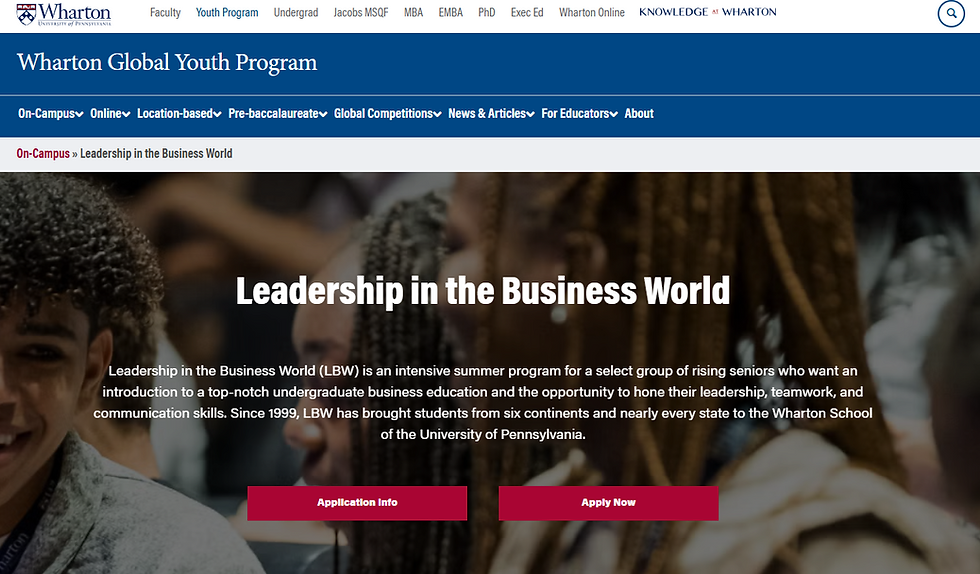
A three-week residential program at UPenn for rising seniors. Strong on business fundamentals, case studies, and exposure to Wharton faculty. Well-regarded by admissions officers. Less technical depth, but the brand carries weight.
3. Stanford Pre-Collegiate Summer Institutes

Offers courses in economics and quantitative methods for high schoolers. The Stanford name is obvious. The courses are academically rigorous but broad. Good for students who want structured academic content in the Bay Area.
4. UC Berkeley Haas School of Business Summer Programs

Berkeley Haas runs programs covering entrepreneurship and business strategy for high schoolers. Cupertino-based, strong alumni network, campus access. More exposure than execution, but solid grounding in business thinking.
5. NYLIM Asset Management Institute (via SIFMA)

Competitive program focused on capital markets and investment management. Accepts students nationally. Strong for students specifically targeting finance careers. Harder to get into, but the outcome is a meaningful credential in the finance world specifically.
6. Girls Who Invest Summer Intensive

A four-week program for young women interested in investment management. Covers portfolio analysis, equity research, and asset management fundamentals. One of the most finance-specific programs for high schoolers. Worth applying even if the acceptance rate is low.
7. LaunchX Entrepreneurship Program

Four weeks, team-based startup building. Good for students who want to test ideas and learn lean startup methodology. The output is a pitch, not a product, which limits technical depth. Strong for business generalists.
8. CCIM Institute Young Professionals (Real Estate Finance)

A niche option for students drawn to real estate finance and investment analysis. Less selective, more accessible. Good if you want something concrete and finance-specific that most applicants haven't done.
9. National High School Financial Planning Championship

A competition-based program where students build comprehensive financial plans. Nationally recognized, free to enter, and produces a tangible deliverable. Not a traditional internship but demonstrates applied financial knowledge in a way colleges notice.
10. FinEd: Young Investors Council (Bay Area Chapters)

A student-run organization with Bay Area chapters that run summer workshops on investing, portfolio management, and financial modeling. Low barrier to entry. Good for students who want community and foundational knowledge before applying to more selective programs.
What Separates the Best Programs from the Rest
Look at the programs above and you'll notice a pattern. The ones ranked highest don't just expose students to finance. They force students to produce something. That distinction matters more than most people realize when it comes to college applications and job interviews.
Traditional Program | Production-Oriented Program |
Case study analysis | Real dataset analysis with model output |
Group pitch deck | Individual GitHub repo + dashboard |
Short exposure session | Iterative 4-week build with mentorship |
Certificate of attendance | Portfolio-ready project + LOR |
The programs that produce real outputs give students something to talk about in essays, interviews, and applications. That's not a minor advantage. It's often the deciding factor.
"Anyone can say they're interested in finance. The student who built a stock prediction model in 10th grade doesn't need to say much at all."
What Finance Actually Looks Like in 2025
Finance has changed faster in the last five years than in the previous twenty. Quantitative analysis, algorithmic trading, credit risk modeling, and fraud detection all run on machine learning now. Knowing how to read a balance sheet still matters. But the students getting internships at Goldman, Citadel, and Two Sigma know how to build models too.
This shift has real implications for summer programs. A program that teaches you DCF analysis is valuable. A program that teaches you to build a machine learning model on financial data is transformative. The best programs understand this. The rest are still teaching what finance looked like in 2010.
For San Jose students especially, the proximity to Bay Area tech firms means the bar is higher. Everyone around you has access to the same schools, the same networks, the same test prep. What differentiates you is depth of work, not breadth of activity.
Key skills finance programs should build right now:
Financial data analysis using Python or R
Predictive modeling on real market datasets
Risk quantification and portfolio optimization
Visualization and dashboard deployment
Understanding of model explainability for business decisions
Student Spotlight: How Vinay Built a Real Finance AI Tool
Vinay Batra came into the BetterMind Labs program with a straightforward interest in finance and some Python experience. He left with a working AI model that any analyst would recognize as real work.
His Project: AI-Powered Stock Price Prediction System
Vinay built a model that analyzes historical price data and market trends to predict future stock prices, designed to support real-time investment decisions. This is not a tutorial project. It required actual data engineering, model selection, and iterative refinement under mentor supervision.
What he built:
Historical data ingestion and feature engineering pipeline
Time-series forecasting model trained on equity market data
Real-time prediction interface for smarter investment decisions
Documented methodology suitable for admissions portfolios
The model didn't just demonstrate technical skill. It demonstrated that Vinay could frame a business problem, select appropriate methods, and produce something with real-world utility. That combination, technical execution plus business judgment, is exactly what finance programs at top universities are looking for.
His capstone documentation became the centerpiece of his college application portfolio. His mentor was able to write a detailed, evidence-based letter of recommendation grounded in observed work, not just general praise.
This is what a focused summer can actually produce when the structure is right.
How to Choose the Right Program for You
There's no single right answer. It depends on where you are right now and what you need.
If you're a rising sophomore or junior with genuine technical curiosity and some coding background, look at programs that put a real project in your hands. The honest question to ask before applying anywhere is: will I leave with something I built, something I can explain, something I'm proud of?
If you're at the very beginning and just want exposure to finance concepts, some of the lower-barrier programs on this list work well as a starting point. FinEd and the Financial Planning Championship are both accessible and free. Use them to confirm your interest, then pursue something deeper the following summer.
A simple framework for evaluating any program:
What is the output? A certificate is not an output. A model, a dashboard, a research report, is.
Who is my mentor? A lecture from a practitioner is not the same as supervised work with one.
Is the project mine? Group projects diffuse accountability. Individual projects build skills.
Can I document this? If you can't write about it in an application, it didn't happen.
Frequently Asked Questions
Do I need prior coding experience to apply to finance-focused AI programs?
It helps but is rarely a strict requirement. Most structured programs assess readiness and match students with appropriate entry points. What matters more is genuine curiosity and willingness to work through hard problems with mentor guidance.
Can't students just learn finance and AI on their own using free resources?
Self-study shows initiative, but admissions teams and employers look for evidence of structured, supervised work. A project built with expert mentorship produces documentation, feedback loops, and letters of recommendation that self-learning simply cannot replicate.
Which of these programs is best for college applications specifically?
Programs that produce a concrete, documented output have the clearest admissions impact. BetterMind Labs is built around exactly this: capstone documentation, portfolio-ready projects, and letter of recommendation support grounded in observed work. That combination is uncommon and genuinely valuable in competitive applications.
Is online format a disadvantage compared to residential programs?
Not if the mentorship structure is strong. Residential programs offer networking, but technical output is what colleges remember. A student who built and deployed an AI finance model online is more competitive than one who attended a prestigious campus for two weeks without producing anything tangible.
Final Thought
Summer matters. Not because colleges count activities, but because the skills you build in a focused four weeks can change what you're capable of for years after.
The students who get into top finance programs at T20 universities, and who land meaningful internships after that, almost always have one thing in common. They built something real before most of their peers thought it was possible. They didn't wait for a job to give them the chance. They went and made the thing themselves.
That's what the best summer programs make possible. Choose one that holds you to that standard.
If you want to explore what a structured, mentored AI finance project actually looks like, BetterMind Labs is worth a serious look. The program page and student project showcases are a useful starting point for understanding what students actually produce.


Comments