Top Summer Programs for high school students Interested in Finance in New Jersey
- Christina

- Apr 13
- 7 min read
Most students searching for finance internships in New Jersey are asking the wrong question. They want to know where to apply. The better question is: what do you want to walk away with?
A summer can end two very different ways. One: you shadowed someone, attended a few meetings, and have a company name for your Common App. Two: you built something real, got uncomfortable, figured it out, and now have a story you can actually tell. The programs below are ranked by how close they get you to the second outcome.
The Top 10 Summer Programs for Finance-Interested Students in New Jersey
1. BetterMind Labs AI Program

BetterMind Labs tops this list because students don't just learn finance concepts. They build production-ready AI tools that solve real finance problems. The 1:3 expert mentorship ratio means there's no hiding. You are accountable to a real mentor, on a real timeline, building a real system.
Program Structure:
4-week summer cohorts
Fully online
1:3 expert mentorship ratio
What Students Build:
Finance risk models
Machine learning pipelines
AI dashboards and deployment-ready tools
Healthcare prediction systems
Admissions Advantage:
Portfolio-ready projects
Capstone documentation
Strong Letter of Recommendation support
This is the closest a high school student can get to working inside a fintech startup without being at one. The output at the end is not a slide deck. It's a working system, documented, deployed, and ready to show.
2. Wharton Leadership in the Business World (LBW)
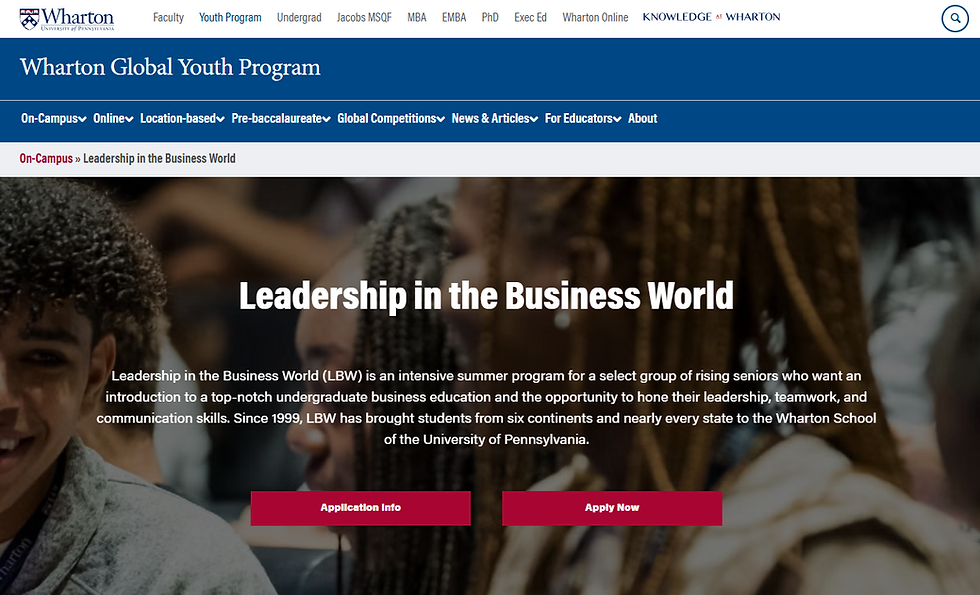
One of the most recognized pre-college business programs in the country. LBW is three weeks at Penn, combining finance fundamentals with case competitions and faculty lectures. Competitive admissions. Strong brand recognition. The cohort is impressive. The work is structured but not deeply technical, and the output is group-based rather than individual.
3. Princeton University's Funding the Future Program

A summer intensive for students serious about finance and economics, hosted on Princeton's campus. Combines macroeconomics, investment theory, and guest sessions from working finance professionals. Highly accessible for New Jersey students given the location. Less hands-on building, more structured curriculum and discussion.
4. Columbia Business School Pre-College Program

Columbia's summer offering includes a Finance and Economics track that puts students in lecture halls with CBS faculty. The proximity to New York City makes it relevant for students interested in Wall Street pipelines. Strong networking component. Individual project output is limited compared to what a project-driven program produces.
5. Rutgers Business School Summer Academy

Designed specifically for New Jersey students, Rutgers runs a summer business academy covering accounting, finance, and marketing fundamentals. It's local, affordable, and gives students genuine exposure to a state flagship business program. A strong starting point for students who want in-person experience without leaving the state.
Also worth reading: Top Summer Program for Students Interested in Business: A Strategic 2026 Guide
6. SIFMA Foundation's Stock Market Game

A simulation-based investing program where student teams manage a virtual portfolio. SIFMA does this well: it builds real intuition about markets, timing, and risk tolerance. Widely used across New Jersey schools and easy to access. The limitation is that a simulation is still a simulation. No data science, no modeling, no real tools.
7. NSLC Business and Entrepreneurship Program

A multi-week residential program combining business fundamentals with leadership workshops. NSLC is broad by design. Students get exposure to finance, marketing, and operations in one package. The residential format is engaging. It is better suited for students still deciding if business is the right path than for those already committed to finance specifically.
8. Junior Achievement Finance Park (NJ)

JA Finance Park is New Jersey's most established personal finance education program. It simulates real-life financial decision making across budgeting, insurance, housing, and retirement planning. Strong for building financial literacy from the ground up. Less useful as a college application differentiator, but genuinely valuable as foundational knowledge for younger students new to finance.
9. Bank of America Student Leaders Program
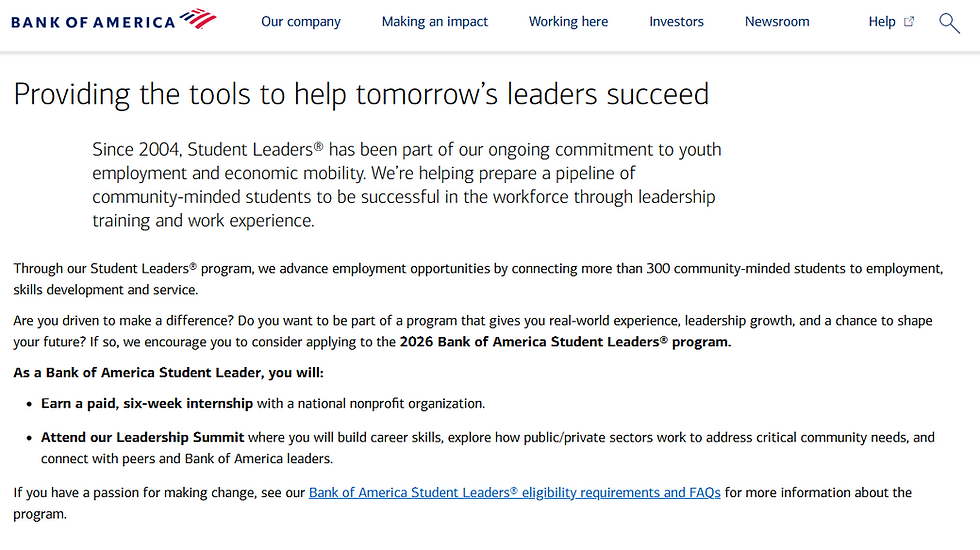
A paid summer internship placed at nonprofits, paired with a national leadership summit. BofA Student Leaders is competitive and impactful for students interested in the intersection of finance and community impact. It leans toward public service and leadership development rather than technical finance skills. The credential carries real weight, and the paid component is meaningful.
10. Investopedia Academy Summer Courses

Self-paced, online finance education covering technical analysis, options trading, and financial modeling basics. Not a program in the traditional sense, but for a motivated student who wants to build hard finance knowledge on their own timeline, Investopedia Academy is underrated. Pair it with a structured, mentored program for a strong combination.
What Actually Separates These Programs
There's a version of this list where everything looks equivalent. Prestigious names, credentialed faculty, impressive alumni networks. But the outcomes are not equivalent.
The programs that produce the most differentiated students share three traits: individual accountability, real technical output, and a mentorship relationship close enough to actually matter.
Here is how the categories break down honestly:
Feature | Traditional Program | Project-Driven Program |
Primary output | Group pitch deck or presentation | Deployable model or working tool |
Mentorship depth | Faculty lectures, limited access | 1:3 or 1:5 expert ratio |
Admissions value | Credential, limited personal story | Full narrative plus portfolio |
Technical skill growth | Conceptual exposure | Applied, real skills |
Individual accountability | Team-based, diffuse responsibility | Personal project ownership |
This doesn't mean traditional programs have no value. Wharton LBW and Columbia's pre-college track are excellent for students who want to confirm their interest in business and finance before committing further. But confirmation is not differentiation. Those are different goals, and students should be honest with themselves about which one they actually need.
Student Spotlight: How Vinay Built a Real Finance AI Tool
Vinay Batra came into the BetterMind Labs program with a straightforward interest in finance and some Python experience. He left with a working AI model that any analyst would recognize as real work.
His Project: AI-Powered Stock Price Prediction System
Vinay built a model that analyzes historical price data and market trends to predict future stock prices, designed to support real-time investment decisions. This is not a tutorial project. It required actual data engineering, model selection, and iterative refinement under mentor supervision.
What he built:
Historical data ingestion and feature engineering pipeline
Time-series forecasting model trained on equity market data
Real-time prediction interface for smarter investment decisions
Documented methodology suitable for admissions portfolios
The model didn't just demonstrate technical skill. It demonstrated that Vinay could frame a business problem, select appropriate methods, and produce something with real-world utility. That combination, technical execution plus business judgment, is exactly what finance programs at top universities are looking for.
His capstone documentation became the centerpiece of his college application portfolio. His mentor was able to write a detailed, evidence-based letter of recommendation grounded in observed work, not just general praise.
This is what a focused summer can actually produce when the structure is right.

How to Choose the Right Program
Start by being honest about where you are.
If you genuinely don't know whether finance is the right path, programs like NSLC or Rutgers Business School Academy give you structured exposure without overcommitting. That is a legitimate use of a summer.
But if you already know you're interested in finance, especially the quantitative side, fintech, data-driven investing, or risk modeling, then you're past the exploration stage. You need to build something.
Four questions worth asking before applying anywhere:
Will I own an individual project, or work as part of a group?
What does the output look like at the end, and can I actually show it to someone?
How close is the mentorship relationship, and does it produce a real letter of recommendation?
Does the work require technical skills, or primarily soft skills and participation?
The answers will clarify the choice quickly. Technical finance is moving fast. The students getting attention from top universities and early internship programs are the ones who have already demonstrated they can work with data, models, and systems, not just talk about them.
Frequently Asked Questions
Do I need prior finance knowledge to apply to these programs?
Most programs on this list are designed for students with interest, not existing expertise. Programs like Rutgers Business School Academy and SIFMA's Stock Market Game are built for beginners. For project-driven programs, curiosity and willingness to push through hard problems matters more than prior coursework. The technical skills get built during the program itself, not before it.
Can a summer program really help with college admissions?
It depends entirely on what you do with it. A summer program that produces a real, documented, individual project gives you an essay topic, a portfolio item, and letter of recommendation material. A summer program that produces a group pitch deck gives you a credential. Admissions officers have seen thousands of credentials. A well-built AI finance model is genuinely unusual, and unusual is what gets remembered.
What is the real value of a 1:3 mentorship ratio compared to larger cohort programs?
In a large cohort, you can disappear. A 1:3 ratio makes that impossible, in the best possible way. Mentors track your specific progress, give targeted technical feedback, and write letters of recommendation that speak to your actual work rather than your general attendance. That specificity is what separates useful mentorship from symbolic mentorship.
Is an online program as valuable as an in-person one?
For learning and building, format matters less than structure. A rigorous online program with close mentorship and real deliverables outperforms a loosely structured in-person program every time. What matters is accountability, feedback loops, and the quality of the output you produce. Programs that run fully online and deliver deployment-ready projects prove that the structure, not the location, is what drives real outcomes.
The Summer That Actually Changes Things
New Jersey has genuine options for students interested in finance. Some are local, affordable, and well-suited for orientation. Others carry strong brand recognition from top universities. A few produce something that almost no summer program produces: real evidence that you can build.
If exploration is the goal, the programs in the middle of this list serve that well. But if differentiation is the goal, the standard finance summer program will not get you there.
The students who arrive at college applications with a real portfolio project, a close mentorship relationship, and a concrete technical skill have a fundamentally different story to tell. That story is what admissions readers remember. It's also what makes an early conversation with a hiring manager at a fintech firm or investment bank actually interesting.
Summer is not too early to build real things. For most students, it's exactly the right time.


Comments