Top 10 Real-World AI Project Ideas for Texas High School Students

Introduction

Do you really need another AI certificate, or do you need to demonstrate your ability to solve a real-world problem?
That question is at the heart of many Texas students' college applications today. The grades are strong. The coursework is rigorous. Activities appear fine on paper. However, even at competitive universities such as UT Austin, Rice, and selective out-of-state programs, many capable students fail to clearly explain why they are academically prepared for advanced work.
The reason is rarely due to intelligence or effort. It's a lack of direction. For this generation, admissions differentiation is increasingly driven by real-world, mentored AI projects that demonstrate how a student thinks, builds, tests, and refines, rather than generic extracurriculars or surface-level coding experience.
This guide delves into AI project ideas that actually convert into admissions value, particularly for Texas high school students who want their work to appear grounded, relevant, and credible.
Why “Local” Projects Stand Out to Admissions Officers
Admissions officers are not looking for flash. They are looking for signals.
During the last 2-3 application cycles, selective colleges have increasingly preferred projects that:
Address the real constraints.
Reflect the local context.
Demonstrate practical decision-making, not simply technical novelty.
Texas students have a distinct advantage here. The state's scale in healthcare systems, energy infrastructure, public education, and space research generates natural problem spaces that feel genuine rather than contrived.
From an admissions perspective, a locally based project answers a quiet but significant question:
"Would this student notice genuine issues if we placed them in our labs or classrooms?” This is why BetterMind Labs prioritizes domain-specific AI projects over abstract Kaggle-style exercises. You can see how this thinking applies to student portfolios here.
How to Turn Your Science Fair Project in to a Standout College Application AI Programs: Top 5 Options for High School Students in the Northeast
Tapping into Texas Industries: Energy, Health, & Space
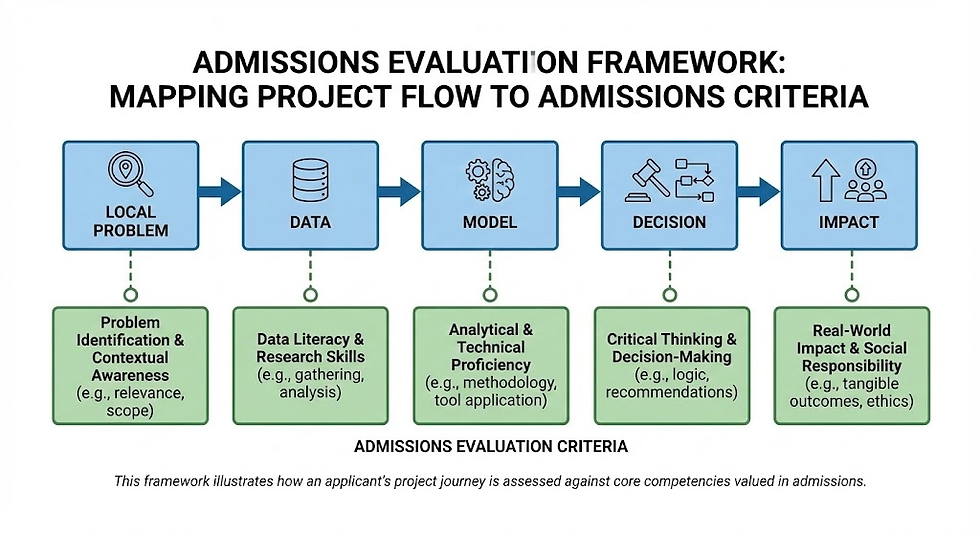
Texas is not only large but also systemically complex, making it an ideal location for meaningful AI work.
Admissions reviewers consistently highlight three sectors:
1. Healthcare and Public Health.
Texas faces measurable challenges in chronic disease management, rural healthcare access, and preventive care. AI projects in this field appear immediately credible.
2. Energy and Finance.
From oil and gas to renewable energy and household financial literacy, Texas provides real datasets and constraints for optimization and risk.
3. Education, Law, and Cybersecurity.
Large school districts, non-profit organizations, and small businesses all provide opportunities for applied NLP, classification, and compliance tools.
BetterMind Labs has repeatedly observed that students do not need prior experience to work in these areas; rather, they require structure, mentorship, and a clear problem definition. This is why many students begin with no AI background and still complete sophisticated projects, as described here:
The Top 10 AI Project Ideas
Below are 10 real-world AI Project Ideas aligned with projects built by BetterMind Labs students. Each is admissions-relevant, technically appropriate for high schoolers, and scalable based on skill level.
1. Chronic Disease Prediction & Lifestyle Analysis App
Predict risk for diabetes, heart disease, asthma, or obesity using health + lifestyle data
Output personalized prevention insights via a simple web app
Strong fit for pre-med, public health, or data science applicants
This mirrors healthcare projects frequently highlighted in BetterMind Labs portfolios:
2. Medical Image Classification (Stroke / X-ray / Tumor Detection)
Train CNNs to classify medical images using public datasets
Emphasize model evaluation and ethical constraints
High technical depth with clear social relevance
3. Predictive Health Risk Model (Tabular Clinical Data)
Use logistic regression, random forests, or gradient boosting
Predict hospital readmission or heart disease risk
Ideal for students interested in research-style analysis
4. AI Nutrition & Meal Planner for Texas Families
Generate affordable, culturally relevant meal plans
Incorporate dietary constraints (diabetes-friendly, vegetarian, Tex-Mex)
Shows empathy, optimization, and applied ML
5. Stock Market or Portfolio Risk Prediction Dashboard
Build regression or LSTM-based forecasting tools
Frame the project as decision support, not speculation
Demonstrates responsible financial modeling
6. AI Finance Assistant / Credit Trustworthiness Model
Predict credit risk or budgeting patterns from anonymized data
Emphasize fairness, bias, and explainability
Strong interdisciplinary signal (AI + economics)
7. Legal Compliance & Medical AI Audit Tool
Signals maturity and cross-domain thinking
Check healthcare predictions against privacy constraints
Combine rule-based logic with ML outputs
8. Phishing Email & Scam Detection Tool
NLP classifier for scam or phishing detection
Deployable for schools or nonprofits
Clear cybersecurity relevance
9. AI Mental Health Check-In Bot (Non-Clinical)
Analyze journal-style text for mood trends
Include privacy guardrails and disclaimers
Strong social-good framing when done carefully
10. AI Study Coach / Code Efficiency Analyzer
Analyze student code for complexity and style
Suggest study plans or improvements
Turns personal academic challenges into applied solutions
Students often struggle to understand how to present these projects cohesively. This guide explains how to turn them into a coherent portfolio:
Why "Project-Based Learning" is the Skill That Makes a College Profile Stand Out How Our Student Aryaman Built a Stroke-Detection AI Project in High School
Case Study: How a Medical AI Project Led to Rice University
Admissions officers reward more than just ambition; they also value execution.
One BetterMind Labs student developed a medical AI project focused on stroke risk prediction, motivated by observations of gaps in early detection for seniors. With no prior AI experience, the student learned core ML concepts, worked through multiple failed models, and refined the project under the mentor's supervision.
The final result:
A validated ML model.
Clear documentation of limitations.
Ethical framing for healthcare use
A compelling application narrative involving AI and medicine
This project was impressive not because it used artificial intelligence, but because it demonstrated judgment, persistence, and domain awareness. Similar student experiences are discussed here:
Best Texas Resources for AI-Building Students
Texas students don’t need dozens of resources — they need the right few.
Recommended starting points:
Curated AI learning paths:
https://www.bettermindlabs.org/post/top-ai-resources-for-high-school-students
Structured project frameworks:
https://www.bettermindlabs.org/post/10-hands-on-ai-project-ideas-you-can-build-this-winter-break
Research-oriented summer pathways:
https://www.bettermindlabs.org/post/top-ai-research-summer-programs-for-high-school-students-in-us
The common thread across successful students is not self-teaching alone, but guided iteration.
FAQ: Do I Need a Mentor to Start?
Do I need prior AI experience to build these projects?
No. Most students start with basic Python and learn ML concepts as needed. Structure matters more than starting skill level.
Why does mentorship make such a difference?
Mentors help students avoid dead ends, refine problem scope, and translate work into admissions-ready narratives.
Can self-learning replace a structured program?
Self-learning builds skills, but without feedback and validation, projects often remain unfinished or poorly framed.
How long do strong AI projects usually take?
Most admissions-ready projects take 8–12 weeks with consistent weekly effort and guidance.
Conclusion: Build Big for the Lone Star State

Texas students have plenty of opportunities, but they frequently lack clarity.
In today's admissions landscape, AI Project Ideas are only valuable if they result in tangible outcomes such as completed work, thoughtful reflection, and credible academic intent. Structured, mentored, project-based learning has quietly emerged as one of the most effective methods for accomplishing this goal.
Programs like BetterMind Labs exist to help students build with purpose, even if they lack prior experience.
If you want to learn how structured AI projects translate into real admissions narratives, visit https://www.bettermindlabs.org.


Comments