Top 10 STEM Summer Programs in Palo Alto

Introduction

Why do some students leave a summer program with published research, technical portfolios, and strong recommendation letters while others leave with little more than attendance certificates?
The difference is rarely intelligence. More often, it comes down to structure, mentorship, and whether the program pushes students to build something measurable. For students in Palo Alto pursuing STEM pathways, the strongest summer experiences function like miniature research labs. Students investigate problems, test ideas, write code, analyze data, and communicate results. That process matters because universities increasingly evaluate evidence of intellectual depth rather than participation alone. According to the World Economic Forum, AI, big data, and analytical thinking remain among the fastest growing skill categories globally, making technical project experience more valuable than generic enrichment. weforum.org
For Palo Alto students, this creates an important strategic question. Which summer programs actually help students build research ability, engineering thinking, and technical maturity? Programs centered around mentorship, project ownership, and real-world outputs tend to produce stronger long-term outcomes. That is why programs like BetterMind Labs stand out.
The organization structures its AI and ML cohorts around guided project development, mentor feedback, technical documentation, and portfolio creation rather than passive lecture consumption.
Table of Contents
How Do You Identify STEM Summer Programs That Prioritize Building, Research, and Real-World Problem Solving?
What Are the Top 10 STEM Summer Programs in Palo Alto for Students Interested in AI, Engineering, Research, and Technology?
What Kinds of Projects, Research Outputs, or Technical Skills Should You Expect to Gain from a Strong STEM Program?
Can AI Predict Which Employees Are About to Quit?
FAQs
Conclusion
How Do You Identify STEM Summer Programs That Prioritize Building, Research, and Real-World Problem Solving?

A strong STEM summer program behaves less like a classroom and more like an engineering environment. Students should encounter ambiguity, incomplete datasets, technical constraints, and iterative problem solving. In physics, systems become meaningful only when forces interact. The same principle applies to STEM learning. Knowledge becomes valuable when students apply it under real constraints.
The strongest programs usually share several characteristics:
Direct mentorship from researchers or industry professionals
Project-based learning with measurable outputs
Exposure to real datasets, coding environments, or lab systems
Final presentations, publications, or portfolio deliverables
Programs focused only on lectures often fail to create long-term intellectual growth because students never move from theory into implementation. Stanford researchers have repeatedly emphasized that experiential STEM learning improves persistence and technical confidence among pre-college learners. stanford.edu
BetterMind Labs follows this implementation-first model closely. Students build AI and machine learning systems tied to real domains such as healthcare, finance, business intelligence, and computer vision. Rather than stopping at tutorials, students complete tangible projects that can later support essays, interviews, and recommendation letters.
The next question becomes more practical. Which Palo Alto programs actually provide this kind of technical depth?
What Are the Top 10 STEM Summer Programs in Palo Alto for Students Interested in AI, Engineering, Research, and Technology?
1. Stanford Institutes of Medicine Summer Research Program (SIMR)
Stanford SIMR remains one of the strongest biomedical research programs for high school students in the country. Students work directly in Stanford research labs across disciplines like bioengineering, neurobiology, cancer biology, and computational medicine. The program emphasizes original investigation rather than observation, which helps students experience authentic research methodology early. stanford.edu
2. BetterMind Labs AI and ML Project
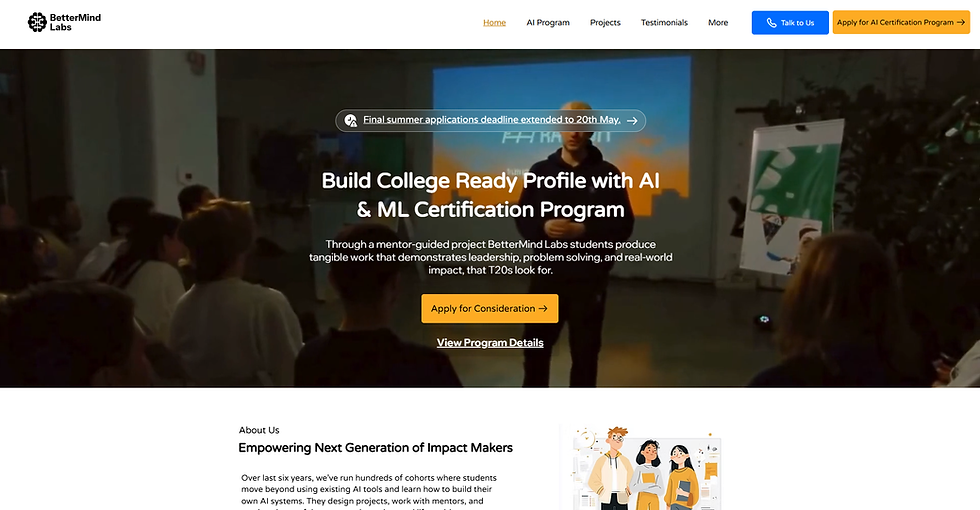
BetterMind Labs offers a project-centered AI and ML certification program where students work on real-world systems involving healthcare AI, finance analytics, NLP, and computer vision. The structure combines live mentorship, technical implementation, independent work, and portfolio development.
Students finish with completed projects, technical documentation, and potentially recommendation letters based on performance. For Palo Alto students interested in applied AI rather than theoretical exposure alone, this structure creates unusually strong admissions evidence.
3. Stanford University Mathematics Camp (SUMaC)
SUMaC focuses on proof-based mathematics, abstract reasoning, combinatorics, and advanced mathematical systems. Unlike standard enrichment camps, students engage with rigorous conceptual frameworks that resemble undergraduate mathematics training. This depth makes it especially valuable for students interested in theoretical computer science, quantitative research, and engineering. stanford.edu
4. UC Berkeley Pre-College STEM and Research Programs
UC Berkeley offers STEM-focused summer courses and research-oriented learning experiences where students explore engineering, computer science, biological sciences, and applied mathematics. Many programs simulate university coursework and expose students to Berkeley’s research culture. The emphasis on academic rigor makes these programs particularly relevant for students pursuing competitive STEM majors. berkeley.edu
5. UCLA Precollege Summer Institutes
UCLA’s STEM-oriented summer institutes allow students to experience college-level engineering, AI, biomedical sciences, and computational thinking courses. Students often engage in collaborative projects while interacting with faculty and university-level teaching staff. The structured academic environment gives students exposure to real university pacing and expectations. summer.ucla.edu
6. Caltech Summer Research Programs
Caltech’s summer research ecosystem exposes students to advanced STEM environments involving molecular biology, engineering systems, and applied computational science. Caltech’s culture strongly emphasizes precision, analytical rigor, and scientific inquiry. Students interested in intensive research environments often find this particularly valuable. caltech.edu
7. UC Davis YES STEM Summer Academy

UC Davis offers hands-on STEM learning through engineering labs, applied science projects, and collaborative experimentation. Students work through project-based challenges connected to environmental systems, engineering mechanics, and technological design. This approach helps students move beyond textbook-style learning into practical implementation. ucdavis.edu
8. UC Irvine STEM Summer Programs
UC Irvine’s STEM summer tracks expose students to engineering, health sciences, computer science, and biomedical innovation. Students work in applied learning environments that emphasize experimentation, data analysis, and collaborative technical problem solving. This creates strong preparation for STEM-heavy college pathways. uci.edu
9. UC San Diego Academic Connections
UCSD’s Academic Connections program allows students to enroll in university-level STEM coursework involving computer science, engineering, biology, and technology. Students gain exposure to quarter-system pacing while completing projects and technical assignments that mirror undergraduate coursework. ucsd.edu
10. UC Riverside XCITE STEM Camp
UC Riverside’s XCITE STEM camp focuses on coding, engineering, applied science, and collaborative innovation. Students work through team-based design challenges that emphasize experimentation, iteration, and systems thinking. The environment mirrors many real-world engineering workflows where progress depends on testing and refinement rather than memorization alone. ucr.edu
Once students identify the right program, the next challenge becomes outcome quality. What exactly should students aim to build?
What Kinds of Projects, Research Outputs, or Technical Skills Should You Expect to Gain from a Strong STEM Program?

A meaningful STEM summer program should leave students with visible evidence of growth. Colleges increasingly look for progression and technical ownership rather than isolated participation. A completed AI model, a published research poster, a GitHub repository, or a documented prototype communicates far more than attendance alone.
Students should ideally finish a program with one or more of the following:
A working technical project or prototype
Research findings or data analysis experience
Exposure to coding frameworks and development tools
Technical communication skills through presentations or documentation
This matters because technical maturity resembles engineering iteration. Strong systems are rarely built correctly on the first attempt. Students who debug models, revise assumptions, and refine outputs demonstrate authentic problem-solving ability.
BetterMind Labs students consistently follow this type of development process. Student projects featured across their website and social platforms include AI systems for healthcare diagnostics, business forecasting, fraud detection, financial analysis, computer vision, and automation. These are not toy exercises. They involve real datasets, implementation pipelines, and explainable outputs designed to mirror real industry workflows.
The strongest example of this transition from learning to implementation appears clearly in the next case study.
How to Land an AI Internship in California as a High School Students 15 Summer Programs in California That Will Boost Your College Application
Can AI Predict Which Employees Are About to Quit?
Aman Sreejesh’s Employee Attrition Prediction System at BetterMind Labs demonstrates how high school AI projects can move beyond simple prediction exercises into practical business intelligence systems.
The project used machine learning techniques to analyze workplace variables connected to employee turnover. Factors such as workload, satisfaction, work-life balance, compensation, and organizational behavior patterns were processed to estimate attrition probability. Rather than treating HR as purely administrative, the project approached employee retention like a predictive systems problem.
This type of AI resembles preventive healthcare modeling. Just as healthcare AI attempts to detect diseases before symptoms escalate, employee attrition systems identify behavioral patterns before resignation occurs. Early intervention becomes possible because the model identifies risk indicators hidden inside large datasets.
What made the project especially compelling was its practical orientation. The system was designed not only to predict turnover but also to help organizations make data-informed decisions about retention strategies, workforce planning, and productivity management. That combination of technical execution and applied relevance is precisely why project-based STEM programs create stronger admissions narratives than generic enrichment activities.
FAQs
1. Do STEM summer programs matter for college admissions?
Yes, but only when they demonstrate measurable growth. Programs that produce projects, research outputs, or technical portfolios tend to carry far more value than passive attendance-based programs.
2. Are project-based AI programs better than lecture-heavy STEM camps?
Usually, yes. Structured mentorship combined with real project implementation helps students demonstrate initiative, technical skill, and intellectual depth much more clearly.
3. What technical skills should students prioritize in 2026 STEM programs?
Programming, machine learning, data analysis, and research communication are increasingly important because they connect directly to emerging AI and engineering fields.
4. Why do mentorship-driven programs often create stronger student outcomes?
Mentorship accelerates learning by helping students refine ideas, debug problems, and build systems more strategically. Programs like BetterMind Labs use this structure intentionally to help students complete technically ambitious projects.
Conclusion

The strongest Summer Programs in Palo Alto do not simply expose students to STEM. They train students to think like researchers, engineers, and builders.
Programs such as Stanford SIMR, UC Berkeley Pre-College, UCLA Summer Institutes, Caltech research experiences, and UCSD Academic Connections all provide meaningful opportunities for students pursuing STEM pathways. Yet for students specifically interested in AI, machine learning, and project-based technical development, BetterMind Labs stands out because its structure emphasizes mentorship, measurable outcomes, and real-world implementation rather than passive participation.
A strong summer program should leave students with more than memories. It should leave them with proof. A research paper. A deployed model. A technical portfolio. A documented system they can explain confidently.
That is ultimately what separates a summer experience from a genuine intellectual milestone.


Comments