5 AI Passion Project Ideas Using Open Data

Introduction

Why do some high school AI projects immediately stand out to admissions officers while others feel interchangeable?
The answer is rarely coding ability alone. Strong projects usually begin with a real-world problem, use meaningful datasets, and produce something functional that others can interact with. A student who trains a machine learning model on public healthcare data to predict hospital readmission risk demonstrates a very different level of thinking than a student who simply follows an online tutorial step by step. One shows ownership. The other shows exposure.
That distinction matters more in 2026 because artificial intelligence is becoming deeply integrated into healthcare, finance, climate science, cybersecurity, and public policy. According to the World Economic Forum, AI and big data remain among the fastest-growing global skills, while employers increasingly value analytical reasoning and applied technical problem solving. (weforum.org) A strong Passion Project therefore acts almost like a research signal. It demonstrates initiative, technical depth, and the ability to translate abstract ideas into useful systems.
Table of Contents
How Can Students Turn Public Datasets into AI Projects That Solve Real Problems?
What Are the 5 Best AI Passion Project Ideas Using Open Financial, Healthcare, and Social Data?
What Should You Build by the End Predictive Models, AI Assistants, Interactive Dashboards, or Decision-Making Tools?
What If an AI Could Become Your Personal Financial Coach?
FAQs
Conclusion
How Can Students Turn Public Datasets into AI Projects That Solve Real Problems?
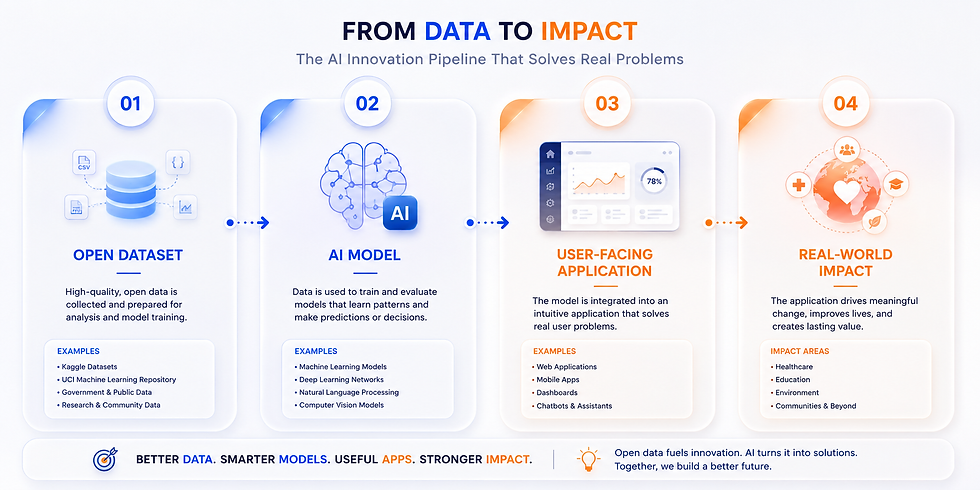
Public datasets are like raw scientific material. On their own, they are simply collections of numbers, text, or observations. But when students apply machine learning, pattern recognition, and domain-specific reasoning, those datasets become systems capable of prediction, classification, recommendation, or automation.
That is why open data has become such a powerful starting point for AI projects. Government organizations, hospitals, financial platforms, and research institutions now release enormous amounts of usable information through APIs and public repositories. Kaggle alone hosts hundreds of thousands of datasets covering medicine, economics, environmental science, sports analytics, and social behavior. (kaggle.com)
Students should look for datasets with three characteristics:
Real-world relevance
Sufficient scale for pattern analysis
Clear opportunities for prediction or decision support
For example, healthcare datasets often contain patient risk indicators, treatment outcomes, and disease progression variables. Financial datasets include historical stock prices, spending behavior, inflation metrics, and fraud signals. Social datasets can reveal trends related to education, transportation, misinformation, or public health.
This is also where mentorship matters. Students often struggle not because they lack intelligence, but because they choose projects that are either too broad or too technically shallow. BetterMind Labs addresses this problem by helping students scope projects realistically while still maintaining technical ambition. Their student projects frequently combine AI with healthcare, finance, law, and business intelligence in ways that feel closer to startup prototypes than classroom assignments.
The next challenge is choosing the right project category. Some ideas naturally create deeper technical narratives than others.
What Are the 5 Best AI Passion Project Ideas Using Open Financial, Healthcare, and Social Data?
1. AI Healthcare Risk Prediction System
Students can build a predictive healthcare model using public datasets from sources like the CDC, WHO, or Kaggle medical repositories. The system could estimate diabetes risk, stroke likelihood, heart disease probability, or hospital readmission risk based on patient health indicators.
This project becomes especially compelling when students explain both the machine learning process and the healthcare logic behind it. Random Forest models, logistic regression, and XGBoost classifiers work particularly well for structured healthcare data. Projects like these mirror real preventative healthcare systems now used in hospitals.
2. AI Financial Budgeting Assistant
Open financial datasets create excellent opportunities for AI-driven personal finance tools. Students can build systems that analyze spending behavior, categorize expenses, predict monthly savings trends, or generate budgeting recommendations.
This type of project works well because it combines technical implementation with practical value. Financial literacy remains a major problem among younger populations, and AI systems that personalize spending advice have strong real-world relevance.
3. AI Misinformation Detection Platform
Using public text datasets from social media platforms and misinformation research repositories, students can train NLP models to identify misleading claims or manipulated narratives. These systems can classify risk levels, flag suspicious language patterns, or explain why specific content appears unreliable.
Natural language processing projects stand out because they combine linguistic reasoning with machine learning pipelines. They also connect strongly to current public concerns surrounding AI-generated misinformation and digital trust.
4. Climate and Pollution Forecasting Dashboard
Students interested in environmental science can use EPA or NASA datasets to build AI systems that forecast pollution levels, temperature anomalies, or wildfire risk patterns. These projects work particularly well when combined with interactive dashboards and geospatial visualization tools.
This category demonstrates systems thinking because students must combine prediction models with environmental context and visualization frameworks.
5. AI Fraud Detection System
Fraud detection projects are particularly strong because they resemble real financial security infrastructure. Using transaction datasets, students can train models to detect suspicious spending patterns, unusual account behavior, or abnormal transaction sequences.
Banks and payment processors already rely heavily on anomaly detection systems. Students who recreate simplified versions of those workflows demonstrate strong understanding of machine learning classification pipelines.
A strong project idea alone is not enough, though. Admissions officers increasingly care about what students actually build by the end.
What Should You Build by the End Predictive Models, AI Assistants, Interactive Dashboards, or Decision-Making Tools?

A high-quality AI project should behave like a finished system, not just a coding exercise.
That distinction matters because universities increasingly evaluate project ownership. Students who deploy applications, explain technical decisions, and communicate measurable outcomes appear far more credible than students who only demonstrate isolated experimentation.
Strong final outputs often include:
Predictive models with evaluation metrics
Interactive dashboards with live visualizations
AI assistants or recommendation systems
Research papers or technical documentation
Think of it like architecture. A blueprint alone is interesting, but a functioning building demonstrates execution. The same principle applies to AI projects. A completed user-facing system shows technical maturity, iteration, and practical reasoning.
This is why project-based AI mentorship programs have become increasingly valuable. BetterMind Labs, for example, structures student learning around tangible outcomes rather than fragmented tutorials. Their published student projects include healthcare AI systems, financial assistants, misinformation detectors, legal analyzers, fraud detection tools, and computer vision applications that demonstrate real implementation depth.
One particularly strong example of this implementation-first philosophy appears in the following case study.
What If an AI Could Become Your Personal Financial Coach?
Neel Parimi’s Budget Buddy project at BetterMind Labs approached personal finance like a predictive intelligence problem rather than a spreadsheet exercise.
The system functioned as an AI-powered financial coaching assistant capable of analyzing user spending behavior, organizing financial patterns, and generating personalized recommendations related to savings and budgeting. Rather than offering generic advice, the application used uploaded financial information to generate individualized insights and actionable improvements.
What makes this project especially strong is the combination of technical and practical reasoning. Personal finance often overwhelms users because raw transaction data lacks context. Budget Buddy transformed that data into interpretable decisions. In many ways, the system behaved similarly to recommendation engines used by modern financial technology platforms.
The project also reflected an increasingly important principle in AI development: explainability. Strong AI systems do not simply output conclusions. They help users understand why those conclusions exist. By combining financial analytics, AI-generated reporting, and user-centered recommendations, Budget Buddy demonstrated both technical implementation and real-world usefulness.
This type of project stands out in admissions because it shows applied intelligence rather than theoretical interest alone.
FAQs
1. Do AI passion projects need advanced mathematics to stand out?
Not necessarily. Strong projects often depend more on problem selection, implementation quality, and system design than advanced theoretical mathematics alone. Clear reasoning and real-world relevance matter significantly.
2. Why do open datasets work so well for AI projects?
Open datasets allow students to work with realistic information used in professional environments. This creates stronger technical depth because students encounter noisy data, incomplete variables, and real prediction challenges.
3. Are mentored AI projects better than completely independent projects?
Usually, yes. Structured mentorship helps students scope projects realistically, debug models efficiently, and build systems with stronger technical coherence. Programs like BetterMind Labs use this framework intentionally.
4. What final deliverable makes an AI project most impressive?
Projects that combine technical implementation with usability tend to stand out most. Interactive dashboards, deployed web apps, and explainable prediction systems generally create stronger admissions narratives than isolated notebooks alone.
Conclusion

A strong Passion Project is rarely about choosing the trendiest AI topic. It is about building something technically meaningful, intellectually coherent, and practically useful.
Open datasets create remarkable opportunities for high school students because they provide access to the same raw information used by researchers, analysts, hospitals, and financial institutions. Students who learn to transform that data into predictive systems, recommendation engines, or decision-making tools demonstrate far more than coding literacy. They demonstrate initiative, systems thinking, and problem-solving maturity.
That is why project-based AI learning environments have become increasingly valuable. BetterMind Labs stands out because its structure emphasizes mentorship, technical implementation, and portfolio-driven outcomes rather than passive instruction. Students leave not only with knowledge, but with tangible systems they can explain, refine, and showcase confidently.
In 2026 admissions, that distinction matters more than ever.


Comments