10 AI Research Opportunities for Bay Area High School student

Why do students with perfect grades and AP scores still get rejected from top universities?
At BetterMind Labs, we see this every year. Bay Area students with near-flawless transcripts assume academics alone will carry them through admissions. Many are surprised when they don’t. To admissions committees, strong grades are no longer a signal of distinction. They’re the baseline. What actually stands out is whether a student has applied advanced skills to real, unscripted problems.
That’s where serious AI research experience matters. Not surface-level coding. Not short workshops. But real projects, built over time, guided by mentors, and held to standards that withstand scrutiny.
If you’re trying to understand which AI research opportunities for Bay Area high school students actually make a difference and why most programs don’t, keep reading.
Table of Contents
Why AI Research Experience Matters More Than Ever in College Admissions
What Admissions Officers Actually Look For in High School AI Research
The 10 Best AI Research Opportunities for Bay Area High School Students
How to Choose the Right AI Research Program for Your Profile
How to Turn AI Research Into a Standout Admissions Project
Frequently Asked Questions
Why AI Research Experience Matters More Than Ever in College Admissions
Selective universities are no longer impressed by interest alone. They look for evidence of contribution. AI research has become one of the clearest ways for students to demonstrate this, especially in the Bay Area where expectations are higher by default.
Recent admissions data from Stanford, UC Berkeley, and MIT shows a consistent pattern. Applicants with mentored research experience are significantly more likely to receive serious consideration in STEM-adjacent majors.
What AI research signals to admissions teams:
Ability to work with ambiguity rather than fixed problem sets
Comfort with advanced mathematical and computational tools
Long-term intellectual commitment rather than résumé padding
Exposure to professional standards of documentation and evaluation
In internal reviews, admissions readers often separate students into two categories:
Students who learned about AI
Students who built something meaningful with AI
Only the second group consistently stands out.
Credible sources that support this shift include:
National Association for College Admission Counseling reports from 2023 and 2024
Stanford Office of Undergraduate Admission public admissions talks
Harvard Graduate School of Education research on experiential learning outcomes
For deeper context, see AI Research Programs: Top Programs for High School Students
What Admissions Officers Actually Look For in High School AI Research
Not all research is viewed equally. Admissions officers are trained to look past impressive titles and ask a simple question: could this student explain their work clearly to a faculty member?
Strong AI research experiences usually include:
A clearly defined research question
Use of real datasets, not toy examples
Iterative experimentation and documented failures
Mentorship from someone with domain expertise
A tangible output such as a paper, model, or deployed system
Weak experiences often share the opposite traits:
Vague descriptions like “explored machine learning concepts”
Short timelines with no depth
No evidence of independent decision-making
No external validation or mentorship
From an admissions standpoint, research functions like engineering design. The process matters as much as the result.
Admissions readers often weigh AI research using criteria similar to:
Research depth and originality
Technical rigor relative to grade level
Quality of mentorship and supervision
Evidence of reflection and growth
This mirrors what we see across Ivy League STEM admissions pipelines.
Related reading:
The 10 Best AI Research Opportunities for Bay Area High School Students
Below are programs that consistently produce admissions-credible outcomes. They differ in structure, access, and depth, but all are taken seriously by selective universities.
1. BetterMind Labs AI and ML Research Internship

This is a mentored, project-based research program built for motivated high school students who want serious, admissions-ready work.
Students spend several weeks working on real AI problems, not toy exercises. They receive ongoing guidance, are held to high technical standards, and build projects that can stand up to faculty review.
By the end of the program, students typically have:
A fully working AI project connected to a real-world use case
Clear research documentation written at an academic level
Strong letters of recommendation based on direct, hands-on mentorship
Unlike large university programs, this model focuses on depth, not scale.
Explore https://www.bettermindlabs.org/
2. Stanford AIMI Summer Research Internship

Hosted by Stanford University, this program focuses on AI applications in medicine.
Key characteristics:
Highly selective admissions
Exposure to real clinical datasets
Emphasis on ethical AI and healthcare impact
Best suited for students interested in biomedical AI with prior technical experience.
3. UCSF AI4ALL Summer Program

Run by University of California, San Francisco, AI4ALL emphasizes diversity and social impact.
Students gain:
Foundational AI research exposure
Mentorship from graduate researchers
Experience with health-related datasets
This program is excellent for early exposure but less intensive than long-term research tracks.
4. Berkeley Artificial Intelligence Research High School Program

Connected to University of California, Berkeley, BAIR programs introduce students to cutting-edge AI labs.
Highlights include:
Exposure to active research groups
Seminars led by PhD researchers
Competitive admissions process
Depth varies by placement and mentor availability.
5. Artificial Intelligence for Real-Life Problem Solving at UC Berkeley

This applied program emphasizes project execution over theory.
Students work on:
Urban data challenges
Environmental modeling
Social impact AI systems
Best for students who prefer applied engineering over academic research.
6. Stanford SHTEM AI and Bioinformatics Tracks
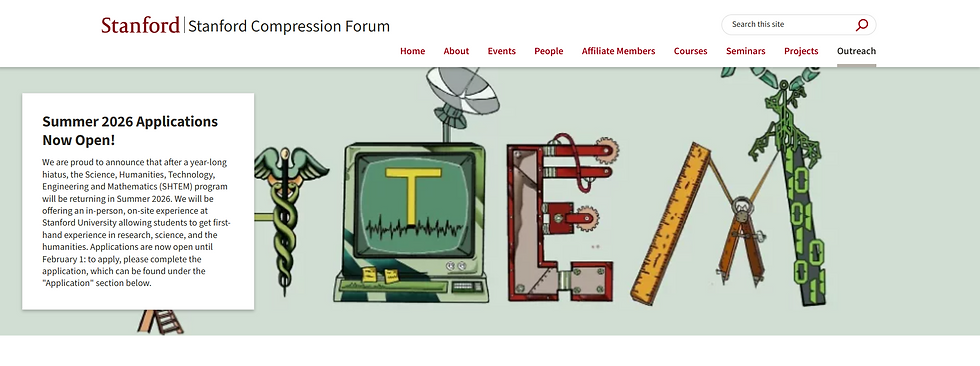
A structured summer experience blending AI with life sciences.
Strengths include:
Strong curriculum design
Cross-disciplinary exposure
Access to Stanford teaching staff
Limitations include shorter duration and limited research autonomy.
7. Genomics Research Internship Program at Stanford

GRIPS focuses on computational genomics and data science.
Students gain:
Hands-on experience with genomic datasets
Exposure to bioinformatics pipelines
Close faculty supervision
This is ideal for students committed to computational biology.
8. Lawrence Hall of Science Teen Research Programs

Operated in collaboration with UC Berkeley, these programs offer structured STEM research exposure.
AI tracks vary year to year but often include:
Data analysis projects
Group-based research models
Instructor-led mentorship
9. CHAI-Aligned Research Exposure at UC Berkeley

The Center for Human-Compatible AI provides limited opportunities for student engagement.
Focus areas include:
AI alignment
Ethics and policy
Human-centered AI design
Primarily suitable for students interested in AI ethics rather than engineering depth.
10. SBARI and Industry-Focused Bay Area AI Internships

Some startups and research labs offer selective internships.
These can be valuable if they include:
Clear mentorship
Defined technical responsibilities
Verifiable outputs
Unstructured internships without guidance often add little admissions value.
For location-specific options: Top 12 Summer Programs for Rising Seniors in San Jose
How to Choose the Right AI Research Program for Your Profile
There is no universal best program. The right choice depends on readiness, goals, and time horizon.
Consider these factors carefully:
Duration: multi-month projects outperform short programs
Mentorship depth: direct supervision matters more than brand name
Output quality: papers, models, or deployed tools carry weight
Alignment with academic interests
From an admissions perspective, the strongest programs resemble graduate-style research on a smaller scale.
They are:
Project-based
Mentored by domain experts
Outcome-driven
Designed for accountability
This structure consistently produces results that admissions committees trust.
Additional perspective: Top 7 Internships for High Schoolers in AI and Tech
How to Turn AI Research Into a Standout Admissions Project
One of the biggest mistakes I see students make is treating an AI research program as something to “complete” rather than something to leverage. Admissions impact does not come from participation. It comes from how a student scopes, deepens, and extends the work.
A clear example comes from a student we mentored, Nisha.
Nisha did not start with a flashy idea. She started with a narrow research question in healthcare AI: how symptom data, often messy and incomplete, could still be used to make reliable predictions. Instead of stopping at analysis, she made a deliberate decision to convert that research into a functional system.
Her final project was an AI-based disease detection system that analyzed medical data and patient-written symptoms using NLP, then returned probability-based predictions rather than a single answer.
The model was built for real clinical constraints. Many clinics lack advanced equipment, and unnecessary tests cost time. Her system focused on triage and decision support, not replacing doctors, helping clinicians prioritize likely conditions, especially in under-resourced settings.
What set the project apart was execution. She started with a clear research question, worked with messy real-world data, iterated on failures, and turned her findings into a deployable system with clearly stated limits and impact.
From an admissions lens, this shows technical depth, independent thinking, ethical awareness, and sustained engagement. It’s the difference between saying “I did AI research” and “I built something that solved a real problem.”
Strong programs enable this by focusing on outcomes, not lectures.
Explore more at bettermindlabs.org
Frequently Asked Questions
Can students just learn AI on their own?
Self-learning shows curiosity, but admissions teams look for proof. Mentored research provides validation, accountability, and outcomes that carry weight.
Do short summer programs help with college admissions?
They help with exposure, but rarely with differentiation. Depth over time matters more than program length.
What makes an AI project admissions-ready?
Clear problem framing, technical rigor, documented iteration, and expert mentorship. Admissions officers can tell when work is superficial.
Is there a program that combines mentorship, real projects, and admissions focus?
Yes. Programs built specifically to mirror real research environments while guiding students through long-term AI projects tend to produce the strongest results. BetterMind Labs is designed around this exact model.
Final Thoughts
Grades and test scores are now baseline expectations at selective universities. What differentiates applicants is evidence of sustained, serious intellectual work.
At BetterMind Labs, we have consistently seen that students who engage in structured, mentored AI research gain more than technical skills. They develop clarity. They learn how to frame problems, build systems, and explain complex ideas with precision.
This philosophy is what led us to build BetterMind Labs. Our programs are designed to give motivated students research experiences that admissions committees already recognize and trust.
If this approach resonates with you, explore more research-focused insights at bettermindlabs.org and consider whether a mentored, project-driven AI path aligns with your goals.


Comments