Top summer internship for high school students Interested in Cybersecurity in New Jersey

Most students spend the summer watching YouTube videos about hacking. The ones who actually get into good colleges spend it building something real.
Cybersecurity is one of the few fields where credentials matter less than proof. Admissions officers at top schools, and hiring managers at the companies after that, want to see what you built — not just what you watched. New Jersey students have access to some genuinely strong programs this summer. Here are the ten worth considering.
The Real Difference Between Programs Worth Your Time
Before the list, one thing matters: most summer programs teach you about cybersecurity. The best ones make you do cybersecurity.
There is a difference between a student who can explain what phishing is and a student who built a tool to detect it. Admissions readers can tell the difference in thirty seconds. So can the mentors writing your letters of recommendation.
What to look for:
A real project with your name on it
A mentor who reviews your actual work, not just lectures to a room
Output you can put in your college application — a GitHub repo, a demo, a write-up
Some connection to the problems cybersecurity actually solves today
If a program doesn't produce any of those things, it is probably not worth your summer.
Top 10 Summer Internships for Students Interested in Cybersecurity in New Jersey
1. BetterMind Labs AI Program
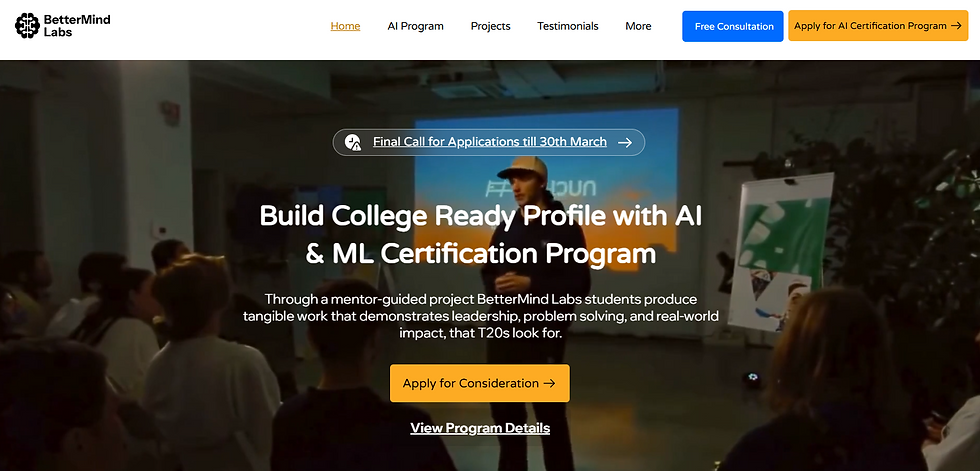
BetterMind Labs belongs at the top of this list because it is the only program that treats high school students like they are capable of building production-level AI tools — not just learning about them.
The program runs in 4-week online cohorts with a 1:3 expert-to-student mentorship ratio. That ratio matters. Most programs have one instructor for thirty kids. At BetterMind Labs, your mentor actually looks at your code.
What students build:
Healthcare prediction systems
Finance risk models
Machine learning pipelines
AI-powered dashboards and deployment-ready tools
For cybersecurity students specifically, the AI skill set transfers directly. Threat detection, anomaly identification, phishing analysis — these are all machine learning problems. Students who come out of BetterMind Labs with a working AI project and strong capstone documentation are genuinely ahead.
The program also provides strong Letter of Recommendation support, which is not a small thing when you're applying to competitive programs or universities.
Why it works: Real mentorship, real projects, real outputs. Not simulation.
Want to understand what real project-based learning looks like? Read: Summer Internships for Teens: Top 10 High-Impact Programs
2. Rutgers University Cybersecurity Summer Camp

Rutgers runs a well-regarded summer camp for high school students through its School of Engineering. It covers network security, ethical hacking basics, and digital forensics. The campus environment is legitimately valuable — you are interacting with university faculty and getting a sense of what studying computer science at a research university looks like.
Best for students who want university exposure alongside technical foundations.
3. NJIT Cybersecurity Pre-College Program

New Jersey Institute of Technology offers a pre-college experience focused on information security. It is credit-bearing, which is useful if you want to signal academic seriousness on your college applications. The curriculum covers cryptography, vulnerability assessment, and security policy — a solid introduction to how cybersecurity actually functions inside organizations.
4. Stevens Institute of Technology Summer Academy

Stevens in Hoboken runs a cyber-focused summer academy for rising high school juniors and seniors. The program is technical, the instructors are active researchers, and the location in Hoboken means you are working near one of the more active tech ecosystems in the Northeast. Their cybersecurity track includes hands-on labs in a controlled environment.
5. GenCyber at Seton Hall University

GenCyber is a nationally funded initiative, and the Seton Hall version is one of the better New Jersey options for students who are just getting started. The program is free, which removes a real barrier for a lot of students. It focuses on the fundamentals — safe online behavior, basic cryptography, network architecture — and does a good job making those concepts concrete rather than abstract.
If you are building toward competitive college applications, see: Top 10 Pre-College Internship Programs to Boost Your College Applications
6. Kean University Cyber Defense Program
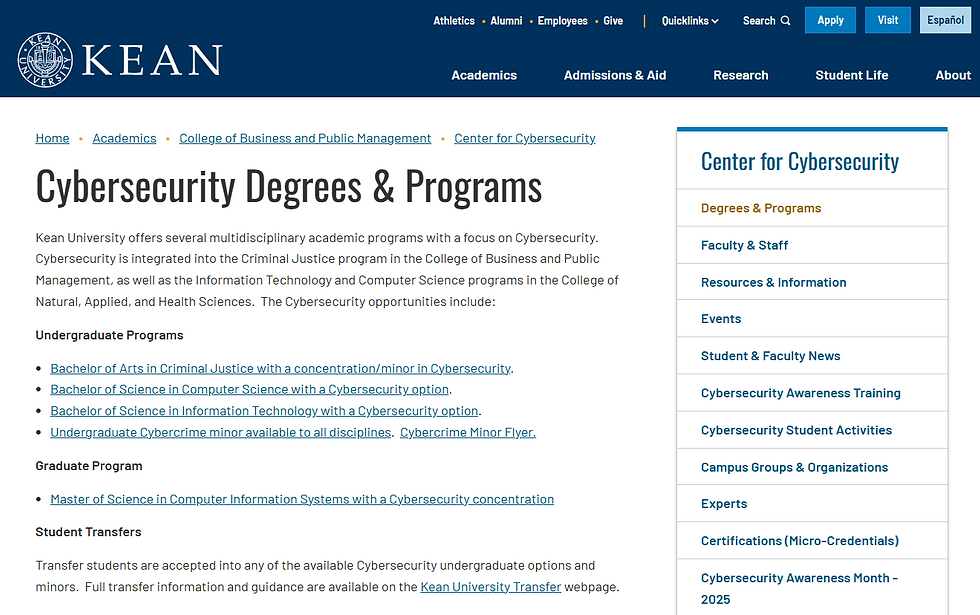
Kean University runs a cyber defense-focused summer program that emphasizes competitive skills. If you are interested in Capture the Flag competitions, this is worth looking at. CTF skills translate well to both college applications and actual cybersecurity work — employers consistently say they hire people who have competed because it demonstrates real problem-solving under pressure.
7. SANS Cyber Aces Online (Self-Paced with Community)
SANS is one of the most respected names in professional cybersecurity training. Their Cyber Aces program is free and can be completed remotely. It is not a structured cohort experience, but it is rigorous and the certification carries genuine weight with anyone in the industry. New Jersey students who want to supplement a weaker local option with something globally recognized should consider this.
8. iD Tech Cybersecurity Camps (Princeton, NJ)

iD Tech runs camps at Princeton University's campus in the summer. The cybersecurity track is well-organized and suited for students between ages 13 and 17 who want structured learning with a hands-on component. The Princeton campus setting is a nice bonus. iD Tech is more introductory than advanced — treat it as a foundation, not a capstone.
9. Fordham University Cybersecurity Bootcamp (NJ Accessible)

Fordham's program is technically based in New York but is easily accessible from most of New Jersey and worth including here. It runs as an intensive bootcamp format with a focus on practical skills: network penetration testing, incident response, and security operations. Students who finish it have concrete vocabulary and demonstrated commitment that reads well on applications.
10. CyberPatriot (School-Team Based, NJ Chapters)

CyberPatriot is a national competition, not a traditional internship, but it deserves a place on this list because the outcomes are real. NJ schools with active CyberPatriot teams give students access to competition-level cybersecurity training, mentorship from coaches who often have professional backgrounds, and national rankings that colleges genuinely notice. If your school has a team, join it. If it does not, start one.
For a broader look at high school programs that actually move the needle: The Ultimate Guide to High School Internships: Top 10 Programs for 2025
What One Student Built: Sushanth Punuru and Verifeye
This is worth reading carefully.
Sushanth Punuru is a high school student who went through BetterMind Labs' AI program. At the end of it, he had built Verifeye.
What is Verifeye?
Verifeye is a web-based AI application that detects phishing and social engineering threats. You give it a suspicious message or URL. You answer a short guided survey. It uses Google Gemini AI to identify risk indicators, assign a risk level, and tell you what to do next.
The goal is simple: make cybersecurity threat detection accessible to ordinary users who are not security professionals.
That is not a class project. That is a working tool solving a real problem that costs companies and individuals billions of dollars every year.
Why this matters for your application:
Sushanth can now walk into any college interview or application essay and explain exactly what he built, what problem it solves, how it works technically, and what he learned building it. That is a conversation most high school applicants cannot have.
The difference between a student who attended a cybersecurity lecture and a student who shipped an AI-powered phishing detector is not subtle. It is the difference between interesting and genuinely impressive.
Verifeye also reflects exactly what modern cybersecurity looks like. The field has moved well past manual threat hunting. AI-assisted detection, automated risk classification, accessible interfaces for non-technical users — Sushanth built something that reflects where the industry is actually going.
Frequently Asked Questions
Q: Do I need coding experience to apply to cybersecurity summer programs?
Most programs on this list accept students with no prior experience. BetterMind Labs, for instance, works with students across experience levels and pairs them with mentors who meet them where they are. The key is commitment, not prerequisites.
Q: Will a summer cybersecurity program actually help my college application?
It depends entirely on what you produce. Programs that give you a real project, documentation, and a mentor who can write specifically about your work will strengthen applications. Programs that give you a participation certificate will not. Look for programs where the output is yours — something with your name on it.
Q: Can I just learn cybersecurity on YouTube for free?
You can learn the concepts. But admissions teams and employers want evidence of what you built, not what you watched. Structured mentorship creates accountability and produces outcomes that are visible on paper. Self-study shows curiosity; project-based programs show execution.
Q: How do I choose between a university camp and an AI-focused program like BetterMind Labs?
University camps are great for exposure and campus feel. If your goal is a portfolio-ready project and a meaningful Letter of Recommendation, a mentor-driven program like BetterMind Labs is more likely to produce those outcomes. The question to ask is: at the end of summer, what will I have to show for it?
The Bottom Line
The cybersecurity field does not care much about where you spent your summer. It cares about what you can do.
The students who stand out — in applications and in careers — are the ones who built something. Not the ones who sat in the most prestigious room.
New Jersey has real options this summer. Use them well. And if you want to understand what a genuinely strong summer program looks like, explore what students are building at bettermindlabs.org.


Comments