Top AI program list for Counselors to Recommend to High School Students targeting Top 20 Colleges

Introduction: AI program list for Counselors

Table of Contents
What top colleges are actually looking for

For top-20 admissions, the question is not whether a program sounds impressive. The question is whether it helps a student show academic readiness, intellectual vitality, initiative, and follow-through in a way that fits their own context.
Stanford says it reviews applicants holistically and looks at academic excellence, intellectual vitality, and personal context.
MIT says it uses extracurriculars to understand how students spend their limited time.
Harvard and Princeton both say they review applicants holistically and consider talents, perspectives, and potential contributions, not just grades. (Stanford Undergraduate Admission)
That matters because counselors are not trying to collect logos. They are trying to reduce risk.
The counselor filter for choosing an AI program
When I look at AI programs for high school students, I use a simple filter.
First, does the student leave with something verifiable, such as a project, a prototype, a presentation, or a documented learning outcome. Second, does the program require real effort, not passive attendance. Third, does it fit the student’s level, because a program that is too advanced can produce confusion rather than growth. Fourth, does it help the student build a coherent story around computer science, data, ethics, medicine, design, public policy, or entrepreneurship. That story matters more than the label on the certificate.
The top AI programs to recommend
1) BetterMind Labs

BetterMind Labs is one of the strongest options for counselors who want students to move beyond surface-level exposure into meaningful project-driven work.
The core difference is that students are not pushed into generic AI coursework. They are first guided toward identifying a domain-specific problem that genuinely matters to them. That becomes the foundation for mentorship, technical learning, and project development.
This matters because selective colleges respond more strongly to coherence than activity accumulation.
BetterMind Labs students exploring wildfire detection, healthcare diagnostics, financial literacy, accessibility design, or education systems through AI develops a far clearer academic narrative than a student who simply completes introductory modules.
2) MIT Beaver Works Summer Institute

MIT Beaver Works Summer Institute is a strong counselor recommendation for advanced students who can handle rigor. MIT describes BWSI as an intensive four-week program for high school juniors that offers hands-on, project-based, workshop-style courses across topics including artificial intelligence and autonomy. MIT Admissions also lists it as an intensive four-week program where juniors can experience college-level curriculum with peers from around the country. (Beaver Works Summer Institute)
This is especially valuable for students who already have strong STEM habits and need a serious challenge, not a polished introductory camp. For top-20 applications, BWSI can support a narrative of sustained technical depth.
3) Carnegie Mellon AI Scholars

Carnegie Mellon’s AI Scholars is one of the clearest examples of a selective, creditable AI experience for high school students. CMU describes it as a fully funded, merit-based program for rising high school seniors, with classroom instruction, hands-on research projects, faculty lectures, and industry engagement. CMU also notes that students engage in college-level courses and seminars that include college admissions, financial aid, and wellbeing topics.
4) UC Berkeley BeSMART

UC Berkeley’s BeSMART program is a strong option for students who need a credible AI experience without prior coursework. Berkeley says the program is for high school students ages 15 to 17, requires no prerequisite coursework, and includes Python, data manipulation, machine-learning techniques, and a final project on a topic of personal interest. Berkeley also describes it as a two-week residential program with faculty-led lectures, hands-on labs, and a final research project using real-world datasets.
5) Mark Cuban Foundation AI Bootcamp
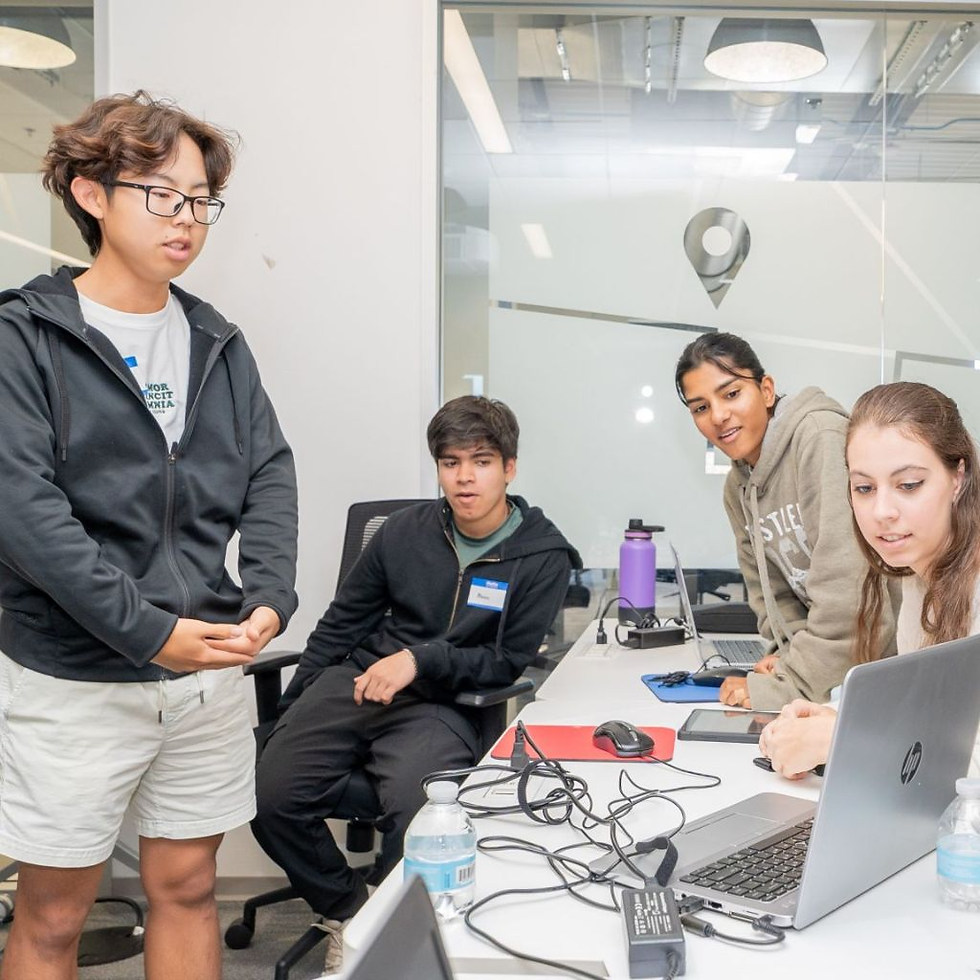
For students who need access, not just prestige, the Mark Cuban Foundation AI Bootcamp is a strong recommendation. The foundation says it is a free, twenty-hour introduction to AI for high school students, with instruction, a capstone project, mentorship from professionals, applied ethics, and entrepreneurship exploration. It also states that the bootcamp is open to students in grades 9 through 12. (Mark Cuban AI -)
6) UC Berkeley pre-college options with AI content
Not every student needs a program labeled “AI” to build a credible AI story. Berkeley’s Pre-College Scholars and Summer Computer Science Academy include exposure to artificial intelligence fundamentals such as supervised machine learning, reinforcement learning, generative AI, and the ethics of AI. Berkeley also notes that high school students can take Berkeley undergraduate courses through its summer sessions. (Pre-College at Berkeley)
7) UC Berkeley’s newer AI research training options
Berkeley has also expanded its AI research training offerings for high school students. Its IEOR page says the new summer machine learning and AI research program will include faculty-led lectures, hands-on lab sessions, and a final research project using real-world datasets. Berkeley’s outreach pages also frame BeSMART and related offerings as pathways into AI that emphasize real-world problem solving. (IEOR Berkeley)
What makes a recommendation actually useful
A useful AI program recommendation depends on the student profile.
A student with strong coding and math should be pushed toward BWSI or CMU AI Scholars, because those programs reward rigor.
A student with high interest but less technical background may do better in Stanford AI4ALL or Berkeley BeSMART, where mentorship and structured entry matter. A student with financial constraints may be better served by the Mark Cuban Foundation AI Bootcamp, because access and completion matter more than brand inflation. A student who is not ready for a pure AI program may be better placed in a broader CS or data-focused environment that still includes AI fundamentals.
That is a more rational recommendation than forcing a premature specialty.
What to avoid

Counselors should be careful with three kinds of weak signals.
First, programs that are mostly passive content consumption. Second, programs that promise “college advantage” but produce no project, no feedback, and no real mentoring. Third, programs that are out of date, especially ones that were strong years ago but no longer exist in the form people remember. AI4ALL is the clearest example of why this matters, because its current FAQ says it does not offer high school programs right now. (AI4All)
The broader rule is simple. Do not recommend an AI program because it sounds elite. Recommend it because the student can leave with evidence.
FAQs
What are the best AI programs for high school students applying to top colleges?
The best AI programs for high school students are the ones that create verifiable outcomes, such as projects, research, or sustained mentorship. Stanford AI4ALL, MIT BWSI, CMU AI Scholars, Berkeley BeSMART, and the Mark Cuban Foundation AI Bootcamp are all credible examples. (Stanford HAI)
Do selective colleges care which AI program a student attends?
They care more about what the student did in the program than the program name itself. Stanford, MIT, Harvard, and Princeton all describe holistic review processes that consider context, initiative, and contribution, not just prestige markers. (Stanford Undergraduate Admission)
Is an expensive AI camp always better for admissions?
No. A free or lower-cost program with real output can be stronger than a costly program with little substance. For admissions, the focus keyword is not the brand of the program, but the quality of the evidence it produces.
Conclusion

There is a rational way to evaluate AI programs for high school students applying to Top 20 colleges.
To conclude, these are the questions you should ask:
Did the student build something real?
Did they work closely with mentors?
Did they explore a problem deeply?
Can they explain their thinking clearly?
Does the experience connect logically to the rest of the application?
Those are strong signals. Certificates alone are not.
For many counselors, that is why BetterMind Labs becomes the logical recommendation. The structure prioritizes mentorship, problem selection, interdisciplinary application, and long-term project development rather than passive exposure. Students leave with clearer direction and stronger evidence, which is ultimately what selective colleges evaluate.
More details are available at BetterMind Labs x Counselors.


Comments