Top 15 AI Programs for High School Sophomores in Silicon Valley

Updated: Jun 30

Is it truly "too early" for sophomores to take AI seriously, or is this belief subtly costing competent students time they can never get back?
I observe the same pattern in every admissions cycle. Silicon Valley sophomores excel academically, are interested in technology, and live in an innovative environment. However, many put off doing significant AI work until their junior year because they believe universities won't value their earlier efforts. Students who already have depth, direction, and completed projects are competing with them by the time they begin.
Talent is not the problem. It's structure and timing. When initiated at the appropriate time, real-world, mentored, project-based AI programs rather than haphazard coding exercises create long-lasting admissions leverage for this generation of applicants.
Table of Contents
Why Sophomore Year Is the “Sweet Spot” for AI Learning
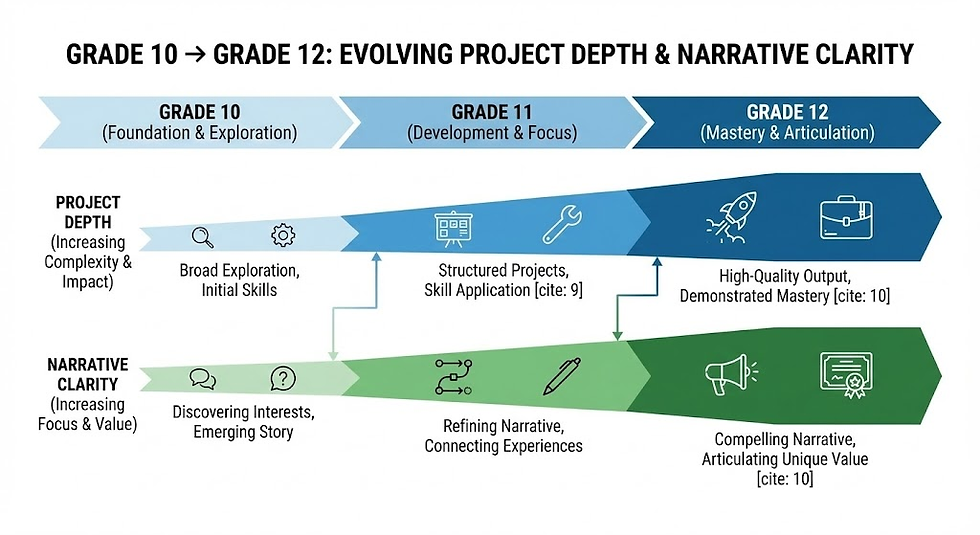
A unique point in the admissions process occurs during the sophomore year.
Students are:
Academically stable but not yet burdened by the AP peak load
Early enough to gradually gain depth but inquisitive enough to investigate
Students who are still forming their academic identities are actively sought after by colleges.
When it comes to admissions, the best senior-year applications usually show two to three years of consistent advancement in a single direction instead of an abrupt spike. By starting AI in grade 10, students can follow a logical progression:
exposure → experimentation → possession → result
Programs that work well for sophomores have three things in common:
Structured learning pathways that keep students from deviating
Mentoring (to prevent projects from stagnating)
observable outcomes (i.e., effort becomes proof)
This explains why many early-starting Silicon Valley students submit applications that are more composed, lucid, and credible, a trend discussed in:
The Silicon Valley Advantage: Proximity to Tech Giants
Students don't always have an advantage because they live in Silicon Valley. It provides them with context.
Admissions officers reward interpretation rather than proximity. When students actively participate in the Valley's ecosystem, they typically:
Organize projects around actual systems, such as platforms, data pipelines, and healthcare.
Recognize the trade-offs between performance, ethics, and scale.
Consider engineering limitations rather than just algorithms.
Applications mentioning applied AI, such as healthcare diagnostics, responsible machine learning, and human-centered design, have read much better over the last two to three years than generic "learned Python" narratives.
Programs that are well-designed assist students in turning their exposure to Silicon Valley into work that is ready for a portfolio, not just inspiration. Here are some examples of how students accomplish this:
The Top 15 AI Programs List (University & Private)
The list of AI programs in Silicon Valley that are suitable for sophomores has been carefully selected based on factors like rigor, mentorship, output quality, and admissions relevance.
1. BetterMind Labs AI & ML Certification Program

The best choice for Silicon Valley high school sophomores overall
BetterMind Labs consistently ranks first because it is designed for students who want results rather than exposure.
Crucial traits:
Students in grades 8–12 can take a live, mentor-led AI/ML course.
Research and industry-savvy mentors in small groups
Useful projects in the domains of finance, cybersecurity, healthcare, and law
You don't need to know anything about AI.
6–8 hours a week, suitable for SV's workload
Items from the portfolio in addition to detailed recommendation letters
Students often begin ambiguously and develop unique project narratives over the course of several years that become precisely what selective colleges value.
Program overview: https://www.bettermindlabs.org
2. Stanford AIMI — Summer Research Internship (Stanford)
AI in medicine focus
Faculty-led research exposure
Sophomore-eligible, highly selective
Best for students leaning pre-med + AI
3. Stanford AI4ALL (Stanford)
AI fundamentals + social impact
Emphasis on ethics and responsibility
Strong mentorship and reflection
4. UC Berkeley — BAIR High School Summer Program
Human-compatible AI concepts
Lab tours and scientist mentorship
Short duration, strong conceptual grounding
5. UC Berkeley — AI for Real-Life Problem Solving
One-week intensive
Python + ML foundations
Strong for early exposure
6. Berkeley Coding Academy — Data Science to AI
Project-based ML and visualization
Portfolio-friendly outputs
Sophomore-accessible
7. Summer Springboard — AI & Machine Learning (Berkeley)
Startup-style projects
Hands-on coding
Short but immersive
8. Stanford — Global Innovation Race/DMA AI
Design-thinking + AI tools
Team-based innovation projects
9. iD Tech Global Academy — AI with NVIDIA
Neural networks and applications
Good technical introduction
Limited long-term project depth
Research-aligned coursework
Strong theoretical grounding
11. Caltech Summer Tech Camp — AI/ML
College-level exposure
Short-term skills focus
12. UC Santa Cruz Extension — AI Series
Applied AI coursework
Local accessibility
13. Northeastern University Silicon Valley — AI Exploration
Industry-aligned learning
Career-oriented framing
14. NSLC — Artificial Intelligence Program
Leadership + AI concepts
Broader exposure, lighter depth
Computational research focus
Highly selective
Best for mathematically inclined students

Case Study: How a “Passion Project” Secured a T20
Passion is not rewarded in the abstract by admissions readers. They reward performance in the face of uncertainty.
Aayan Deshpande, a student at BetterMind Labs, developed an AI system for the early detection of multiple sclerosis (MS), a complicated neurological disorder whose prognosis is greatly impacted by an early diagnosis.
The undertaking:
examined medical imaging and patient data
found subtle early-stage trends
gave clinicians understandable insights
presented AI as a tool to aid in decision-making rather than a substitute.
Why it was important
Unambiguous medical motivation
Technically suitable scope
Awareness of ethics
Reviewable, tangible results
This project demonstrated to admissions officers not only interest in AI but also judgment, self-control, and practical reasoning qualitie that are highly correlated with success at elite universities.
How to Build a Competitive Application in Grade 10
Sophomore year is not about perfection. It’s about trajectory.
Strong grade-10 strategies include:
Choosing one domain (health, finance, security)
Completing one well-scoped project
Reflecting on failures and revisions
Continuing the work into junior year
Programs that provide structure help students avoid the common trap of starting many things and finishing none — a dynamic explored here:
FAQ
Is sophomore year too early for AI programs?
No. Sophomore year is ideal for building foundations that mature into depth by senior year.
Do I need prior coding or AI experience?
No. Well-designed programs teach concepts as needed within projects.
Why does mentorship matter so much?
Mentors help scope projects realistically and translate work into admissions-ready narratives.
Can self-learning replace a structured program?
Self-learning builds skills, but without feedback and structure, projects often remain unfinished or poorly framed.
Conclusion: Future-Proof Your Skills Today

Clarity is the limiting factor in Silicon Valley, not access.
AI programs are only relevant to today's applicants if they produce tangible results, such as completed projects, introspective analysis, and ongoing academic guidance. With structure and guidance beginning in the sophomore year, students can gradually develop those results.
Capable students can transition from interest to evidence with the aid of programs like BetterMind Labs, which eliminate overload and guesswork.
Check out the programs and resources at https://www.bettermindlabs.org to learn how structured AI projects translate into authentic admissions narratives.




Comments