Pre-college AI program in Florida: how high school students can apply

Why do excellent grades no longer guarantee strong admissions results?
After sitting across the table from families year after year and watching admissions results come back, a pattern has become hard to dismiss. Students with flawless transcripts, heavy AP loads, and strong test scores apply to top Florida universities like University of Florida, Florida State University, and University of Central Florida, expecting academics to carry the application. Instead, many find that academic strength is assumed. It no longer sets anyone apart.
The applications that break through usually show something else entirely. Those students can point to work they’ve built from the ground up, wrestled with when it didn’t work, and improved through iteration. More often than not, that work takes the form of applied AI projects. Not because artificial intelligence is fashionable, but because building real systems exposes how a student thinks when the answer isn’t in the textbook.
Table of Contents
Why Florida High Schoolers Should Apply to Pre-College AI Programs
Florida is quietly becoming a high-impact testing ground for applied AI education.
Between state-funded STEM initiatives, public research universities, and Florida-specific challenges, hurricanes, environmental modeling, coastal infrastructure, students here have a rare opportunity: to work on problems that look like real research, not simulations.
Admissions readers increasingly ask:
Can this student handle ambiguity?
Have they applied math and code to an open-ended problem?
Did they work with expert feedback, or entirely alone?
A well-structured AI program answers all three.
Why AI matters specifically for Florida students:
STEM applicant volume is rising at UF, UCF, and USF faster than humanities tracks.
AI and data science sit at the intersection of math, computer science, and real-world impact.
Project artifacts (models, reports, GitHub repos) give admissions committees something concrete to evaluate.
Top 5 Pre-College AI Programs in Florida (With Application Details)
1. BetterMind Labs – AI Certification Program (Online, Statewide Access)

Offered by BetterMind Labs, this program is designed for high school students who need application-ready depth rather than short-term exposure.
Unlike university summer camps that compress learning into 1–2 weeks, this certification program runs on a longer timeline, allowing students to build, test, and refine real AI systems under close mentorship.
Program format
Fully online, accessible statewide (Miami, Orlando, Tampa, Gainesville, Tallahassee)
Multi-month structure (not a single summer block)
1:1 or small-group mentorship with AI practitioners
Project-based progression rather than lecture-first instruction
Eligibility
High school students (grades 8–12)
No formal prerequisites; prior coding experience is helpful but not required
Students are placed into tracks based on readiness, not age alone
What admissions officers actually see
Independently scoped, defensible AI projects
Clear evidence of technical growth over time
Mentor insight into student decision-making, persistence, and problem-solving
Why it stands out for admissions
Rolling admissions (not limited to summer calendars)
No geographic or travel constraints within Florida
Projects are explicitly designed to support:
College essays
STEM portfolios
Detailed Letters of Recommendation grounded in observed work
Application process
Online application form → mentor matching → project track selection
2. UF Gator Artificial Intelligence Camp
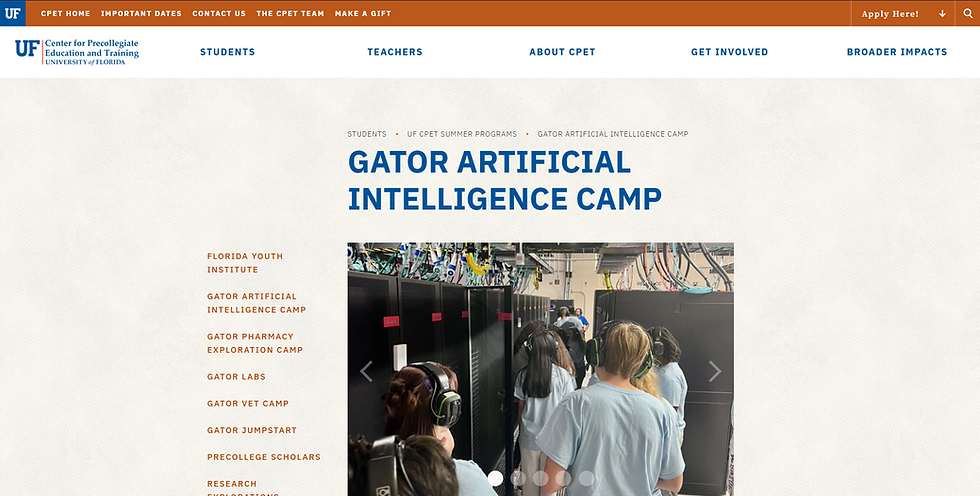
Hosted by University of Florida, this is one of the few explicitly AI-branded summer camps run directly through a major Florida engineering school.
Program format
2-week residential summer camp on UF’s Gainesville campus
Lecture + guided lab structure
Introductory machine learning, Python, and AI tools
Exposure to UF computing infrastructure and research labs
Eligibility
Rising 10th–11th grade students
No formal prerequisites, but prior coding experience is strongly recommended
Application requirements
Online application form (UF CPET portal)
Short written interest statement (why AI, why UF)
Academic information (unofficial transcript or GPA self-report)
Rolling review until seats are filled
What admissions officers actually see
Strength: University-level exposure and seriousness
Limitation: Projects are guided and short-term; most students do not leave with a unique, defensible AI artifact
3. UCF Computer Science Summer Institute — University of Central Florida

Hosted by University of Central Florida, this is a three-week residential program focused on foundational computer science rather than applied AI.
Program format
3-week, on-campus residential institute
Faculty-led instruction with daily coding labs
Emphasis on Python programming, algorithms, and computational thinking
Cohort-based learning with structured assessments
Eligibility
Rising 7th–11th grade students
Prior coding experience recommended but not strictly required
Application process
Online application through UCF summer programs portal
Academic background information
Program-specific short responses (interest and readiness)
Seats capped at ~35 students per cohort
What admissions officers actually see
Evidence of early technical preparation in computer science
Signals readiness for future AI or engineering coursework
No independent or original AI project output by default
4. USF Bright Minds: AI + STEM Exploration Camp — University of South Florida

Offered through University of South Florida, this is a short-duration exploratory program introducing AI concepts within a broader STEM context.
Program format
Typically 1-week, summer-based camp
On-campus or partner-site delivery (varies by year)
Guided activities using AI-enabled tools and digital platforms
Group-based participation rather than individual project tracks
Eligibility
Middle and early high school students (approximately grades 6–10)
No technical prerequisites
Application process
Registration-based or short application (program year–dependent)
Priority often given to local or district-partner schools
Limited selectivity
What admissions officers actually see
Early exposure to AI and STEM fields
Demonstrated interest, not demonstrated mastery
Not sufficient as a standalone credential for selective STEM admissions
5. Miami Dade College — Applied AI in Business Summer Camp

Hosted by Miami Dade College, this program introduces students to AI applications in business and decision-making contexts.
Program format
1-week, project-oriented summer camp
Instruction combined with guided, use-case-driven activities
Focus on applying AI tools to predefined business scenarios
Eligibility
High school students (grades 9–12)
Designed for beginners; no formal coding prerequisites
Application process
Online registration or short application via Miami Dade College outreach programs
First-come or lightly screened admission depending on capacity
What admissions officers actually see
Exposure to applied AI use cases
Familiarity with AI as a problem-solving tool
Limited evidence of independent technical depth or long-term project ownership
Application Tips and Next Steps for Success
Applying to pre-college AI programs is less about volume and more about alignment.
Before you apply, ask yourself:
Will this program let me build something I can explain in detail?
Is there structured mentorship or just lectures?
Will I leave with artifacts I can reference in essays?
High-impact application strategies:
Frame interest statements around problems, not buzzwords
Reference specific AI use cases you want to explore
Show evidence of follow-through (previous projects, even small ones)
You can also read: How an AI Program can help high school students get into colleges in Florida

Frequently Asked Questions
Q: Can I just learn AI on my own from YouTube?
A: Self-learning shows initiative, but admissions officers value proof. Structured programs turn learning into documented outcomes and verified mentorship.
Q: Are short AI camps enough for competitive Florida universities?
A: They help with exposure, but depth matters more. Multi-week or multi-month projects demonstrate persistence and technical growth.
Q: Do online AI programs carry the same weight as in-person ones?
A: When they produce real projects and include expert mentorship, yes. Admissions committees evaluate outputs, not classroom location.
Q: When should Florida students start applying?
A: Ideally between 9th–11th grade, allowing time to build and refine projects before senior-year applications.
Conclusion
Traditional metrics, grades, test scores, course rigor, no longer separate top applicants. Demonstrated capability does.
Students who can point to a trained model, a written technical report, or a real-world AI application tell a clearer story about who they are and what they’ll contribute on campus.
Programs built around mentorship, project ownership, and tangible outcomes quietly solve the admissions problem most families don’t realize they have.
If you want to explore how that model works in practice, you’ll find additional guidance and programs at bettermindlabs.org, and plenty of examples of what strong student AI work actually looks like.


Comments