BetterMind Labs MIT Alumni case study: Said Azaizah's path to MIT


We hear the same concern from parents again and again. Families are not confused about ambition. Families are confused about proof. Parents want to know what actually counts, what is just decoration, and what gives a student a real advantage in a T20 application.
That is why we share Said Azaizah’s path to MIT. It is not a story about looking polished. It is a clear example of what “substance” looks like when a student’s work is grounded in a real problem, real constraints, and outcomes that can be reviewed and trusted.
The real question is not “What looks impressive?” It is, “What will convince a T20 admissions committee that a student is ready?”
In Said’s case, the answer was not a logo-chasing summer activity. It was a serious project with enough specificity that a reader can understand what was built, why it mattered, and what changed because of it. That is the kind of evidence we want parents to prioritize.
Table of Contents
What we see parents misunderstand about T20 admissions
At the top level, grades and test scores stop being differentiators. We have said this plainly in our own writing: grades and test scores are table stakes. That is not dramatic. It is what families experience when applications are compared side by side. Once the academic baseline is met, committees look for evidence of judgment, initiative, ownership, and the ability to create something real.
That is also why so many expensive summer programs disappoint parents. They promise exposure, names, and momentum. What they often produce is a certificate, a slideshow, and a student who cannot explain what they actually did. In our guidance on evidence-based extracurriculars, we argue that admissions committees respond to outcomes, not vague participation. The work has to be specific enough to trust and detailed enough to defend.
For parents, the issue is risk. A summer can be spent on something that sounds good but leaves very little usable for essays, interviews, or recommendations. Or it can be spent on work that produces an artifact, a story, and credible adult supervision. Those are not the same thing. One is noise. The other is evidence.
What Said Azaizah- The MIT Alumni's case study actually shows
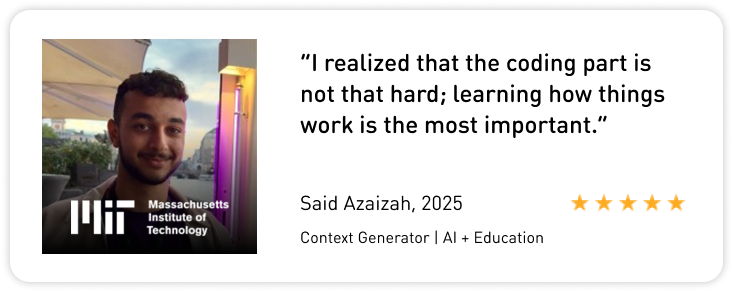
Said Azaizah is now at MIT, and we highlight his work because it reflects what serious student output can look like when it is structured properly. In Said’s case study, he built a web tool for MEET, a binational education program operating across Israel and Palestine. The tool takes slide text and instructor context, then generates teaching supports such as hooks, punchlines, interactive moments, clarifying questions, and reset cues. In other words, it solves a real instructional bottleneck, not a fake one.
That detail matters. The strongest student projects are not the ones with the flashiest buzzwords. They are the ones that understand constraints. Said’s work addressed nightly lesson-prep time, inconsistent teaching style across instructors, and the practical challenge of keeping lesson delivery aligned with MEET’s values. In the case study, we note that two instructors responded positively and that the Student Director was open to piloting the tool with a larger cohort. That is the difference between a demo and a meaningful project. It has measurable usefulness.
Why this matters more than a certificate
A certificate says a student attended something. A project like Said’s shows that a student can think, scope, build, revise, and explain. That is a very different signal. We emphasize that the value is not in “doing a program.” The value is in producing output that survives scrutiny: a real problem, expert mentorship, milestones, and something concrete at the end. That is why this kind of work becomes useful in essays, interviews, and recommendation letters.
Our parent resources reinforce this structure. We describe our mentors as industry and academic experts in AI, data science, and STEM education, and we explain that the program is designed around structured mentorship, measurable outcomes, and 8 to 10 hours per week of work. For a parent, that level of detail matters. It means a student is not left alone to wander, and it means families are not paying for vague inspiration.
This is also why we encourage parents to evaluate programs based on what admissions can actually verify: ownership, depth, reflection, and a finished artifact. If a program cannot produce that, it is not reducing risk. It is adding it.
What we recommend parents look for in any program
First, start with the problem, not the credential. In our guidance, we are blunt on this point. Students who stand out begin with a real problem and end with something that answers it. That standard matters for T20 applicants because it creates a clean story. The student did not merely participate. The student identified, worked on, and improved something meaningful.
Second, look for mentorship that can challenge a student’s thinking. The strongest projects are not created by encouragement alone. They are created by feedback, revision, and accountability. We have seen that a project-based environment forces students to own the whole problem and to iterate after receiving pushback. That is the kind of pressure that produces maturity, not just activity.
Third, insist on an outcome that can be shown. A student should be able to explain what was built, why it mattered, what failed, what changed, and what the final result was. That is what admissions readers remember. A vague summer story fades. A specific project with real stakes does not. Said’s MEET tool is a strong example because it can be described in concrete terms, tied to a real institution, and discussed as evidence of judgment.
FAQ
How does BetterMind Labs support students applying to T20 colleges?
We support students through structured mentorship, research depth, and real project ownership, which gives colleges credible evidence of intellectual growth. We also help students produce portfolios and work that can strengthen essays, interviews, and letters of recommendation.
Is a summer certificate enough for T20 admissions?
No. A certificate can show participation, but it does not show depth, judgment, or ownership. What matters more is whether a student built something specific enough to explain, defend, and connect to a real problem.
What makes the BetterMind Labs MIT case study useful for parents?
It shows the kind of work that can actually help a student stand out. It is a real problem, a real user, a real tool, and a real outcome. Said’s project is valuable because it demonstrates process, not just polish. That is exactly the kind of evidence we want parents to prioritize for T20 admissions.

Conclusion
Parents do not need more noise. Parents need a rational path. At the T20 level, traditional metrics no longer separate one strong applicant from another. Real research, real problem-solving, and real ownership do. That is why the BetterMind Labs MIT case study matters. It shows what credible evidence looks like when a student builds something that exists beyond the summer itself.
Said’s MIT outcome is not proof that every student will get the same result. That would be dishonest. What it does show is that when a student works in the right structure, with the right mentorship and the right standard, the work can become the kind of evidence selective colleges actually respect. If you are trying to minimize wasted time and false signals, we encourage you to explore the blogs and resources on bettermindlabs.org to see more examples of what that looks like in practice.
Get details for BetterMind Labs AI Program




Comments